
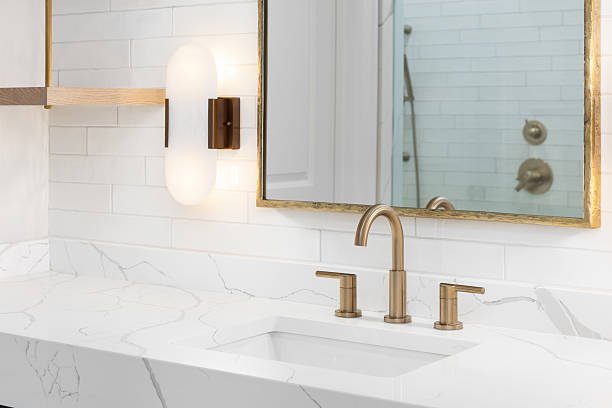
Bathroom lighting has to do much more than simply make the room bright. It needs to help you see clearly at the mirror, create a relaxing atmosphere around the bath or shower, work safely in a wet environment and complement the colours and finishes used throughout the room.
The best bathroom lighting ideas use several layers rather than relying on one bright ceiling fitting. A practical scheme usually combines general lighting with focused mirror lighting and softer feature or mood lighting.
That might mean recessed ceiling lights for everyday brightness, vertical lights beside the mirror for grooming, and concealed LEDs beneath a vanity or inside a niche for atmosphere.
Because bathrooms are wet environments, electrical work also needs additional care. Electrical Safety First notes that bathrooms have special electrical installation requirements, and GOV.UK specifically lists electrical work near baths and showers among work that can fall under Building Regulations requirements.
If you are planning a complete refurbishment, our guide to how much a bathroom renovation costs in 2026 can help you budget for lighting alongside plumbing, tiling, sanitaryware and installation.
1. Layer your bathroom lighting
One of the biggest bathroom lighting mistakes is expecting one ceiling light to do everything.
A better approach is to think in layers.
Ambient lighting
This provides the room’s general illumination.
Common options include:
- recessed ceiling lights;
- flush ceiling fittings;
- suitable ceiling-mounted fixtures.
Task lighting
Task lighting helps with activities that require clearer visibility.
In a bathroom, this usually means lighting around:
- mirrors;
- vanity units;
- make-up areas;
- shaving areas.
Accent lighting
Accent lighting is more decorative.
It can highlight:
- wall niches;
- textured tiles;
- a freestanding bath;
- floating furniture;
- architectural details.
When these three layers work together, the bathroom can feel bright and practical in the morning but much softer in the evening.
2. Use recessed ceiling lights for even illumination
Recessed ceiling lights are one of the most versatile choices for modern UK bathrooms.
They create a relatively clean ceiling and can spread light across the room more evenly than one central fitting.
Rather than simply installing as many spotlights as possible, think about where illumination is actually needed.
Useful areas include:
- around the vanity;
- near the shower;
- above circulation areas;
- around the bath.
Spacing also matters.
Too few fittings can create dark patches, while too many can make the bathroom feel overly bright and clinical.
A properly planned scheme should distribute light rather than create isolated pools of brightness.
3. Add lighting on both sides of the mirror
For grooming, lighting from the sides of the face can often be more useful than light coming only from above.
A pair of wall lights positioned either side of a mirror can provide much more balanced illumination.
This can make everyday tasks such as:
- shaving;
- applying make-up;
- skincare;
- hair styling
much easier.
A single spotlight directly above the mirror can create shadows beneath the eyes and chin.
Vertical lighting on either side tends to reduce those shadows.
The fittings still need to be suitable for their bathroom location, so electrical placement should be considered before buying decorative lights.
4. Choose a backlit bathroom mirror
Backlit mirrors are particularly useful if you want a clean contemporary look.
LED lighting is built into or behind the mirror, creating an illuminated border or soft glow against the wall.
Advantages include:
- integrated task lighting;
- minimal visual clutter;
- contemporary appearance;
- useful illumination during evening routines.
Some mirrors also include features such as:
- demister pads;
- adjustable colour temperature;
- touch controls;
- shaver sockets;
- Bluetooth functions.
You do not need every smart feature available.
Prioritise useful lighting quality and a mirror size that suits the vanity.
If you’re interested in more connected features throughout the home, our guide to smart home installation costs in 2026 covers wider smart-home upgrades and installation considerations.
5. Light beneath a floating vanity
LED lighting beneath a wall-hung vanity can create a subtle floating effect.
This works particularly well in modern bathrooms because it highlights the gap between the furniture and floor.
It can also function as low-level night lighting.
Instead of switching on bright ceiling lights during the night, a soft glow beneath the vanity may provide enough orientation without fully illuminating the room.
This idea works especially well with:
- wall-hung furniture;
- large-format flooring;
- neutral bathrooms;
- darker contemporary schemes.
Keep the lighting concealed so you see the glow rather than the individual LED source.
6. Add lighting inside shower niches
A recessed shower niche can become more than storage.
Integrated lighting can turn it into a design feature.
This is particularly effective where the niche uses:
- contrasting tile;
- marble effect;
- mosaic;
- textured stone.
The light highlights the depth of the recess and makes the shower feel more considered.
However, shower areas are exactly where electrical safety becomes particularly important.
Electrical equipment used close to baths and showers must be appropriate for its location, and bathroom installations are subject to specific wiring requirements. Electrical Safety First advises using a registered electrician for bathroom electrical installation work.
So this is something to plan during the renovation rather than improvising afterwards.
7. Use warm lighting around a freestanding bath
A bath is usually associated with relaxation rather than task lighting.
That makes it the ideal area for softer illumination.
Instead of placing an intense spotlight directly above the bath, consider:
- dimmable ceiling lighting;
- concealed wall lighting;
- warm wall lights;
- indirect LED strips.
The bath can then become a calmer visual zone.
This is especially effective in bathrooms using:
- stone;
- timber;
- beige;
- warm white;
- green;
- earthy neutrals.
Lighting colour can completely change how those materials feel.
8. Use pendant lights carefully
Pendant lights can add decorative impact, particularly beside a vanity or in a larger bathroom.
They can work well with:
- contemporary bathrooms;
- boutique hotel-inspired designs;
- double vanities;
- tall ceilings.
However, bathrooms are not the place to position decorative fittings purely because they look good in a photograph.
Electrical Safety First recommends enclosed ceiling lights rather than hanging fittings where practical and says fittings that are not enclosed should be kept out of reach of someone using, or still wet from using, a bath or shower.
Use an electrician to determine whether a particular pendant and position are appropriate.
9. Install a statement wall light
You do not need several decorative fittings to give a bathroom personality.
One well-chosen wall light can be enough.
For example:
Fluted glass + brass
Works well in traditional or warm contemporary bathrooms.
Black metal + opal glass
Suits monochrome and industrial-style schemes.
Minimal cylinder fittings
Work well with modern cabinetry.
Wall lights can also help connect the lighting with other metal finishes such as:
- taps;
- shower controls;
- cabinet handles;
- mirrors.
Keep electrical suitability ahead of aesthetics when selecting the fitting.
10. Use dimmable bathroom lighting
Bathrooms have very different lighting needs at different times of day.
At 7am, you may want clear bright light.
At 9pm, you may want something much softer.
Dimming makes one lighting scheme more flexible.
A dimmable system can be particularly useful around:
- baths;
- large showers;
- spa-style bathrooms;
- ensuites.
Make sure the lamps, drivers, controls and fittings are compatible with one another.
If smart controls are involved, discuss the complete setup with the electrician rather than purchasing unrelated components separately.
11. Choose lighting with the right colour temperature
Colour temperature affects whether the bathroom feels crisp, warm or clinical.
It is usually measured in Kelvin.
Broadly:
Warm white
Creates a softer atmosphere and works well with beige, timber, brass and warm stone.
Neutral white
Can provide clearer task lighting while still feeling comfortable.
Cooler white
Can appear brighter but may make warm bathroom finishes feel harsher.
Many homeowners prefer slightly brighter or more neutral lighting around the mirror and warmer lighting for decorative areas.
You do not necessarily need the same colour temperature everywhere, but the different sources should still feel intentional together.
12. Light a double vanity properly
A double vanity deserves more than one small light in the middle.
If two people use separate basins and mirrors, the lighting should work for both.
Possible layouts include:
- one light beside each outer edge plus a central fitting;
- vertical illuminated mirrors;
- individual backlit mirrors;
- balanced wall lighting.
The goal is to avoid one person standing in good light while the other works in shadow.
For larger bathrooms, separate lighting zones can also make the space feel more luxurious.
13. Use a statement ceiling light in larger bathrooms
A decorative ceiling fitting can work in a generous bathroom where there is sufficient space away from wet areas.
It can help a bathroom feel more like a furnished room than a purely functional space.
This can suit:
- high ceilings;
- large period bathrooms;
- bathroom suites;
- rooms with decorative panelling.
But decorative fittings need to be selected and positioned according to bathroom electrical requirements.
Do not assume a standard bedroom light fitting can simply be moved into a bathroom.
14. Highlight textured bathroom walls
If you have invested in textured tiles or decorative surfaces, lighting can help reveal them.
Light directed across a textured surface creates shadows and highlights that make the material much more visible.
This works particularly well with:
- fluted tiles;
- ribbed wall panels;
- natural stone;
- textured porcelain;
- handmade-effect tiles.
In flat overhead light, these surfaces can lose much of their character.
Directional or concealed accent lighting can make them a stronger feature.
15. Use illuminated shelving
Bathroom shelves can incorporate subtle lighting underneath.
This can highlight:
- folded towels;
- decorative bottles;
- plants;
- accessories.
It works particularly well in open storage niches.
Keep it restrained.
If every shelf, niche, mirror, vanity and bath is illuminated, the room can begin to resemble a showroom.
Choose one or two features to highlight.
16. Add motion-sensitive night lighting
Motion-sensitive low-level lighting can be very useful in family bathrooms and ensuites.
It can activate automatically when someone enters during the night.
Possible locations include:
- beneath the vanity;
- low-level wall lighting;
- cabinet plinths.
The benefit is practical rather than purely decorative.
You can navigate the bathroom without switching on bright ceiling lights.
Smart lighting controls can also provide similar automation, but keep the setup simple enough that the bathroom still works normally if an app or internet connection is unavailable.
17. Use lighting to strengthen your bathroom colour scheme
Lighting and colour should be planned together.
The same wall colour can look dramatically different under different light.
For example:
Warm beige bathroom
Warm white lighting reinforces the soft, spa-like feel.
Green bathroom
Warmer light often brings out olive and sage tones, while cooler light can make some greens appear greyer.
Navy bathroom
Good lighting is essential because dark surfaces absorb more light.
White bathroom
Avoid making the scheme excessively bright and cold. Warm timber or warmer lighting can soften it.
Black bathroom
Use several layers of light so the room does not become gloomy.
Before choosing final lamps and fittings, test colours under both daylight and artificial light.
Our guide to bathroom colour ideas can help you build the wider palette around your lighting choices.
What lighting is best for a bathroom mirror?
The best bathroom mirror lighting provides clear illumination across your face without creating harsh shadows.
Good options include:
- vertical lights beside the mirror;
- integrated illuminated mirrors;
- backlit mirrors;
- balanced wall lights.
Lighting only from directly above tends to create more shadows.
If make-up or shaving is important, colour rendering is also worth considering so skin tones and colours appear more natural.
Try to avoid extremely cold, harsh lighting around the mirror unless that is specifically the look you prefer.
How bright should bathroom lighting be?
There is no single brightness level that suits every bathroom.
A compact ensuite with white tiles may require much less light than a large bathroom with dark stone surfaces.
Brightness should depend on:
- room size;
- wall colours;
- amount of daylight;
- ceiling height;
- number of light sources;
- tasks performed.
The key is distribution.
One extremely bright fitting is not necessarily better than several appropriately positioned lights.
A layered design usually gives you much more control.
What IP rating does bathroom lighting need?
Bathroom electrical equipment must be suitable for the environment and its exact position relative to the bath or shower.
The required protection depends on the bathroom zone and exposure to water, so there is not one IP rating that can safely be quoted for every fitting in every bathroom.
Electrical Safety First explains that bathrooms have special electrical requirements because wet conditions increase electric-shock risk. Its technical guidance also notes that electrical equipment needs an IP rating appropriate to the external influences present in the location.
This is why it is better to choose fittings after the bathroom layout and exact locations have been confirmed.
A registered electrician can determine what is appropriate for each position.
What are bathroom electrical zones?
Bathroom electrical zones are used to distinguish areas according to their proximity to baths and showers.
The exact boundaries depend on the layout.
For example, Electrical Safety First’s technical guidance states that in a shower without a basin, such as some wet rooms, Zone 1 extends horizontally 1.2 metres from the centre point of the fixed water outlet.
These technical rules are one reason bathroom lighting should not be designed solely from an interior photograph.
The bath, shower, water outlets and proposed fitting positions all influence what can be installed.
Do bathroom lights need an electrician?
For new or altered electrical installations, using a suitably qualified electrician is strongly recommended.
Electrical Safety First advises homeowners to use a registered electrician for bathroom electrical installation work and notes that bathroom circuits require additional protections such as RCD protection.
GOV.UK also notes that electrical changes near baths and showers are among works that may require Building Regulations approval in England.
If a registered competent person carries out notifiable work, they may be able to self-certify it rather than you arranging approval separately.
Are normal light switches allowed inside bathrooms?
Bathroom switches need careful consideration because of damp conditions and wet hands.
Electrical Safety First states that a ceiling-mounted pull-cord switch is preferable to a typical wall-mounted switch in the bathroom.
Another common arrangement is to position the standard wall switch outside the bathroom.
The right approach depends on the installation and layout, so this should form part of the electrical plan rather than being decided after decoration.
Can bathroom lighting be smart?
Yes.
Smart bathroom lighting can offer features such as:
- dimming;
- schedules;
- scenes;
- motion detection;
- voice control;
- adjustable colour temperature.
For example, you might create:
Morning mode: brighter task lighting.
Evening mode: softer ceiling and vanity lighting.
Night mode: low-level motion-activated lighting.
The important thing is not to make everyday lighting unnecessarily complicated.
The bathroom should still have simple physical controls that everyone in the home can understand.
For wider pricing and installation considerations, see our 2026 smart home installation cost guide.
Bathroom lighting ideas for small bathrooms
A small bathroom does not need lots of fittings.
Instead, focus on making each one useful.
A simple scheme might include:
Ceiling: several well-positioned recessed lights.
Mirror: integrated illuminated mirror.
Vanity: optional low-level LED.
That gives you general, task and mood lighting without visually cluttering the room.
Mirrors can also help distribute light by reflecting it around the space.
Light-coloured surfaces increase the effect further.
Bathroom lighting ideas for dark bathrooms
Bathrooms with small windows or no natural light need more careful layering.
Instead of one central light, consider:
- ceiling lighting;
- illuminated mirror;
- under-vanity LED;
- niche lighting.
Use surfaces that reflect some light, such as:
- glazed tiles;
- mirrors;
- pale stone;
- selected satin or gloss finishes.
You do not need to make everything white.
Dark bathrooms can still work beautifully, but they generally require stronger lighting design.
Bathroom lighting ideas for low ceilings
Pendant lights are often unnecessary in bathrooms with low ceilings.
Flush or recessed fittings usually work better because they do not project into the room.
You can create visual interest elsewhere using:
- wall lights;
- backlit mirrors;
- niche lighting;
- concealed LEDs.
This keeps the ceiling feeling relatively uncluttered while still giving the bathroom personality.
Bathroom lighting ideas on a budget
You do not need an elaborate smart system to improve bathroom lighting.
Prioritise:
- good general ceiling lighting;
- useful mirror lighting;
- one optional feature layer.
For example, an illuminated mirror can provide both a mirror and task lighting.
You can then use relatively simple recessed ceiling lights rather than adding several decorative wall fittings.
During a renovation, planning electrical points before tiling is one of the most important ways to avoid expensive changes later.
How much does bathroom lighting cost?
The total cost depends heavily on how much work is involved.
Replacing an existing suitable fitting is very different from:
- adding several new downlights;
- rewiring lighting circuits;
- installing illuminated mirrors;
- moving switches;
- adding smart controls;
- fitting LEDs into niches;
- altering ceilings.
The fitting itself may cost relatively little compared with the labour involved in running new cables and repairing finished surfaces.
This is why bathroom lighting should ideally be planned before plastering, tiling and decorating begin.
If lighting forms part of a larger project, our bathroom renovation cost guide can help you plan the electrical work alongside the rest of the refurbishment.
Common bathroom lighting mistakes
Using only one ceiling light
It may illuminate the room but provide poor mirror lighting.
Putting a spotlight directly above the mirror
This can create unflattering facial shadows.
Choosing fittings before confirming their location
Bathroom electrical suitability depends on where the fitting will be installed.
Ignoring dimming
Bright bathroom lighting can feel unnecessarily harsh in the evening.
Using too many different lighting styles
A bathroom can quickly become visually chaotic.
Forgetting the colour scheme
Lighting changes how wall colours, tiles and cabinetry appear.
Planning electrics after tiling
This can turn a simple lighting change into a disruptive job.
Choosing style over electrical safety
A beautiful fitting is useless if it is unsuitable for the bathroom location.
Frequently asked questions
What is the best lighting for a bathroom?
A layered combination is usually best: general ceiling lighting, dedicated mirror or vanity lighting and optional accent lighting for features such as niches or floating furniture.
Are spotlights good for bathrooms?
Yes, appropriately specified recessed spotlights can provide good general illumination. Placement and suitability for the bathroom location are important.
Is warm or cool white better for bathrooms?
Warm or neutral white usually creates a more comfortable atmosphere, while slightly clearer task lighting can be useful around mirrors. The best choice depends on the colour scheme and your preferences.
How should I light a bathroom mirror?
Lighting from either side of the face or an integrated illuminated mirror can provide more balanced task lighting than relying solely on a ceiling spotlight.
Can I put LED strip lights in a bathroom?
Yes, where the product and installation are suitable for the location. Because bathrooms contain designated electrical zones and high moisture levels, ask an electrician to confirm suitability.
Can I use pendant lights in a bathroom?
Potentially, depending on the fitting and location. Electrical Safety First advises that non-enclosed fittings should remain out of reach of people using or still wet from using a bath or shower.
Do bathroom lights need to be waterproof?
Not every bathroom light needs the same level of protection. The required protection depends on where it is installed and the likelihood of water exposure.
Can bathroom lights be dimmable?
Yes, provided the fittings, lamps, drivers and controls are compatible and suitable for the installation.
Are smart bathroom lights worth it?
They can be useful for dimming, motion-activated night lighting and different morning or evening scenes, but simple physical controls should still make the system easy to use.
Final thoughts: planning the best bathroom lighting
The best bathroom lighting ideas combine practical visibility, atmosphere and safety.
Instead of asking how many lights you need, think about where you need light.
Start with general ceiling illumination.
Then make sure the mirror has proper task lighting.
Finally, add one or two softer features — perhaps a backlit mirror, illuminated niche or low-level vanity lighting — if they genuinely improve the room.
The bathroom’s colours and finishes matter too. Dark green, navy and charcoal surfaces usually need more considered illumination than pale neutral schemes. Our bathroom colour ideas can help you coordinate lighting with the wider design.
If you’re planning connected dimming, motion sensors or automated lighting, our smart home installation cost guide provides additional context.
And if the lighting forms part of a complete refurbishment, use our 2026 bathroom renovation cost guide to plan the project as a whole.
For bathroom electrical installation, use a suitably qualified electrician and make sure the fittings are appropriate for their exact locations. If you need professional help with a renovation or lighting installation, you can use The Right Guy to find local electricians, bathroom fitters and other relevant tradespeople.

Author: manager
Company test