
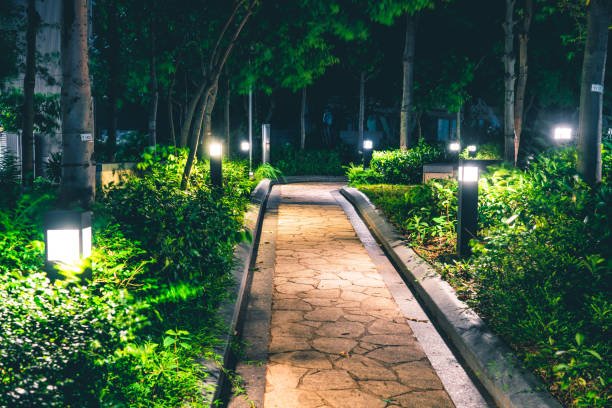
The right garden lighting can completely change what happens to your outdoor space after sunset. A patio that disappears into darkness can become an inviting evening seating area, a garden path can become easier to navigate, and trees or planting that barely attract attention during the day can become some of the most striking features at night.
The best garden lighting ideas combine those practical benefits with atmosphere. Rather than installing one extremely bright security light and expecting it to illuminate everything, think in layers: softer lighting around seating, targeted light on plants and walls, practical illumination along routes and brighter security lighting only where it is genuinely needed.
Whether you have a small courtyard, a long garden, a modern patio or a more traditional planted space, here are 15 ideas for creating a garden that looks just as considered after dark.
1. Light garden paths rather than the whole garden
A garden does not need to be flooded with light to make it easier to use at night.
Instead, concentrate light where people actually walk.
Low-level bollards, appropriately positioned spike lights or other exterior fittings can define a path without turning the entire garden into something resembling a car park.
The aim is to illuminate changes in direction and potential obstacles while retaining darker areas elsewhere.
That contrast is important. If everything is equally bright, individual garden features disappear. When lighting is concentrated along the route, your eye naturally follows the path through the landscape.
For steps and level changes, practical visibility becomes particularly important. These areas should be considered from the beginning of the lighting plan rather than added as an afterthought.
2. Use warm string lights to make seating areas feel cosy
String lights are one of the easiest ways to introduce atmosphere without redesigning the garden.
They work particularly well above patios, pergolas and dining areas, where several small points of light can create a softer effect than one powerful overhead fitting.

Festoon-style bulbs can suit relaxed and contemporary gardens, while smaller decorative lights can create a subtler effect through planting or around structures.
Make sure any lights used permanently outdoors are specifically designed for exterior use. Indoor decorative lights should not simply be moved into the garden because they happen to fit the look.
Also consider the colour temperature. Warm white light generally creates a softer, more inviting atmosphere around seating and dining spaces than very cool white light.
3. Uplight trees for an instant evening focal point
A mature tree is impressive during the day and potentially even more dramatic after dark.
A carefully positioned light aimed upwards through the trunk and canopy can emphasise bark, branches and foliage while creating interesting shadows.
You do not need to illuminate every tree.
In many gardens, lighting one particularly attractive specimen produces a stronger result than placing a spotlight underneath everything.
Experiment with the direction before making the installation permanent. Moving a light by a relatively small distance can dramatically change the shadows it creates.
Take care not to position fittings where they will be repeatedly damaged by lawnmowers, garden tools or regular foot traffic.
4. Add wall lights around doors and patios
Exterior wall lights are particularly useful because they can provide practical illumination without taking up garden space.
Position them around doors, patios, outdoor kitchens or other areas where people regularly spend time.
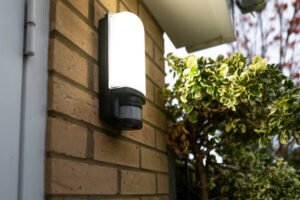
The fitting itself can become part of the exterior design.
Traditional lantern-style lights can complement older properties, while simple black or architectural fittings often work better with contemporary homes.
Think about brightness and direction rather than choosing purely on appearance. A beautiful wall light at eye level can become unpleasant if an exposed bulb produces excessive glare whenever you sit outside.
5. Use motion-sensor lighting where you need security
Not all garden lighting needs to remain switched on throughout the evening.
Motion sensors are particularly useful around entrances, side passages, sheds and other practical areas.
A light activates when movement is detected, providing visibility when required without continuously illuminating the space.
Correct positioning matters.
If a sensor constantly reacts to movement outside your property or every small movement of vegetation, the light can quickly become irritating. Adjust sensitivity and detection range where the fitting allows it.
Security lighting also does not have to be excessively bright. The goal is useful visibility around the property, not illuminating several neighbouring gardens.
6. Hide lights inside flower borders
Some of the best garden lighting is difficult to notice during the day.
Small fittings positioned among planting can illuminate leaves, ornamental grasses and flowers from below, giving the border an entirely different appearance after sunset.
Instead of placing lights at perfectly equal intervals, concentrate them around plants with interesting shapes or textures.
Grasses can look particularly effective because light passes through their foliage, while large leaves can create dramatic shadows on nearby surfaces.
Remember that plants grow.
A light carefully positioned beside a small shrub in spring may be completely hidden by August, so leave room for mature growth and make fittings accessible for adjustment and maintenance.
7. Highlight a garden wall or fence
Garden boundaries provide large surfaces for lighting effects.
One technique is to position light relatively close to a textured wall so that it grazes across the surface, emphasising brick, stone or render.
Another is to illuminate planting in front of a fence so that leaves cast shadows onto the boundary behind them.
This can make an ordinary fence feel like part of the design rather than simply the point where the garden stops.
If you are replacing the boundary as part of a larger project, our guide to the best fencing ideas explores modern slatted fencing, privacy panels, timber and planted boundaries that can all work well with a considered lighting scheme.
8. Install subtle lighting around steps
Steps need particular attention after dark.
Integrated step lights or discreet fittings positioned nearby can make changes in level easier to see without overwhelming the rest of the garden.
This is one area where practical lighting should come before decorative effects.
Avoid creating strong glare directly into someone’s eyes as they walk up the steps. The light should help reveal the surface and edge rather than obscure it.
If you are having new garden steps constructed, decide on lighting before the landscaping is completed. Planning cable routes and fittings at the construction stage is generally much neater than trying to retrofit them later.
9. Add lighting beneath a pergola
Pergolas are ideal places to integrate lighting because the structure gives you somewhere to position fittings above or around the seating area.
Festoon lights can create an informal atmosphere, while discreet integrated fittings produce a cleaner contemporary appearance.
Wall lights may also work where the pergola is attached to the house.
Think about what happens underneath it.
A dining table requires enough illumination for people to comfortably see food and one another. A lounge area can usually use softer lighting.
This is particularly relevant as covered outdoor living continues to influence garden trends in 2026, with gardens increasingly designed as usable evening spaces rather than something viewed mainly during daylight.
10. Light an outdoor kitchen properly
An outdoor kitchen needs more than decorative lighting.
You need to see what you are preparing and cooking.
Task lighting should therefore illuminate worktops and cooking areas without casting awkward shadows over them.
Ambient lighting can then be added around dining and seating areas to create a more relaxed atmosphere.
This separation is useful because the person cooking needs more practical illumination than someone sitting nearby with a drink.
If you are planning a complete cooking space, our outdoor kitchen ideas guide covers layouts, covered kitchens, preparation areas, sinks and dining zones.
11. Use lighting around a fire pit carefully
A fire pit already produces its own light, which makes it a perfect place to use restraint.
Bright floodlights around the seating area can destroy much of the atmosphere created by the flames.
Instead, consider subtle background lighting along the route towards the fire pit and perhaps low-level illumination around the wider seating zone.
The fire itself can remain the focal point.
Lighting can also help people navigate safely back towards the house without requiring the whole area to be brightly illuminated.
If you are designing this part of the garden from scratch, our fire pit ideas include patio, small-garden and built-in seating layouts.
12. Try solar garden lighting in the right locations
Solar lighting can be useful where installing electrical cabling would be unnecessary or difficult.
It is particularly suited to decorative applications such as small path markers, pots and areas where you simply want a gentle glow.
Performance varies significantly between products and locations.
Solar lights need enough daylight to charge, so placing a small solar panel beneath dense evergreen planting is unlikely to produce impressive results during a dark British winter.
Battery capacity, panel quality and seasonal daylight all influence how long the light operates.
For important task or security lighting, a properly designed wired system may provide more dependable performance.
13. Light water features after dark
Water can become one of the most dramatic elements in a night garden.
Carefully positioned lighting can highlight movement and reflections across ponds, fountains and other water features.
A small amount of light is often enough.
Illuminating planting beside the water can sometimes produce a more natural effect than making the entire pond glow.
Electrical safety is particularly important anywhere electricity and water are in close proximity. Use equipment specifically designed and rated for its intended environment and have permanent installations designed by a competent professional where required.
14. Use garden lighting to create depth
One of the cleverest garden lighting ideas for small gardens is actually to illuminate something at the far end.
If all the lighting is concentrated immediately outside the back door, everything beyond it disappears into darkness.
A softly illuminated tree, sculpture, wall or group of plants at the far boundary draws the eye through the space.
This can make the garden feel deeper.
The same principle works in long gardens. Create several subtle points of interest rather than one brightly illuminated patio followed by complete darkness.
Privacy can also be enhanced by controlling what is visible after sunset. If your garden feels overlooked, our garden privacy ideas include planting and screening options that can be incorporated alongside lighting.
15. Layer different types of garden lighting
The most polished garden lighting schemes rarely rely on one type of fitting.
Instead, they combine different layers.
You might have practical wall lights beside the house, subtle path lighting through the garden, an uplight beneath a tree and softer decorative lighting around the patio.
The important part is restraint.
You do not need one light for every plant, fence panel and paving slab.
Think of darkness as part of the design.
When certain areas remain darker, the illuminated features become more noticeable and the garden retains a sense of depth.
How do you plan garden lighting?
Start by looking at how you use the garden rather than choosing fittings.
Walk through the space and identify:
Routes — where do you walk after dark?
Hazards — are there steps, level changes or narrow paths?
Activity areas — where do you cook, eat or sit?
Features — which trees, walls or plants are worth highlighting?
Security areas — which entrances or side passages need practical lighting?
Once those areas are identified, decide what kind of light each actually needs.
A step may require practical illumination. A tree needs accent lighting. A patio may need a combination of task and ambient light.
This is much more effective than buying ten matching lights and spacing them evenly around the garden.
What colour light is best for gardens?
For most residential garden seating and planting, warm white lighting tends to create a comfortable and natural-looking effect.
Very cool, blue-white lighting can sometimes make domestic gardens feel harsh, particularly around timber and traditional planting.
Colour temperature is usually expressed in kelvin (K). Lower colour temperatures produce a warmer appearance, while higher numbers look cooler and bluer.
You do not necessarily need exactly the same colour temperature everywhere, but dramatic differences between neighbouring fittings can make a scheme look inconsistent.
Avoid brightly coloured decorative lighting unless it is a deliberate part of the design. Subtle lighting generally ages better than strong blue, green or purple effects across an entire garden.
How bright should garden lights be?
Brighter is not automatically better.
The required output depends entirely on what the light is doing.
A security light covering an entrance has different requirements from a decorative fitting illuminating ornamental grass.
For ambient garden lighting, relatively modest output can often be more effective because your eyes adapt to lower light levels after dark.
Excessive brightness creates glare and can flatten the garden visually.
If you can clearly see every corner of the garden at midnight, you may have lost much of the atmosphere that good landscape lighting is supposed to create.
Are solar or wired garden lights better?
Both have useful applications.
Solar lights are convenient because they do not require mains cabling and can often be installed or repositioned easily. They are useful for decorative lighting and some low-level applications.
However, performance depends on the amount of available daylight, battery condition and product quality.
Wired garden lighting can provide more consistent performance and greater flexibility for permanent schemes, particularly where reliable task, feature or security lighting is required.
Installation is more involved and may require professional electrical work.
Many gardens can use both: wired lighting for the important permanent elements and solar products for smaller decorative additions.
What IP rating should outdoor garden lights have?
Outdoor electrical fittings need to be suitable for the conditions in which they are installed.
You will commonly see an IP rating on lighting products. This indicates the level of protection provided against the ingress of solid objects and water.
The appropriate rating depends on exactly where the fitting will be installed and the exposure it will experience.
A sheltered exterior wall is not the same environment as a fitting installed close to the ground and exposed directly to rain, and equipment used around water requires additional consideration.
Do not choose an outdoor fitting based solely on appearance. Check that it is designed for the intended location.
Can you install garden lighting yourself?
Some low-voltage or self-contained solar garden lights are specifically designed for straightforward consumer installation when used according to the manufacturer’s instructions.
Permanent mains electrical work is different.
Outdoor electrical installations are exposed to moisture and weather, so appropriate equipment, protection and installation methods are essential.
In England, certain electrical installation work in or associated with a dwelling can also fall within the scope of Building Regulations requirements.
For new permanent circuits, mains outdoor sockets, fixed lighting systems or situations where you are unsure, using a suitably qualified electrician is the sensible approach.
How much does garden lighting cost in the UK?
There is an enormous difference between adding a few solar lights and commissioning a professionally designed landscape lighting scheme.
A handful of decorative solar lights may cost relatively little, while quality exterior fittings, cabling, controls, electrical installation and landscaping work can push a larger project into hundreds or thousands of pounds.
The final price depends on factors including:
- number and quality of fittings;
- whether mains power is required;
- cable routes;
- garden size;
- access;
- ground conditions;
- smart controls or timers;
- existing electrical supply;
- landscaping that needs to be disturbed and reinstated.
If you are planning a permanent installation, ask for an itemised quote rather than comparing projects purely by the number of lights.
How can you light a garden cheaply?
You do not need to illuminate the entire garden.
Prioritise the areas that will have the biggest impact.
Start with the seating area and main route from the house. Then choose one feature — perhaps a tree or attractive section of planting — to illuminate.
Solar string lights or good-quality decorative solar fittings can add atmosphere without extensive installation.
Existing exterior wall lighting might also be improved simply by changing the type or positioning of the fitting rather than adding numerous new lights.
If the wider garden is being improved on a limited budget, our cheap garden makeover ideas include other affordable ways to make the space feel more finished.
Does garden lighting affect wildlife?
It can.
Artificial light at night can affect wildlife, particularly when gardens are brightly illuminated for long periods.
That is another reason to avoid lighting every part of the garden unnecessarily.
Direct lights carefully, use timers or motion sensors where appropriate and allow genuinely dark areas to remain.
Lighting only when and where it is needed can reduce energy use as well as unnecessary light spill.
A garden does not need to resemble daylight at midnight to be attractive.
Make your garden work after sunset
The best garden lighting ideas reveal just enough.
Illuminate the paths you use. Give steps and entrances practical light. Highlight a favourite tree or section of planting. Add warm ambient lighting around the patio and allow other areas to fade naturally into darkness.
The result is usually far more attractive than relying on one extremely powerful light attached to the back of the house.
Lighting also works best when it is considered alongside the rest of the garden. Paths determine where practical lights are needed, planting creates opportunities for dramatic shadows, and patios and pergolas determine where people actually spend their evenings.
If you are planning a larger permanent lighting project, you can find local electricians, landscapers and garden professionals through The Right Guy. An electrician can help with safe permanent outdoor electrical installations, while a landscaper or garden designer can incorporate lighting into paths, planting, patios and other features from the beginning.

Author: The Right Guy Team
UK service guides published by The Right Guy Ltd.