
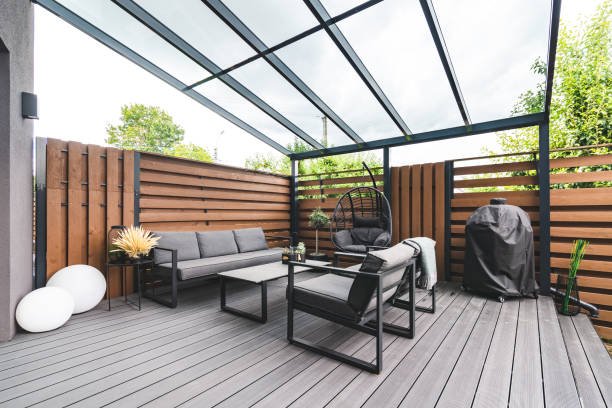
A garden fence has a much bigger impact on your outdoor space than you might expect. It can provide privacy, define boundaries, improve security, shelter a seating area and become an important part of the garden design itself.
The best fencing ideas therefore balance appearance with what you actually need the fence to do.
For one garden, that might mean tall solid timber panels that make an overlooked patio feel more private. Somewhere else, contemporary horizontal slats may be a better choice, while a smaller front garden might benefit from a lower, more open boundary that does not make the property feel enclosed.
From affordable timber panels to contemporary composite-style designs, decorative screens and planting combinations, here are 15 fencing ideas to consider for a UK garden.
1. Choose horizontal slatted fencing for a modern garden
Horizontal slatted fencing has become a popular alternative to traditional vertical fence panels, particularly in contemporary gardens.
The long horizontal lines can make a boundary feel wider and create a clean architectural backdrop for furniture and planting.
It works especially well alongside simple paving, decking, pergolas and modern garden furniture. Timber brings warmth to an otherwise minimalist design, preventing the garden from becoming dominated by grey hard landscaping.
The width of the gaps between slats makes a significant difference. Wider gaps create a lighter, more open appearance but provide less privacy, while closely spaced boards create greater screening.
If you like this style, our modern garden ideas include more ways to combine contemporary boundaries with planting and hard landscaping.
2. Use solid fencing when privacy is the priority
If neighbouring gardens directly overlook yours, appearance may not be your first concern. You may simply want a more private space.
Solid timber fencing can create a much stronger visual barrier than open slats.
Traditional closeboard fencing is a common choice because it provides a relatively continuous boundary and can work in both modern and traditional gardens.
It is particularly useful behind seating areas, patios and spaces where you spend a lot of time.
Before automatically choosing the tallest fence available, however, consider whether you need the same level of screening across the entire boundary.
Sometimes strategic screening around one part of the garden provides the privacy you want without making the whole space feel enclosed.
Our guide to garden privacy ideas explores alternatives including planting and targeted screening.
3. Combine fencing with masonry posts
Timber fencing does not have to rely entirely on timber posts.
Combining fence panels with brick, concrete or masonry pillars can create a more substantial boundary and introduce architectural structure.
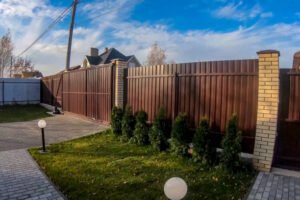
This approach can work particularly well around larger gardens, driveways and properties where a lightweight panel fence would look visually insignificant.
The posts themselves can become part of the design. Their colour and material might relate to the house, garden wall or paving.
More substantial construction usually means more groundwork too. Foundations, levels and structural stability need proper consideration rather than treating the pillars as decorative objects.
4. Try dark grey contemporary fencing
Grey has been enormously popular across UK garden design, and fencing is one place where darker tones can still work particularly well.
A charcoal or dark grey boundary creates a strong background that makes green foliage stand out.
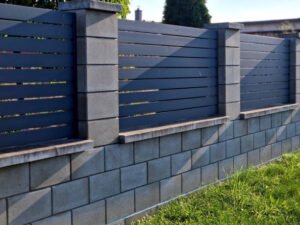
Rather than making the garden feel darker, a deep fence colour can visually recede when surrounded by generous planting.
The result works particularly well with ornamental grasses, green shrubs and pale flowers.
If you are painting an existing timber fence, choose a product intended for exterior timber and prepare the surface according to the manufacturer’s instructions. The final appearance and durability depend heavily on preparation as well as paint quality.
5. Use warm timber fencing to soften hard landscaping
Not every contemporary garden needs to be grey.
Natural or warm-toned timber can create a beautiful contrast with concrete, porcelain paving and rendered walls.
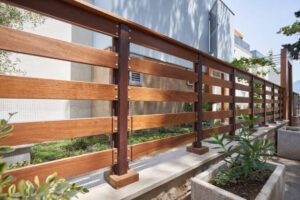
Timber also works well when you want the garden to feel more relaxed and natural.
The exact appearance will change as timber weathers, so decide whether you are happy for the material to develop naturally or whether you intend to maintain a particular finish.
Exterior treatments should be suitable for the timber and intended use.
6. Use fencing to create zones within the garden
Fences are not only for boundaries.
A shorter section of fencing or decorative screening can separate different areas within a larger garden.
For example, you could partially screen:
- a bin storage area;
- an outdoor kitchen;
- a children’s play area;
- a utility section;
- a hot tub;
- a composting area;
- a seating space.
Partial screening is often enough. You do not necessarily need to construct another full-height boundary through the middle of the garden.
This technique is especially effective in long gardens, where creating several defined zones can make the space feel more interesting.
If you are building an entertaining area, screening can also work beautifully alongside an outdoor kitchen or patio.
7. Add climbing plants to soften a fence
A completely bare fence can dominate a small garden, particularly if it runs along several sides.
Plants can transform it.
Climbers allow you to introduce greenery vertically without sacrificing much floor space. Depending on the conditions and support available, suitable choices might include clematis, climbing roses, honeysuckle or other climbers appropriate for the site.
Always check the mature size and support requirements of the plant before buying it.
Some vigorous climbers can become extremely heavy, particularly when mature, so the fence and supporting system need to be capable of carrying them.
You can also position shrubs and perennials in front of the fence rather than trying to cover every centimetre.
A combination of fencing and planting usually looks softer than either one used alone.
8. Use trellis above a solid fence
If you want more screening without creating a completely solid wall, trellis can provide a useful transition.
A solid lower fence gives privacy at eye level while the more open upper section allows light through and can support climbing plants.
This can be especially effective around patios where a fully solid boundary might feel oppressive.
However, do not assume that adding trellis allows you to bypass restrictions on fence height.
For planning purposes, the overall height of the boundary treatment can matter, including additions such as trellis. Check the rules applicable to your property before increasing an existing fence.
9. Consider composite fencing for a contemporary finish
Composite fencing is an alternative to conventional timber for homeowners who prioritise a consistent modern appearance and reduced routine finishing.
Products vary, but composite systems typically combine manufactured boards with dedicated posts and installation components.
Potential advantages can include resistance to some of the maintenance issues associated with untreated timber and a consistent colour and finish.
The trade-off is usually a higher initial material cost compared with basic timber panels.
Quality also varies between products, so look beyond colour when comparing systems. Check warranties, installation requirements, UV performance and whether replacement boards will remain available in future.
For a long-term installation, a slightly higher upfront cost may be worthwhile if the material suits your maintenance expectations.
10. Use traditional closeboard fencing for practicality
Trends come and go, but there is a reason closeboard fencing remains common across Britain.
It is practical, relatively straightforward in appearance and provides good screening.
Individual vertical boards are fixed to horizontal rails, creating a robust boundary that can be adapted to different garden lengths.
It also works well where you want the fence to disappear visually behind planting rather than become the main design feature.
Paint it dark and surround it with foliage for a contemporary effect, or retain a more natural timber appearance for a traditional garden.
If your priority is function rather than making the fence a statement feature, closeboard remains worth considering.
11. Make a small garden feel wider with horizontal lines
The orientation of fence boards can influence how a garden feels visually.
Horizontal boards draw the eye sideways, which can make a narrow space appear broader.
This can be particularly effective in small urban gardens where the boundaries are constantly visible.
Keep the overall design relatively simple. Too many competing materials, colours and decorative features can make a compact space feel cluttered.
A limited palette — perhaps timber fencing, one paving material and repeated planting — often produces a stronger result.
12. Hide bins and practical garden equipment
Wheelie bins, recycling boxes, hoses and garden equipment are necessary, but they rarely improve the view from a patio.
Small timber screens can hide practical items without requiring a full garden redesign.
Position the screen somewhere that keeps bins accessible. A beautiful enclosure becomes irritating very quickly if you have to drag bins through a narrow flower bed every collection day.
Ventilation and access matter too.
For outdoor equipment such as heat pumps or other installations, do not simply build a solid fence around them. Equipment may require specific airflow and maintenance clearances, so always follow the manufacturer’s requirements.
13. Combine fencing with raised beds
One way to stop a fence feeling like a blank wall is to integrate planting directly in front of it.
Raised beds can create a clear transition between the vertical boundary and the rest of the garden.
They also give you an opportunity to layer plants at different heights.
Use taller shrubs or ornamental grasses towards the back, medium-sized plants through the centre and lower plants towards the front.
If you are not confident choosing plants yet, our guide to the best plants for beginners includes straightforward options for sunny and shady UK gardens.
Just remember that soil and moisture should not be allowed to create unsuitable long-term conditions against timber components.
14. Create a low-maintenance fence line
The area directly beneath a fence can become one of the most irritating parts of a garden to maintain.
Grass can be difficult to cut neatly against posts, while narrow strips of exposed soil quickly collect weeds.
Plan this edge deliberately.
A planted border can remove the need to mow immediately against the fence. Mulch between established plants can suppress many weeds, while appropriate edging creates a clean separation from the lawn.
For non-planted areas, a properly prepared gravel strip may be another option.
If weeds are already taking over your fence line, our guide on how to stop weeds permanently explains how mulching, planting density and correctly prepared surfaces can dramatically reduce regrowth.
15. Mix fencing with hedging for a greener boundary
You do not necessarily have to choose between a hedge and a fence.
Combining the two can give you the immediate structure of fencing while planting gradually softens the boundary.
A fence provides definition while the hedge or shrubs introduce greenery, habitat and seasonal interest.
The available space is important. Some hedge plants become surprisingly wide at maturity, so a narrow garden needs carefully chosen species.
Maintenance should also be considered before planting. A fast-growing hedge may provide quicker screening but require much more frequent trimming.
For a lower-maintenance garden, slower-growing or naturally compact plants may be more practical.
What is the best type of garden fencing?
There is no single best fence because different gardens require different things.
If privacy is your priority, solid closeboard or appropriate solid-panel fencing may work best.
For a modern appearance, horizontal slats or contemporary composite systems are worth considering.
If you want to support climbing plants, trellis or a suitable fence-and-wire support system may be useful.
For a traditional garden, natural timber closeboard or decorative timber panels can blend easily with planting.
The right choice depends on budget, exposure, maintenance, desired lifespan and how much privacy you actually need.
What is the cheapest garden fencing?
Basic timber panel fencing is often among the lower-cost ways to create a conventional garden boundary, but the cheapest purchase price does not necessarily produce the lowest long-term cost.
Posts, gravel boards, fixings, concrete and labour all contribute to the final price.
Access can matter too. Installing fencing in a garden with easy side access may be considerably simpler than transporting materials through the house.
If an existing fence is structurally sound, cleaning, repairing and refinishing it could be substantially cheaper than replacement.
Before replacing an entire boundary because it looks tired, check whether the posts and main structure are still serviceable.
How much does garden fencing cost in the UK?
Fence installation costs vary significantly, so quoting one national figure can be misleading.
The final price depends on:
- fence length and height;
- panel or board type;
- timber, composite or other materials;
- number and type of posts;
- gravel boards;
- gates;
- ground conditions;
- removal of the existing fence;
- disposal;
- access to the garden;
- labour rates in your area.
A straightforward run of standard timber fencing will generally cost considerably less than a bespoke horizontal slatted system with masonry pillars or premium composite boards.
For an accurate budget, measure the boundary and obtain several itemised quotes showing materials, labour and removal separately.
How high can a garden fence be without planning permission?
This is one area where UK homeowners should check before building rather than relying on a neighbour’s fence as a guide.
In England, planning permission is generally required if a gate, fence or wall would be over 1 metre high when next to a highway used by vehicles, or over 2 metres high elsewhere.
Different considerations can apply to listed buildings, properties affected by planning conditions or other particular circumstances, and planning rules are not identical throughout every nation of the UK.
Always check the current guidance for your property and local planning authority before installing a tall boundary.
Remember that additions such as trellis can contribute to the overall height.
Which side of the garden fence belongs to me?
There is a common myth that you can identify fence ownership by looking at which side has the posts or “good” face.
That is not a reliable legal rule.
Responsibility for a particular boundary may be shown in property documents, deeds or other available information, but sometimes ownership or maintenance responsibility is not clearly defined.
If you are planning to remove or alter a boundary and are unsure whether it is yours, establish the position before starting work rather than relying on assumptions.
For shared-boundary projects or disputes, professional legal or surveying advice may sometimes be appropriate.
Which fence is best for windy gardens?
Wind exposure should influence fence design.
A completely solid fence presents a large surface to strong winds. In particularly exposed locations, designs that allow some airflow may reduce wind loading compared with a fully solid barrier.
That does not mean an open fence is automatically structurally suitable.
Post depth, spacing, materials, fixings, soil conditions and overall installation quality are critical.
If your garden is very exposed, tell the fencing contractor before choosing panels. A fence designed primarily around appearance may not be the best system for the site.
Timber or composite fencing: which should you choose?
Timber offers a natural appearance and is widely available. It can also be painted or stained to change the garden’s style.
However, timber is a natural material and its appearance changes with exposure. Depending on the product and finish, ongoing maintenance may be required.
Composite fencing usually offers a more consistent manufactured appearance and can reduce some routine finishing requirements. It may, however, cost more initially and does not replicate natural timber exactly.
Neither material is automatically “better”.
Choose based on the look you prefer, expected maintenance, budget, product quality and installation requirements.
Should fencing match decking and garden furniture?
It does not have to match exactly.
In fact, using precisely the same finish everywhere can make a garden look overly coordinated.
Instead, look for materials that relate to one another.
Warm timber fencing might complement timber furniture while contrasting with grey paving. Dark fencing can echo black metal furniture or window frames. A natural fence can soften a modern composite deck.
This is particularly useful when creating an outdoor living area. As we explored in our guide to garden trends for 2026, modern gardens are increasingly combining structured hard landscaping with softer, more generous planting.
How can you make a cheap fence look more expensive?
You do not necessarily need premium fencing to create a polished garden.
Consistency makes a surprisingly large difference.
Repair leaning sections, replace visibly damaged boards, straighten untidy edges and use a consistent finish across the boundary.
Then work on what sits in front of the fence.
Repeated planting can make a relatively ordinary timber boundary look considerably more intentional. Climbers, ornamental grasses and shrubs break up large areas of timber and shift attention towards the garden.
Outdoor lighting can highlight planting rather than the fence itself.
Often the difference between an inexpensive-looking garden and a well-designed one is not the cost of the fence — it is how well the boundary has been integrated into everything around it.
Choose fencing as part of the garden, not just the boundary
The best fencing ideas do more than mark where your property ends.
A good fence can make a patio feel private, provide a backdrop for planting, hide practical areas and help define the overall character of the garden.
For a modern space, horizontal timber or dark contemporary panels can create clean architectural lines. Traditional closeboard fencing provides straightforward privacy, while trellis and planting can soften boundaries that would otherwise feel imposing.
Before choosing purely on appearance, think about exposure, maintenance, privacy, planning restrictions and the eventual height of nearby planting.
And if your project involves replacing a long boundary, installing new posts, constructing masonry sections or redesigning the landscaping around it, you can find local fencing contractors, landscapers and gardeners through The Right Guy. Getting the structure right from the beginning can make the difference between a fence that simply fills a boundary and one that genuinely improves the garden.

Author: manager
Company test