
If your car keeps drifting left or right when you are trying to drive straight, it is easy to assume the wheel alignment is wrong. And sometimes it is.
But a car pulling to one side can have several causes, including incorrect tyre pressure, uneven tyre wear, wheel alignment problems, sticking brakes, damaged suspension components or even the natural camber of the road.
The timing of the problem can provide useful clues. A car that suddenly starts pulling after hitting a pothole may point towards alignment, tyre, wheel or suspension damage. Pulling that occurs mainly when braking suggests a different problem. A gradual change accompanied by uneven tyre wear may indicate alignment or suspension issues.
Because some causes affect tyres, steering or braking, a strong or sudden pull should not simply be ignored.
So, why is your car pulling to one side, how can you narrow down the cause, and when should you get it professionally inspected?
Why is my car pulling to one side?
The most common possibilities include:
| Possible cause | Typical clue |
|---|---|
| Incorrect tyre pressure | One tyre significantly lower than another |
| Wheel alignment | Pulling plus uneven tyre wear/off-centre steering |
| Uneven or damaged tyres | Pull changes after tyres fitted or tyre is visibly abnormal |
| Road camber | Mild drift varies depending on the road |
| Brake problem | Pulling mainly when braking |
| Sticking brake caliper | Pulling, heat or braking resistance |
| Suspension wear/damage | Pulling with knocking or unstable handling |
| Steering component problem | Loose, inconsistent or unusual steering |
| Pothole/kerb damage | Problem begins immediately after impact |
| Wheel damage | Vibration or visible deformation after impact |
These symptoms overlap, so avoid diagnosing the problem from one clue alone.
1. Your tyre pressures are uneven
Start with the simplest possibility.
If the pressure in one tyre is significantly different from the tyre on the opposite side, the car’s behaviour can change.
A low tyre can create more rolling resistance and affect how the vehicle tracks.
Check all four tyres when they are cold and compare the readings with the manufacturer’s recommended pressures for your particular vehicle and load.
You can normally find the recommended figures in places such as:
- the owner’s handbook;
- driver’s door aperture;
- fuel-filler flap;
- vehicle information system.
Do not simply inflate every tyre to the pressure printed on the tyre sidewall. That marking is not the same as your vehicle manufacturer’s normal recommended operating pressure.
If correcting the pressures solves the pulling, you may have found the problem.
But if one tyre repeatedly loses pressure, investigate why.
2. Your wheel alignment is incorrect
Wheel alignment is one of the most common things drivers associate with a car pulling left or right.
The wheels are designed to sit at particular angles relative to the vehicle and road. If those angles move outside the manufacturer’s specifications, the car may no longer track correctly.
Other possible alignment symptoms include:
- an off-centre steering wheel;
- uneven tyre wear;
- inner- or outer-edge tyre wear;
- steering that requires constant correction;
- changes after hitting a pothole or kerb.
If several of these symptoms appear together, alignment becomes a stronger possibility.
Our guide to how to tell if your wheels need alignment explains the warning signs in more detail.
Why does wheel alignment make a car pull?
Wheel alignment determines how the wheels are positioned and point relative to the vehicle.
Three terms commonly associated with wheel geometry are toe, camber and caster.
If relevant geometry differs excessively from specification, the vehicle may favour one direction or wear its tyres incorrectly.
However, simply saying “the tracking is out” does not diagnose every pulling problem.
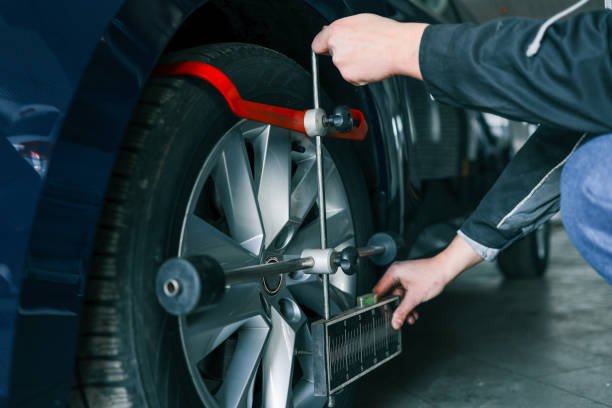
Modern wheel-alignment equipment measures the vehicle’s geometry and compares it with manufacturer specifications.
That measurement is much more useful than guessing.
3. The road itself may be causing a slight drift
Not every car that drifts slightly left has a mechanical problem.
Roads are generally not completely flat.
They are designed with slopes and cambers that help water drain away from the carriageway.
As a result, a vehicle may behave slightly differently depending on the surface and road design.
The clue is consistency.
If the car pulls strongly left on virtually every suitable road, that deserves investigation.
If you notice only a very mild drift on particular roads and the vehicle otherwise behaves normally, road camber could be contributing.
Never test this by letting go of the steering wheel in unsafe conditions. Judge the behaviour through normal controlled driving.
4. One of your tyres is worn unevenly
Tyres are your vehicle’s contact with the road, so their condition can significantly affect handling.
Check whether one tyre has:
- excessive inner-edge wear;
- excessive outer-edge wear;
- unusual tread patterns;
- substantially less tread than its counterpart.
Uneven wear may itself have been caused by alignment or suspension problems.
That creates an important distinction:
the worn tyre may be contributing to the pulling, but you still need to find out why it became worn.
Simply replacing the tyre without correcting the underlying cause can result in the new one wearing the same way.
5. Your tyres don’t match properly
Differences between tyres can sometimes influence how a car behaves.
Factors can include:
- tread pattern;
- tyre construction;
- tread depth;
- condition;
- size;
- pressure.
This is particularly worth considering if the car began pulling immediately after tyre replacement.
Tell the tyre specialist exactly when the problem started.
If the vehicle drove straight before new tyres were installed but pulled immediately afterwards, that timeline is useful diagnostic information.
Also check that the fitted tyres are the correct specification for the vehicle.
6. A tyre may be damaged
A tyre can develop internal or external damage that affects the way it rolls.
Sometimes there will be visible clues such as:
- sidewall bulges;
- cuts;
- distortion;
- impact damage.
Other problems may not be obvious to an untrained eye.
If the pulling began immediately after hitting a pothole or kerb, inspect the affected tyre.
A visible sidewall bulge or serious tyre damage warrants professional attention rather than continuing to drive normally and hoping it disappears.
Alignment cannot repair a physically damaged tyre.
7. Your car may have a sticking brake
This is an important alternative to wheel alignment.
A brake that does not release correctly can create resistance at one wheel.
That can cause the vehicle to pull towards one side.
A sticking brake can sometimes be accompanied by other symptoms, including:
- unusual resistance;
- excessive heat from one wheel area;
- burning smells;
- reduced performance;
- abnormal brake wear.
Do not touch a wheel or brake assembly to test whether it is hot. Braking components can reach temperatures capable of causing injury.
If you suspect a brake is sticking, have the vehicle inspected.
Why does my car pull when I brake?
If the vehicle drives reasonably straight normally but pulls strongly when you apply the brakes, the braking system deserves particular attention.
Possible explanations include uneven braking force caused by issues involving:
- brake calipers;
- pads;
- discs;
- hydraulic components;
- contamination or damage.
Suspension and tyre problems can also influence braking behaviour.
Because braking performance directly affects vehicle control, pronounced pulling under braking should be professionally investigated rather than treated as an alignment problem by default.
Why does my car pull left when braking?
The direction of the pull can sometimes help a technician diagnose the issue, but it is not sensible to conclude:
“It pulls left, therefore the left brake is definitely faulty.”
Braking systems and vehicle dynamics are more complicated than that.
The important diagnostic information is that the pull appears or becomes much stronger when braking.
Tell the mechanic:
- which direction it pulls;
- how strongly;
- whether it happens under light or hard braking;
- whether you feel vibration;
- whether there are unusual noises;
- when the problem began.
That information is far more useful than trying to replace parts based on an internet diagnosis.
8. Suspension components may be worn
The suspension controls the relationship between the wheels and vehicle body.
Worn or damaged components can therefore influence wheel position and handling.
Possible components involved can include:
- bushes;
- ball joints;
- control arms;
- springs;
- dampers;
- related suspension joints.
The exact setup varies between vehicles.
Other symptoms may accompany the pulling, such as:
- knocking;
- clunking;
- uneven tyre wear;
- unstable handling;
- changes during acceleration or braking.
If an alignment technician cannot bring the geometry into specification, worn or damaged components may need investigating before further adjustment.
9. Steering components may be worn or damaged
The steering system itself can also cause abnormal directional behaviour.
Potential issues can involve components such as track-rod ends or other steering joints, depending on the vehicle.
You might notice:
- looseness;
- unusual steering feel;
- knocking;
- inconsistent response;
- difficulty maintaining direction.
A steering problem should not be repeatedly “corrected” through wheel alignment without diagnosing the underlying cause.
If a component has excessive movement, it may need repairing before accurate alignment can be achieved.
10. You’ve hit a pothole or kerb
If your car drove normally yesterday, hit a serious pothole today and immediately started pulling afterwards, the timing is significant.
A hard impact can potentially affect:
- wheel alignment;
- tyre condition;
- alloy wheels;
- suspension;
- steering components.
Do not assume the only possible result is “tracking”.
Check for visible tyre and wheel damage and pay attention to:
pulling + vibration + noises + steering-wheel position.
The more symptoms that appeared after the impact, the stronger the reason for a proper inspection.
Can a pothole knock wheel alignment out?
Yes, a sufficiently severe impact can disturb wheel alignment or damage components that influence it.
But not every pothole requires an alignment.
If you drive through a minor road defect and the car continues to:
- drive straight;
- steer normally;
- show no vibration;
- wear its tyres evenly;
there may be nothing to correct.
If the behaviour changes noticeably, checking the geometry becomes much more sensible.
Can hitting a kerb make a car pull?
Yes, depending on the force and angle of impact.
A gentle scrape while parking may cause nothing more than cosmetic alloy-wheel damage.
A harder impact can affect:
- the tyre;
- wheel;
- alignment;
- suspension;
- steering.
If the alloy is cosmetically damaged but the vehicle still drives perfectly, refurbishment may be all you need.
Our guide to alloy wheel refurbishment costs in the UK explains typical prices and refurbishment options.
If the steering changed after the impact, however, treat the cosmetic damage and mechanical symptoms as separate issues.
Why is my steering wheel crooked after hitting a pothole?
An off-centre steering wheel following a significant impact can indicate that wheel geometry has changed.
For example, the vehicle may travel straight while the steering wheel now sits noticeably left or right.
This is a strong reason to arrange an alignment measurement.
But if the impact was substantial, the technician should also consider whether a component has been bent or damaged.
Adjusting around damaged parts is not the same as properly repairing the vehicle.
11. Wheel damage may be affecting how the car drives
A badly bent wheel can potentially affect the vehicle’s behaviour and produce vibration.
Minor cosmetic kerb rash does not usually cause a car to pull.
Structural wheel damage is different.
If you see:
- significant deformation;
- cracking;
- loss of tyre pressure;
- severe impact damage;
the wheel needs proper assessment.
Do not assume an ordinary cosmetic refurbishment will make a structurally unsafe wheel suitable for continued use.
12. Previous repairs may have changed the geometry
If the pulling started after suspension or steering work, the repair history matters.
Certain repairs can make wheel alignment necessary afterwards.
If the geometry was not checked or correctly adjusted, the vehicle may no longer track as intended.
Return to the workshop and explain exactly what changed.
This is especially useful when the timeline is clear:
“The car drove straight before the suspension repair and began pulling immediately afterwards.”
That gives the technician somewhere sensible to begin.
Why is my car pulling left after wheel alignment?
If the vehicle still pulls after an alignment, several possibilities exist.
First, ask whether the alignment measurements are now actually within manufacturer specification.
If they are, the cause could lie elsewhere.
Possible areas to investigate include:
- tyres;
- tyre pressures;
- brakes;
- suspension;
- steering;
- road camber.
It is also possible that the alignment work itself needs reviewing.
If available, look at the before-and-after alignment report.
A proper report can show what was measured and whether the values were corrected.
Do not simply pay for another alignment elsewhere without finding out why the first one did not resolve the problem.
Why is my car pulling right after wheel alignment?
The same principle applies.
An alignment service is not a universal cure for directional problems.
If the geometry is correct but the vehicle still pulls, another factor may be influencing it.
Tell the garage:
- whether the pull existed before alignment;
- whether it became better or worse;
- whether the steering wheel is centred;
- whether tyres were recently replaced;
- whether pulling changes during braking.
Diagnosis becomes much easier when you describe exactly what changed.
Can wheel balancing stop a car pulling?
Wheel balancing and wheel alignment solve different problems.
Wheel balancing
Corrects uneven weight distribution in the rotating wheel-and-tyre assembly.
A balancing problem commonly causes vibration, particularly at certain speeds.
Wheel alignment
Concerns the angles at which the wheels sit relative to the vehicle.
Alignment problems are more commonly associated with:
- pulling;
- off-centre steering;
- uneven tyre wear.
There can be overlap in how problems feel to the driver, but balancing is not simply a cheaper version of alignment.
Why does my steering wheel vibrate as well as the car pulling?
When pulling and vibration appear together, there may be more than one issue — or one problem capable of creating several symptoms.
Possible areas for investigation include:
- tyre damage;
- wheel damage;
- wheel balancing;
- suspension;
- steering;
- alignment.
If both symptoms started immediately after a pothole impact, tell the technician.
That information can direct the inspection towards the affected corner and related components.
Can low tyre pressure make the steering wheel feel heavy?
Yes, significantly underinflated tyres can affect steering feel and vehicle behaviour.
Modern cars may also provide a tyre-pressure warning where the system detects an issue.
Do not ignore repeated pressure loss.
If you inflate a tyre and it loses pressure again shortly afterwards, there may be:
- a puncture;
- valve problem;
- wheel sealing issue;
- tyre damage.
Find the cause rather than continually topping it up.
Can overinflated tyres cause pulling?
Incorrect pressures in either direction can influence tyre behaviour and contact with the road.
The important goal is not to make tyres “as hard as possible”.
Use the vehicle manufacturer’s specified pressure for the relevant tyre/load conditions.
If one side is significantly different from the other, correct that first before diagnosing more complicated causes.
Can uneven tyre tread make a car pull?
Potentially, yes.
Tyres with substantially different wear or characteristics can affect tracking.
If one tyre is badly worn, investigate both:
- whether that tyre is contributing to the pulling; and
- why it wore differently in the first place.
Alignment and suspension problems can create the tyre wear that then becomes another contributor to poor handling.
This is why treating only the visible symptom can become expensive.
Why does my car pull only when accelerating?
Pulling that changes noticeably under acceleration can have different causes from a constant alignment-related drift.
Vehicle drivetrain layout, tyre condition, suspension and mechanical faults can all influence behaviour under load.
Some powerful front-wheel-drive cars can also exhibit torque steer under acceleration to varying degrees.
However, a new or severe pull that was not previously present should be inspected rather than dismissed as normal.
Tell the mechanic that acceleration specifically triggers the behaviour.
That distinction matters diagnostically.
Why does my car pull when I let go of the accelerator?
Changes between acceleration and deceleration can reveal suspension, steering, tyre or drivetrain-related issues.
Again, the important information is the pattern.
Instead of telling a garage:
“My alignment is bad”,
say:
“The car pulls left when I accelerate, but moves right when I lift off.”
That gives the technician a much clearer description of the actual symptom and avoids anchoring the diagnosis on alignment before the car has been inspected.
Why does my car suddenly pull to one side?
A sudden significant change deserves more attention than a mild long-term tendency.
Consider what happened immediately before it.
Did you:
- hit a pothole?
- hit a kerb?
- have tyres replaced?
- have suspension repaired?
- notice a tyre-pressure warning?
- hear a new noise?
- feel the pull during braking?
A sudden pull can potentially indicate tyre, braking, steering or suspension problems.
If the vehicle feels difficult to control or you suspect serious tyre, steering or braking damage, avoid continuing to drive it normally and arrange appropriate professional assistance.
Is it normal for a car to pull slightly left in the UK?
A slight tendency can sometimes be influenced by road camber, particularly because many roads slope for drainage.
But “all cars pull left” is not a good reason to dismiss a noticeable problem.
A properly functioning vehicle should feel predictable and controllable.
If you are constantly applying steering pressure to stop the car moving towards the kerb, investigate it.
Compare behaviour across different suitable roads rather than judging it from one heavily cambered street.
Can bad wheel alignment cause tyre noise?
Incorrect alignment can contribute to abnormal tyre wear, and unusual wear patterns can subsequently increase road noise.
But tyre noise has many possible causes.
These include:
- tyre design;
- road surface;
- tread wear;
- pressure;
- wheel bearings;
- abnormal wear patterns.
Noise alone therefore does not prove the car needs alignment.
Inspect the tyres and consider the other symptoms.
Can bad alignment make steering feel heavy?
Alignment can influence steering behaviour, but heavy steering has many other possible causes.
Depending on the vehicle, these can involve:
- tyre pressures;
- steering system faults;
- suspension;
- power-steering components.
If the steering suddenly becomes substantially heavier than normal, don’t assume a £40 tracking adjustment will solve it.
Have the steering system properly assessed.
How much does wheel alignment cost if that’s the problem?
For many UK vehicles, basic front tracking may cost around £30–£60, while a more comprehensive four-wheel alignment can commonly cost around £60–£120 or more.
Specialist vehicles and advanced geometry setups can cost more.
For a detailed breakdown, see our guide to wheel alignment costs in 2026.
Before booking, ask whether the quoted price includes:
- measurement;
- adjustment;
- all four wheels;
- a before-and-after report.
A £35 “tracking” service and a £100 four-wheel geometry session may not be directly comparable.
Should I get alignment done immediately?
If the vehicle has mild symptoms but remains otherwise normal, arrange an alignment or inspection reasonably soon to avoid unnecessary tyre wear.
More urgent attention is sensible when pulling is accompanied by signs such as:
- serious tyre damage;
- significant steering changes;
- strong pulling during braking;
- severe vibration;
- unusual braking behaviour;
- major impact damage.
The important distinction is between a slightly crooked steering wheel and a vehicle whose handling or braking has suddenly changed substantially.
Can I diagnose a pulling car myself?
You can perform several useful initial checks.
Start with:
- Check tyre pressures.
- Look for visible tyre damage.
- Inspect tread for obvious uneven wear.
- Think about when the problem started.
- Notice whether it changes during braking or acceleration.
- Check whether the steering wheel is off-centre.
- Remember any recent pothole or kerb impact.
That information can make a professional diagnosis faster.
What you should avoid is buying parts based solely on assumptions.
A car pulling left does not automatically need new tyres.
It does not automatically need alignment.
And it certainly does not automatically need suspension components replaced.
Test first.
Should I ask for tracking or four-wheel alignment?
If you suspect geometry, ask the garage what service is appropriate for your particular vehicle.
Traditional front tracking generally concentrates on front toe.
More comprehensive four-wheel alignment measures the relationship between all four wheels and can assess additional geometry depending on the vehicle and equipment.
If you’re experiencing persistent pulling or unusual tyre wear, a more comprehensive measurement may provide more information than a basic tracking adjustment.
But not every vehicle has every geometry angle adjustable.
A good technician should explain what can actually be changed.
What should I tell the mechanic?
Do not just say:
“My car needs alignment.”
Describe the symptom.
For example:
“The car started pulling left after I hit a large pothole. The steering wheel now sits slightly right when driving straight and I’ve noticed vibration at around 60 mph.”
That information is far more valuable.
Also mention:
- recent tyre changes;
- suspension work;
- brake work;
- accidents;
- kerb impacts;
- when you first noticed the problem.
You are helping the mechanic diagnose the cause rather than instructing them to perform one particular repair.
Why is my car pulling to one side? The verdict
If you’re asking “why is my car pulling to one side?”, wheel alignment is certainly one possibility — but it is not the only one.
Start by checking your tyre pressures and looking for visible tyre damage or unusual wear.
If the car also has an off-centre steering wheel or uneven tyre wear, having the wheel alignment checked is sensible.
If it pulls mainly when braking, investigate the braking system.
If the problem appeared after hitting a pothole or kerb, consider the tyre, wheel, alignment and suspension rather than assuming only one thing has been affected.
And if the pull is sudden, severe or accompanied by significant changes to steering or braking, have the vehicle assessed promptly.
If you need professional help diagnosing the problem, you can find local mechanics, tyre specialists and automotive professionals through The Right Guy. Describe exactly when the car pulls and what happened before the problem began so the professional can investigate the cause rather than simply replacing parts by guesswork.

Author: manager
Company test