If your car suddenly starts pulling to one side, the steering wheel no longer sits straight or your tyres are wearing unevenly, you may be wondering: how do I know if my wheels need alignment?
Wheel alignment refers to the angles at which your wheels sit relative to the vehicle and road. Those angles are designed to keep the tyres contacting the road correctly and the car travelling predictably.
Alignment can gradually move outside the manufacturer’s specification through normal wear, but impacts are a common trigger. Hitting a pothole, clipping a kerb or driving over a substantial road defect can potentially disturb alignment or damage suspension components.
The problem is that poor wheel alignment does not always produce one dramatic symptom.
Sometimes the first sign is simply that one tyre is wearing much faster than the others.
Here are 10 signs that it may be time to have your wheel alignment checked — and how to distinguish alignment problems from issues with tyres, balancing or suspension.
1. Your car pulls to one side
This is probably the best-known sign of possible alignment trouble.
On a reasonably flat, straight road, the vehicle should not constantly require significant steering input simply to keep travelling in a straight line.
If it consistently drifts or pulls towards one side, wheel alignment is one possible explanation.
However, do not immediately assume alignment is definitely responsible.
Pulling can also be caused by:
- unequal tyre pressures;
- tyre condition;
- braking problems;
- suspension issues;
- road camber;
- different tyre characteristics.
The first easy check is tyre pressure.
Make sure all tyres are inflated according to the vehicle manufacturer’s recommended pressures before assuming there is a mechanical problem.
If the car still pulls consistently, arrange an inspection.
2. Your steering wheel isn’t straight when driving straight
Look at the steering wheel while travelling on a straight, level section of road.
If the vehicle is moving straight ahead but the steering wheel sits noticeably to the left or right, alignment may need checking.
A small amount of variation can be influenced by the road surface, but a steering wheel that is consistently off-centre is worth investigating.
This can sometimes happen after:
- hitting a pothole;
- suspension work;
- steering-component replacement;
- kerbing a wheel;
- previous poor alignment.
A proper alignment should involve more than simply making the steering wheel appear straight.
The technician needs to measure and adjust the relevant wheel angles to specification.
3. Your tyres are wearing unevenly
Tyre wear can reveal alignment problems before you notice anything unusual from the driver’s seat.
Inspect the tread across the width of each tyre.
If one edge is wearing significantly faster than the other, incorrect alignment is one possible cause.
For example, excessive wear on the inner or outer shoulder can potentially relate to wheel geometry.
But tyre wear can also have other causes.
Incorrect pressures, worn suspension components and driving style can all affect tyre condition.
That is why an alignment check should be part of diagnosis rather than assuming that every uneven tyre automatically needs tracking adjustment.
4. One tyre is wearing much faster than the others
This deserves separate attention from general uneven tread.
Suppose three tyres have plenty of usable tread remaining while one has become noticeably worn.
Something may be different at that corner of the vehicle.
Possible causes include:
- alignment;
- suspension wear;
- tyre pressure;
- braking issues;
- previous tyre damage.
If you simply fit another tyre without establishing why the previous one wore prematurely, the new tyre may begin doing exactly the same thing.
A wheel-alignment check can help determine whether incorrect geometry is contributing.
5. You recently hit a large pothole
British roads make this particularly relevant.
Hitting a pothole does not guarantee your wheel alignment has changed.
But a substantial impact can potentially affect:
- wheel alignment;
- tyre condition;
- wheel shape;
- suspension components;
- steering.
If the car drives differently immediately afterwards, pay attention.
Look for:
pulling + vibration + steering-wheel position + visible tyre/wheel damage.
A strong pothole impact can also damage an alloy wheel.
If yours has become visibly bent, cracked or badly marked, our guide to alloy wheel refurbishment costs explains the difference between cosmetic refurbishment and damage that requires more substantial assessment.
6. You hit or mounted a kerb
Kerbs are another common reason drivers start thinking about alignment.
A very light brush while parking may do nothing beyond scuffing the alloy.
A harder impact can potentially affect the tyre, wheel or steering/suspension geometry.
If the car starts pulling or the steering wheel changes position afterwards, arrange a check.
Do not focus exclusively on alignment, though.
Inspect the tyre sidewall for visible damage and get professional advice if there is a bulge, cut or other concern.
A hard enough impact can produce more than one problem.
7. The car feels less stable than it used to
Poor alignment can sometimes make the vehicle feel less settled or precise.
You might find yourself making frequent small steering corrections on a straight road.
The car may feel as though it wants to wander rather than naturally maintaining its direction.
This does not automatically prove misalignment.
Worn suspension or steering components, tyre defects and tyre pressures can produce similar symptoms.
But if the behaviour is new — particularly following an impact or suspension work — wheel geometry is worth checking.
8. Your steering behaves differently after suspension or steering work
Replacing suspension components can alter or disturb wheel geometry.
Depending on the components changed, an alignment may be required afterwards.
Common work that can make alignment relevant includes replacement of certain:
- track-rod ends;
- control arms;
- suspension components;
- steering components.
If your mechanic recommends alignment after this type of work, it is not necessarily an unnecessary add-on.
Correct alignment can be part of finishing the repair properly.
Ask whether the work performed affects the adjustable geometry on your particular vehicle.
9. Your fuel economy seems worse
Poor alignment can increase rolling resistance in some circumstances because the tyres are not moving in the most efficient direction.
In theory, that can contribute to higher fuel consumption.
However, reduced fuel economy alone is a very weak way to diagnose wheel alignment.
Fuel consumption changes with:
- traffic;
- driving style;
- weather;
- tyre pressure;
- journeys;
- engine condition;
- vehicle load.
So if your MPG has dropped but the car drives perfectly straight and the tyres are wearing evenly, don’t immediately pay for alignment based on fuel economy alone.
Use it only as a supporting clue alongside more convincing symptoms.
10. You haven’t had the alignment checked for a long time and the tyres show suspicious wear
Wheel alignment does not necessarily need to be performed on a rigid calendar.
If the vehicle drives correctly and tyres are wearing evenly, there may be no reason to repeatedly adjust it simply because 12 months have passed.
Condition is more useful than time.
However, if your tyres show unusual wear and the car’s alignment has not been checked for years, a measurement can provide useful information.
Unlike guessing from tyre appearance, a proper alignment machine shows whether relevant angles fall within the manufacturer’s specified range.
What is wheel alignment?
Despite the familiar term wheel alignment, technicians are really adjusting the relationship between the wheels and suspension geometry.
Three terms commonly associated with alignment are:
Toe
Toe describes whether the wheels point slightly towards or away from one another when viewed from above.
Incorrect toe can contribute to rapid tyre wear.
Camber
Camber describes the inward or outward tilt of a wheel when viewed from the front.
Some camber is designed into vehicles, but excessive or incorrect camber can affect tyre contact and wear.
Caster
Caster relates to the steering axis and contributes to steering stability and self-centring.
Not every angle is adjustable on every car.
A modern alignment system measures the relevant geometry and compares it with specifications for the vehicle.
Wheel alignment vs tracking: are they the same?
People often use the terms interchangeably, but they can describe different levels of service.
Traditional tracking generally refers mainly to adjustment of front-wheel toe.
A more comprehensive wheel alignment can measure multiple angles and, where the vehicle allows, geometry across more than the front wheels.
When requesting a quote, ask whether you are getting:
front tracking
or
four-wheel alignment.
This matters because prices and the amount of measurement involved differ.
Our guide to how much wheel alignment costs in 2026 explains typical UK pricing and the differences between services.
Does a steering wheel that isn’t straight always mean bad alignment?
No.
It is a useful clue, but not a definitive diagnosis.
The steering wheel may have been positioned incorrectly during previous work, or there may be steering or suspension issues.
Road camber can also make the steering position feel slightly different.
A professional alignment check measures the wheel geometry rather than relying purely on steering-wheel appearance.
If the wheel is significantly and consistently off-centre, however, investigation is sensible.
Does vibration mean I need wheel alignment?
Not usually as the first assumption.
Steering-wheel vibration is commonly confused with alignment trouble.
Vibration at certain road speeds can relate more directly to issues such as:
- wheel imbalance;
- tyre problems;
- damaged wheels;
- suspension components.
Alignment tends to show itself more through directional behaviour and tyre wear.
If your steering wheel vibrates around motorway speeds but the car does not pull, wheel balancing may be among the first things a garage checks.
Again, diagnosis matters.
Don’t pay for three different services just because one symptom appears in several internet lists.
Wheel balancing vs wheel alignment: what’s the difference?
They solve different problems.
Wheel balancing
Balancing corrects uneven weight distribution within the wheel-and-tyre assembly.
Small weights are used so the assembly rotates smoothly.
Poor balance can produce vibration.
Wheel alignment
Alignment concerns the angles at which the wheels sit and point.
Incorrect geometry can contribute to pulling and uneven tyre wear.
You can have perfectly balanced wheels with poor alignment.
You can also have correctly aligned wheels with a balancing problem.
One does not automatically fix the other.
Can tyre pressure make a car pull to one side?
Yes.
If one tyre has significantly lower pressure than its counterpart, the vehicle can behave differently.
This is why tyre pressure should be checked before deciding that the car definitely needs alignment.
Use the manufacturer’s recommended pressures for your vehicle and load rather than simply inflating all four tyres to a random figure.
Pressure information can usually be found in places such as the owner’s handbook, door aperture or fuel-filler area, depending on the vehicle.
If pressures are correct and pulling remains, continue the investigation.
Can worn tyres cause pulling?
Yes.
Different tread depths, tyre construction, uneven wear or defects can affect how a car tracks.
This is especially relevant if the problem began immediately after fitting replacement tyres.
Tell the technician when the symptom started.
The timeline can help narrow down whether the issue is likely to involve alignment, tyres or something else.
Can bad alignment damage tyres?
Yes, incorrect alignment can accelerate tyre wear.
This is one of the main financial reasons to deal with alignment problems rather than simply tolerating a steering wheel that sits slightly crooked.
A relatively inexpensive alignment adjustment can be much cheaper than prematurely replacing tyres.
Imagine ruining the inner edges of two expensive tyres while plenty of tread remains across the rest.
The tyres may need replacing despite appearing reasonably healthy from a casual look at the outside shoulder.
Inspect the whole visible tread regularly rather than only the most convenient edge.
How quickly can poor alignment wear tyres?
There is no universal mileage.
The answer depends on how far the alignment is outside specification, the vehicle, tyre and driving conditions.
A minor deviation may produce gradual unusual wear.
A severe problem can damage tyres much faster.
If you already see pronounced uneven wear, don’t wait for a particular mileage interval before getting the cause investigated.
Once tyre material has worn away, alignment cannot put it back.
Correcting the geometry only helps prevent further abnormal wear.
Will alignment fix unevenly worn tyres?
It can stop alignment-related wear from continuing, but it cannot restore tread that has already disappeared.
If the tyre has become excessively or illegally worn, it may still require replacement after the alignment is corrected.
This is another reason early detection saves money.
Once you see significant inner-edge wear, both the alignment and tyre condition need attention.
Do I need wheel alignment after fitting new tyres?
Not automatically every time.
Fitting tyres does not inherently change suspension geometry.
However, replacing tyres is a convenient time to examine the previous tyres for unusual wear.
If the old set shows:
- inner-edge wear;
- outer-edge wear;
- feathering;
- significantly different wear between sides,
an alignment check may be sensible.
It can protect the investment you just made in new tyres.
Many tyre centres offer alignment at the same appointment for this reason.
Should I get alignment before or after new tyres?
If the current tyres remain safe and the alignment is clearly wrong, the geometry can be assessed before replacement.
If the tyres need replacing anyway, alignment can be checked around the same appointment so the new tyres begin their life with the vehicle geometry correctly set where possible.
The important point is to address both issues.
Installing expensive new tyres and ignoring obvious alignment-related wear would risk damaging the replacements.
Do I need alignment after hitting a pothole?
Not after every pothole.
If that were necessary, many UK drivers would never leave the alignment centre.
Consider a check when a substantial impact is followed by:
- pulling;
- steering-wheel misalignment;
- new vibration;
- visible wheel damage;
- tyre damage;
- unusual handling.
If the impact was severe, a mechanical inspection may be more useful than requesting alignment alone because suspension components can also be damaged.
Does alignment need checking after a kerb impact?
Again, severity and symptoms matter.
A gentle parking touch that leaves only a cosmetic mark may not affect anything else.
A heavy sideways impact deserves more attention.
Check the tyre and wheel and pay attention to how the vehicle drives afterwards.
If the steering has changed, an alignment measurement is relatively straightforward and can tell you whether geometry has moved outside specification.
Do I need alignment after suspension work?
Often, depending on what was replaced.
Work involving components that affect wheel positioning or steering geometry can require alignment afterwards.
The mechanic performing the repair should be able to tell you whether the particular job affects alignment.
Do not blindly reject it as an “extra”.
Equally, don’t assume every tiny suspension-related job automatically requires a four-wheel geometry session.
Ask why it is being recommended.
Can worn suspension cause alignment problems?
Yes.
There is an important difference between alignment being wrong because it needs adjustment and alignment measurements being affected because a component is worn or damaged.
If suspension joints or bushes have excessive movement, simply adjusting the wheel angles may not provide a lasting solution.
The underlying mechanical problem needs addressing.
A good alignment technician should identify situations where adjustment alone is inappropriate.
This is why the cheapest “tracking while you wait” service isn’t always the correct answer to unusual tyre wear.
How is wheel alignment checked?
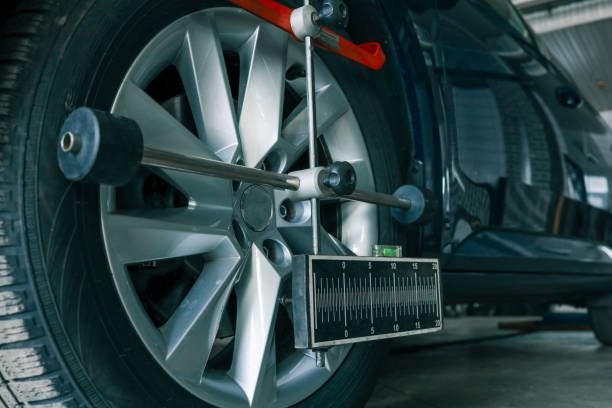
The vehicle is positioned on alignment equipment and sensors or targets are attached to the wheels.
The system measures relevant angles and compares them with manufacturer specifications.
The technician can then determine whether adjustments are needed and which ones are possible on that vehicle.
Many systems display the measurements visually, often showing whether values are inside or outside specified tolerances.
Ask for a before-and-after printout or report where available.
That gives you evidence of what was measured and changed.
How long does wheel alignment take?
A straightforward alignment can often be completed within around 30 minutes to an hour, although the time depends on the vehicle and adjustments required.
Problems can extend the job.
For example, seized adjusters or worn components can complicate matters.
More comprehensive geometry setups on specialist or performance vehicles may also take longer.
If the technician discovers damaged suspension components, alignment may need to wait until those parts have been repaired.
How much does wheel alignment cost?
Prices vary according to whether you need basic front tracking or more comprehensive four-wheel alignment.
For many UK cars, expect roughly £30–£60 for basic front-wheel tracking, while four-wheel alignment can commonly cost around £60–£120 or more, depending on the vehicle and workshop.
Specialist geometry setups can cost more.
For a full breakdown of current pricing, see our dedicated guide to wheel alignment costs in 2026.
When comparing quotes, find out whether adjustment is included or whether the advertised amount covers measurement only.
Can mobile mechanics do wheel alignment?
Traditional wheel alignment usually requires specialist alignment equipment and an appropriate level working setup, so it is more commonly carried out at a tyre centre, garage or alignment specialist than on an ordinary driveway.
Some specialist mobile operations may have suitable equipment, but this should not be assumed.
A mobile mechanic can still be useful for investigating suspension or steering problems and identifying whether the vehicle needs workshop-based alignment.
Our mobile mechanic vs garage guide explains which types of automotive jobs are best suited to each approach.
Can I check wheel alignment myself?
You can identify symptoms yourself.
You can inspect:
- tyre wear;
- steering-wheel position;
- whether the car pulls;
- tyre pressures;
- obvious wheel or tyre damage.
But accurately measuring vehicle geometry requires suitable equipment.
DIY string methods exist among experienced enthusiasts, particularly in motorsport settings, but they are not equivalent to simply looking at the wheels and deciding they “seem straight”.
For most drivers, a professional measurement is a relatively inexpensive way to remove the guesswork.
Is wheel alignment included in an MOT?
No.
An MOT is not a comprehensive wheel-alignment service.
The MOT checks specified vehicle components and roadworthiness requirements, including relevant tyre and steering/suspension items, but it does not provide the same geometry measurement and adjustment as a dedicated alignment service.
A vehicle can therefore pass an MOT while having alignment that contributes to unwanted tyre wear.
Likewise, receiving perfect alignment measurements does not mean the car automatically passes every part of an MOT.
They are different services.
Is wheel alignment included in a car service?
Normally, no.
A mechanic may inspect tyres and suspension during a service and notice signs that suggest alignment should be checked.
But using specialist alignment equipment and making geometry adjustments will normally be charged separately.
This distinction matters if a service report states:
“Uneven tyre wear – recommend wheel alignment.”
That is generally a recommendation for another piece of work rather than something the service has already completed.
Does wheel alignment improve fuel economy?
Correct alignment can help ensure the tyres roll as intended rather than unnecessarily resisting one another.
If the alignment was significantly wrong, correcting it may therefore reduce unnecessary rolling resistance.
But don’t expect wheel alignment to suddenly transform your fuel economy.
Its main practical benefits are:
- correct vehicle tracking;
- more even tyre wear;
- appropriate steering behaviour;
- protecting tyre life.
Treat any fuel-efficiency benefit as secondary.
How often should wheel alignment be checked?
There is no strict universal interval for every car.
A more sensible approach is to check it when there is a reason.
Those reasons include:
- unusual tyre wear;
- pulling;
- off-centre steering;
- significant pothole impact;
- hard kerb impact;
- certain suspension repairs.
Some owners choose periodic alignment checks, particularly where roads are poor or tyres are expensive.
But repeatedly adjusting a car that drives correctly and wears its tyres evenly is unlikely to provide much value.
What if an alignment doesn’t fix the pulling?
Then something else may be responsible.
Potential causes can include:
- tyre problems;
- braking issues;
- worn suspension;
- steering faults;
- vehicle geometry that cannot be corrected through ordinary adjustment.
Take the vehicle back to the workshop and explain that the symptom remains.
A before-and-after alignment report can be particularly useful because it confirms whether the measured geometry is now within specification.
Do not keep paying different garages to realign the same car without investigating why the problem persists.
How do you choose a wheel alignment garage?
Look for a workshop with suitable alignment equipment and experience working with your type of vehicle.
Ask whether they provide:
- front tracking or full four-wheel alignment;
- measurement before adjustment;
- a printout/report;
- adjustment within the price;
- inspection for worn components where necessary.
For ordinary family cars, a reputable tyre centre or garage may be perfectly suitable.
Performance, modified or specialist vehicles can benefit from businesses experienced in more advanced geometry setup.
What’s the difference between a £30 and £100 wheel alignment?
They may not be equivalent services.
The £30 option might involve simple front tracking.
The £100 service may involve measuring all four wheels and adjusting several available geometry settings.
Or both could be offering similar services with different labour rates.
Ask exactly what is included before comparing them.
Specifically:
How many wheels are measured?
Which angles are checked?
Are adjustments included?
Will I receive a printout?
Once you know that, the price difference becomes much easier to judge.
Do my wheels need alignment or refurbishment?
These solve completely different problems.
Alignment concerns how the wheels are positioned relative to the vehicle.
Refurbishment restores the cosmetic finish of the alloy wheel.
If you scrape an alloy gently against a kerb but the car still drives perfectly, you may have cosmetic damage only.
If you hit the kerb hard and the car subsequently pulls, alignment or other mechanical damage becomes relevant.
If the wheel itself has become bent or cracked, the issue goes beyond cosmetic refurbishment altogether.
Our alloy wheel refurbishment cost guide explains when cosmetic restoration is appropriate.
So, how do I know if my wheels need alignment?
The strongest signs are:
- The car consistently pulls to one side.
- The steering wheel sits off-centre while driving straight.
- Tyres show unusual inner- or outer-edge wear.
- One tyre is wearing substantially faster than expected.
- The vehicle started behaving differently after a pothole or kerb impact.
- Steering feels less stable or requires constant correction.
- Relevant suspension or steering work has recently been completed.
None of these proves alignment is definitely the problem.
They tell you it is worth measuring.
And that is the biggest advantage of professional wheel alignment: you do not have to guess.
The equipment can show whether the vehicle falls within the manufacturer’s geometry specifications and whether adjustment is actually required.
If your car is pulling, wearing tyres unevenly or simply doesn’t feel right after hitting a pothole, you can find local mechanics, tyre specialists and automotive professionals through The Right Guy. Ask for an alignment check and, if possible, a before-and-after measurement so you know what actually needed changing.

Author: manager
Company test