
Kitchen Lighting Ideas: 15 Ways to Make Your Kitchen Brighter, Warmer and More Practical
Good kitchen lighting should do more than make the room bright.
It needs to help you chop vegetables safely, illuminate worktops, make an island feel welcoming, create atmosphere when dinner is finished and still look good when the lights are switched off.
That is why the best kitchen lighting ideas use several types of light rather than relying on one central ceiling fitting.
A well-planned kitchen normally combines ambient lighting for general illumination, task lighting where you prepare and cook food, and accent or decorative lighting to add warmth and character. This layered approach is particularly useful around kitchen islands, where good task lighting and feature lighting can work together.
Whether you are planning a completely new kitchen or simply trying to improve a dark existing one, here are 15 practical ideas worth considering.
1. Layer your kitchen lighting instead of relying on one light
The most important kitchen-lighting principle is also one of the simplest:
Do not expect one ceiling light to do everything.
A kitchen usually needs three layers.
Ambient lighting
This provides the room’s general background illumination.
Examples include:
- recessed ceiling spotlights;
- flush ceiling fittings;
- larger pendants;
- ceiling tracks.
Task lighting
Task lighting illuminates specific working areas.
Think about:
- worktops;
- sink;
- hob;
- island preparation zone.
Under-cabinet LEDs are particularly useful here because they illuminate the worktop directly rather than casting light from behind you.
Accent and decorative lighting
This is where the room begins to feel designed rather than merely illuminated.
Examples include:
- pendants over an island;
- internal cabinet lighting;
- shelf lighting;
- plinth lighting;
- wall lights.
Using all three gives you much more control over the room throughout the day.
2. Use under-cabinet lighting for worktops
If there is one upgrade that can improve the practicality of an existing kitchen without completely redesigning it, it is under-cabinet task lighting.
Closeup to luxury grey and white modern kitchen interior
Ceiling lights often sit behind you while you prepare food.
That means your own body can cast a shadow directly onto the chopping board.
An LED strip or slim fitting beneath the wall cabinets solves this by placing the light much closer to the work surface.
It also creates a clean contemporary appearance.
Electrical Safety First confirms that under-cupboard lighting can be fitted to kitchen units when appropriately installed.
For a polished result, consider whether the light source itself can be concealed so you see the illuminated worktop rather than a line of exposed LEDs.
3. Hang pendant lights over a kitchen island
Pendant lighting is one of the easiest ways to turn a kitchen island into the visual centre of the room.
It combines function with decoration.

Which? specifically recommends providing good task lighting above an island as well as feature lighting that adds atmosphere and visual interest.
Three smaller pendants can create rhythm across a long island, while one or two larger fittings can make a stronger statement.
Avoid choosing the number purely because you’ve seen it on Pinterest.
The right arrangement depends on:
- island length;
- pendant size;
- ceiling height;
- sight lines;
- what the island is used for.
A huge pendant above a small island can dominate the room. Tiny pendants over a three-metre island can look lost.
4. Add recessed ceiling spotlights for even general light
Recessed spotlights are popular in modern kitchens because they distribute light across the room without introducing visually heavy ceiling fittings.
They are especially useful in:
- large kitchens;
- low-to-standard ceiling heights;
- minimalist interiors;
- kitchen-diners;
- rooms already containing statement pendants.
But more spotlights are not automatically better.
A ceiling covered with dozens of fittings can create a harsh, showroom-like effect.
Plan them around actual kitchen zones rather than creating a perfect mathematical grid regardless of what sits underneath.
For example, the lighting should respond to:
- cabinet runs;
- island position;
- walkways;
- dining table;
- sink;
- cooking area.
Your lighting plan should follow the kitchen, not the other way around.
If you are still deciding where cabinets, island and appliances will sit, finalise your kitchen layout before deciding exactly where every ceiling light belongs.
5. Put your lighting on separate circuits or controls
One of the easiest ways to make a kitchen feel more expensive is not actually the light fittings.
It is control.
If all the lights switch on together, you only have two atmospheres:
bright and dark.
Separating the lighting into logical zones lets you choose what the room feels like.
For example:
Zone 1: ceiling spotlights
Zone 2: island pendants
Zone 3: under-cabinet LEDs
Zone 4: dining-area lights
Zone 5: decorative cabinet or shelf lighting
When preparing dinner, you may want most layers on.
Later, you might switch off the ceiling lights and leave only the island pendants and under-cabinet lights glowing.
The room suddenly becomes much softer without changing a single fitting.
6. Use dimmers where the fittings are compatible
Dimmers are particularly valuable in kitchens that are also used for dining and entertaining.
The lighting required at 7am while making packed lunches is not necessarily the lighting you want at 9pm with friends around the island.
Dimming allows the same space to move between those uses.
However, the fittings, lamps, drivers and controls need to be compatible.
Do not assume every LED light can simply be connected to any dimmer.
Check the manufacturer’s specifications or have the lighting design reviewed by an electrician.
7. Light the sink properly
The sink is one of the most frequently used work zones in a kitchen, yet its lighting is often treated as an afterthought.
If the sink sits beneath wall cabinets, under-cabinet lights can illuminate it effectively.
If it sits beneath a window, natural light helps during the day — but disappears completely after sunset.
A ceiling spotlight or pendant positioned appropriately can provide evening illumination.
Think about where your head and body will be while standing at the sink.
The goal is to illuminate the work area without creating distracting glare on the window or worktop.
8. Give the hob its own task lighting
You need to see what is happening while cooking.
In many kitchens, the extractor hood provides integrated lighting directly above the hob.
That can be an effective task-lighting solution.
The rest of the lighting should complement it rather than leaving a huge contrast between an extremely bright hob and dark surrounding worktops.
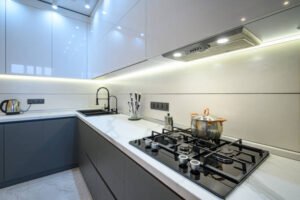
The first supplied image demonstrates this combination particularly well: under-cabinet LEDs continue across the preparation area while the extractor provides focused light directly above the cooking zone.
For a complete renovation, consider the hob and extractor positions before the lighting is finalised.
Moving either later can mean moving electrical connections as well.
9. Add lighting inside glass-fronted cabinets
Glass cabinets can become decorative features after dark rather than simply storage.
Small integrated LED lights can illuminate:
- glassware;
- ceramics;
- display pieces;
- shelving.
This works particularly well when the rest of the room uses warm neutral colours.
Avoid lighting every cupboard.
If everything glows, nothing feels special.
Choose one or two display zones and allow darker areas to provide contrast.
10. Use open-shelf lighting for a softer look
Open shelving has become common in contemporary kitchens, particularly above coffee stations and smaller preparation areas.
Lighting beneath or above shelves can provide subtle accent light.
It works especially well with:
- timber shelves;
- stone splashbacks;
- textured tiles;
- decorative ceramics;
- plants.
Instead of thinking of the shelf light as something designed to make the room brighter, think of it as a way to reveal texture.
A wall with beautifully textured tiles can appear almost flat under general ceiling lighting but become much more interesting when light grazes across the surface.
11. Consider plinth lighting carefully
LED lighting installed at the bottom of kitchen cabinets can create the impression that units are floating above the floor.
Used carefully, it can look excellent in a contemporary kitchen.
It is particularly effective:
- along an island;
- beneath handleless cabinets;
- in dark kitchens;
- for low-level evening lighting.
But this is also one of those features that can quickly become excessive.
Bright blue strips running around every cabinet can make a kitchen look more like a nightclub than a high-end interior.
If you want a sophisticated effect, subtle warm or neutral lighting is usually easier to integrate into the wider scheme.
12. Use warmer lighting around dining areas
A kitchen-diner has two very different functions.
The kitchen needs good visibility for preparation.
The dining area benefits from softer, more atmospheric illumination.
You do not necessarily need every fitting to produce exactly the same effect.
A pendant above the dining table can create a warmer focal point while ceiling lighting provides practical illumination elsewhere.
This is particularly useful in open-plan spaces where lighting can help create visual zones without walls.
A change in light level tells you:
this is where we cook
and
this is where we sit down.
13. Coordinate lighting with the kitchen island
If your island is a major design feature, the lighting should reinforce it.
A long linear pendant can emphasise a contemporary island.
Three individual pendants can create symmetry.
Two oversized shades can make a stronger architectural statement.
If the island contains a sink or hob, task lighting becomes more important.
If it is primarily used for seating, the lighting can lean more decorative.
The wider island design matters too — seating, storage, appliances and lighting should be planned together rather than as separate decisions.
14. Use smart lighting for different kitchen scenes
Smart lighting can make layered lighting significantly easier to use.
Instead of operating several switches individually, you might create scenes such as:
Cooking
Bright worktop and ceiling lighting.
Breakfast
Moderate general lighting with island pendants.
Dinner
Dimmed pendants and softer ambient lighting.
Evening
Under-cabinet and decorative lights only.
Away
Lighting controlled automatically for security or energy management.
Smart-home systems can also integrate lighting with voice assistants, schedules, occupancy sensors and other connected devices.
If you are considering more than a few smart bulbs, our guide to smart home installation costs in the UK in 2026 explains the difference between simple DIY devices and more integrated professional systems.
15. Make natural light part of the kitchen lighting plan
The best kitchen lighting does not begin with electricity.
It begins with daylight.
Large windows, rooflights, glazed doors and open-plan extensions can dramatically change how much artificial light you need during the day.
Think about where the sunlight falls.
A south-facing kitchen may receive large amounts of strong light, while a north-facing room can feel noticeably cooler and darker.
If you are replacing or extending the kitchen, consider:
- window position;
- rooflights;
- glazed doors;
- cabinet height;
- colours and reflectivity.
Gloss and pale surfaces bounce more light around than very dark matt finishes, although too much gloss can introduce glare.
Artificial lighting should fill the gaps left by daylight rather than trying to compensate for a poorly planned room after everything has been installed.
What colour temperature is best for kitchen lighting?
Colour temperature is measured in kelvin (K).
In simple terms:
warmer light appears more yellow and relaxed;
cooler light appears whiter and more clinical.
There is no single perfect number for every kitchen.
Many homeowners prefer relatively warm or neutral lighting because very cool light can make a domestic kitchen feel more commercial.
You might choose a slightly brighter neutral task light under cabinets while using warmer decorative pendants around dining areas.
The most important thing is consistency.
Several noticeably different whites operating side by side can make the lighting feel accidental.
Whenever possible, check the colour temperature before purchasing all the fittings.
How bright should kitchen lighting be?
There is no useful universal answer because kitchen size, surface colours, ceiling height and natural light all affect how bright the room feels.
Instead of chasing one number, think about where light is needed.
Preparation surfaces need strong task lighting.
Walkways need enough general illumination for safe movement.
Dining areas may require much less.
Dark cabinets and worktops absorb more light than pale reflective surfaces.
This is another reason layered lighting works better than simply installing an extremely bright central fixture.
You can add light where it is useful rather than flooding the entire kitchen indiscriminately.
How many pendant lights should go over a kitchen island?
Usually one, two or three — but there is no fixed rule.
A small island may look best with one substantial pendant.
A medium island might suit two.
A long island often works well with three.
The actual decision depends on pendant diameter and how far apart they need to be to illuminate the surface effectively without visually overcrowding it.
Before buying, mark the proposed positions temporarily or create a simple elevation drawing.
This makes it much easier to see whether the pendants look proportional to the island.
How low should pendant lights hang over an island?
Pendant height depends on the fitting, ceiling height and users.
The important goals are to avoid:
- blocking sight lines;
- creating glare at eye level;
- hanging fittings where tall people can hit them;
- placing lights so high that they lose their relationship with the island.
Manufacturer guidance should be followed for individual fittings, particularly where minimum clearances are specified.
Adjustable pendant cables can be useful because they allow the final height to be tuned after installation.
Should kitchen lighting match cabinet handles?
It can, but it doesn’t have to.
Matching black pendants with black cabinet handles creates a coordinated look.
Likewise, brass lighting can complement warm brass hardware.
But repeating exactly the same finish everywhere is not mandatory.
Mixed metals can work when they appear deliberate.
For example, black pendants can sit comfortably above an island with brushed-brass cabinet handles if the overall palette includes both tones elsewhere.
Design consistency is more important than perfect matching.
Are spotlights or pendant lights better in a kitchen?
They do different jobs.
Spotlights are excellent for general and task illumination.
Pendants create stronger visual focal points and can also provide useful light over islands or dining tables.
In many kitchens, the best answer is both.
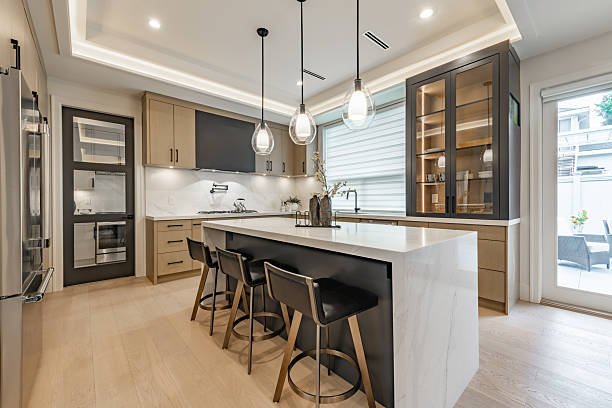
The featured image demonstrates this nicely: recessed ceiling lights provide the general illumination while pendant lights give the island more character.
This is layered lighting in practice.
What lighting is best for a small kitchen?
In a small kitchen, avoid allowing decorative fittings to overwhelm the room.
Consider:
- recessed or flush ceiling lights;
- under-cabinet LEDs;
- one small pendant where appropriate;
- lighting within open shelves or glass cabinets.
Good task lighting is particularly important because compact kitchens often contain wall cabinets directly above most worktop areas.
A few carefully positioned lights can make the space feel much brighter without filling the ceiling with fittings.
Pale surfaces can also help distribute available light.
How should you light a kitchen with no wall cabinets?
Kitchens without wall cabinets give you more freedom.
You might use:
- wall lights;
- adjustable ceiling spots;
- pendant fittings;
- shelf lighting.
Without cabinets, however, you lose the obvious location for under-cabinet LEDs.
Make sure worktops still receive direct task lighting rather than relying only on central ceiling fittings.
Adjustable spots can be particularly useful because their beams can be aimed towards the preparation surfaces.
Kitchen lighting mistakes to avoid
One of the biggest mistakes is planning the lighting before the kitchen layout is finalised.
The electrician needs to know where the:
- island;
- worktops;
- sink;
- hob;
- dining table;
- cabinets
will actually be.
Otherwise, you risk ending up with pendants slightly off-centre from the island or spotlights casting shadows in the wrong places.
Another mistake is relying on decorative lighting alone.
A beautiful pendant is not automatically good task lighting.
Likewise, a ceiling full of spotlights may provide excellent visibility but leave the room feeling flat and cold in the evening.
The third mistake is putting every light on one switch.
Layered lighting only becomes genuinely useful when you can control the layers independently.
Plan sockets and lighting together
Lighting is only one part of the kitchen electrical plan.
You also need to think about sockets for:
- kettle;
- toaster;
- coffee machine;
- microwave;
- small appliances;
- fridge-freezer;
- dishwasher;
- washing machine;
- extractor;
- oven;
- island appliances.
Electrical Safety First advises avoiding overloaded sockets because excessive loading can create a fire risk.
It also recommends allowing around 30 cm between electrical outlets and sinks or other water or heat sources where possible, although it notes that there is no specific general regulation setting one universal distance.
Planning the electrical layout at the same time as the lighting and cabinetry can prevent the need for awkward extensions or visible cables later.
Do you need an electrician to install kitchen lighting?
For fixed electrical installation work, the safest route is to use a competent electrician where new wiring, circuits or significant alterations are involved.
In England, fixed electrical work in homes falls within the scope of Part P of the Building Regulations, which requires electrical installations to be designed and installed to provide reasonable protection from fire and electric shock.
Exactly what work is notifiable depends on the type and location of the installation, so homeowners should not assume that every lighting alteration has identical requirements. Government Approved Document P sets out when notification is required.
Changing a lamp or plugging in a suitable decorative light is obviously very different from installing new fixed wiring.
For a major kitchen renovation, include electrical planning early rather than trying to add lighting after the kitchen has already been fitted.
How much does kitchen lighting cost?
There is no sensible single figure because “kitchen lighting” could mean two £20 pendants or a complete rewiring project with dozens of fittings, smart controls and cabinet LEDs.
Your cost depends on:
- number of fittings;
- cost of the fittings;
- existing wiring;
- whether new circuits are required;
- ceiling access;
- wall chasing;
- dimmers;
- smart controls;
- cabinet lighting;
- labour;
- making good afterwards.
A premium pendant can cost more than several standard spotlights combined.
Likewise, an inexpensive LED strip can become a more involved job if new wiring and drivers need to be concealed inside completed cabinetry.
If the lighting forms part of a complete refurbishment, our guide to how much a new kitchen costs in the UK in 2026 can help you budget for the wider project.
Can better kitchen lighting make a small kitchen feel bigger?
Yes — visually.
Lighting cannot add square metres, but it can reduce dark corners and make the room feel more open.
Useful techniques include:
- lighting worktops rather than leaving them shadowed;
- using subtle cabinet lighting;
- combining daylight with artificial light;
- keeping the ceiling visually uncluttered;
- illuminating the far end of the room;
- using reflective surfaces carefully.
A kitchen where only the centre is bright and the edges disappear into shadow often feels smaller than one with balanced illumination throughout.
Can kitchen lighting increase the value of your home?
Good lighting contributes to the overall impression of a kitchen, but it would be unrealistic to claim that a particular set of pendant lights directly adds a predictable amount to a home’s value.
What good lighting does achieve is presentation.
It can make:
- worktops look better;
- cabinetry appear more premium;
- an island feel like a focal point;
- the room feel larger;
- an open-plan kitchen feel more considered.
It is best viewed as part of the quality of the kitchen rather than an isolated investment.
A well-planned £200 lighting scheme can sometimes improve the room more than another £1,000 spent upgrading one decorative finish nobody notices.
Frequently asked questions about kitchen lighting
What is the best lighting for a kitchen?
A layered combination is generally the most useful: ambient ceiling lighting, task lighting over worktops and decorative or accent lighting around islands, dining areas and cabinets.
Are LED lights good for kitchens?
Yes. LEDs are widely used for ceiling, cabinet and decorative kitchen lighting because they are available in many formats and can provide efficient, controllable illumination.
Where should kitchen spotlights be placed?
Position them according to work areas and circulation rather than simply creating an equal grid across the ceiling. Worktops, sink, island and walkways all need consideration.
Do I need under-cabinet lighting?
It is not essential, but it can dramatically improve task lighting because the worktop is illuminated directly instead of relying on ceiling lighting behind you.
What lights are best over a kitchen island?
Pendants are one of the most popular choices because they combine task and decorative lighting. Which? recommends ensuring islands have adequate task lighting as well as feature lighting.
Can I put kitchen lighting on a dimmer?
Often, yes, provided the lamps, LED drivers and dimmer are compatible. Check the manufacturer’s specifications before installation.
Should kitchen lights be warm white or cool white?
Warm-to-neutral white lighting generally creates a more domestic atmosphere, while cooler lighting can feel more clinical. Many kitchens use relatively neutral task lighting alongside warmer decorative lighting.
Can I install kitchen lights myself?
Simple plug-in lighting and lamp changes can be DIY tasks. New fixed wiring and more substantial electrical alterations should comply with applicable electrical-safety requirements and may require a competent electrician.
Should pendant lights be centred over the island?
Usually, they should relate visually to the island rather than to the entire room. If the island is off-centre in the kitchen, centring the pendants to the room instead can make the design look obviously wrong.
Kitchen lighting ideas: the final plan
The strongest kitchen lighting ideas are rarely about finding one perfect fitting.
They are about building layers.
Start with enough general light to move around the room comfortably. Add direct task lighting above the worktops, sink and cooking areas. Then use pendants, cabinet lighting and other decorative features to create atmosphere.
Most importantly, design the lighting around how the kitchen is actually used.
If you prepare food on the island, illuminate the island properly.
If the dining table becomes the centre of family life every evening, give it its own warmer lighting.
If your wall cabinets create shadows over the worktop, add under-cabinet LEDs rather than increasing the brightness of every ceiling light.
And if you are renovating from scratch, plan your lighting alongside the kitchen layout, cabinetry and electrical points rather than treating it as the final decorative decision.
If you are planning a complete refurbishment, our 2026 UK new kitchen cost guide can help you understand how electrics and lighting fit into the overall budget.
When you are ready to start the work, you can find local electricians, kitchen fitters and other tradespeople through The Right Guy. For new circuits or significant fixed electrical alterations, make sure the work is carried out appropriately and complies with the relevant electrical-safety requirements.