
Black Bathroom Ideas: 17 Stylish Ways to Create a Dark, Luxurious Bathroom
Black bathrooms can look dramatic, sophisticated and surprisingly warm when they are designed properly. But creating a successful dark bathroom involves more than covering every surface in black.
The best black bathroom ideas use contrast, texture and lighting to prevent the room from feeling flat or gloomy. Black can be combined with white sanitaryware for a crisp monochrome scheme, warmed with timber and brass, softened with beige and natural stone, or used selectively through taps, vanity units and feature tiles.
You also don’t need a huge bathroom to make black work. In smaller UK bathrooms, carefully positioned dark surfaces can actually create depth while lighter flooring, mirrors and good lighting keep the room balanced.
Below are 17 ways to introduce black into a bathroom, ranging from subtle black accents to dramatic floor-to-ceiling schemes.
If you’re still deciding how dark you want to go, our guide to bathroom colour ideas can help you compare black with warmer neutrals, greens, blues and other bathroom palettes.
1. Combine black with warm wood
Black and timber are one of the strongest combinations for creating a dark bathroom that still feels inviting.
The black provides contrast while the wood introduces warmth and natural-looking texture.
This works particularly well with:
- walnut tones;
- medium oak;
- dark wood-effect porcelain;
- timber-effect vanity units;
- black stone or marble-effect surfaces.
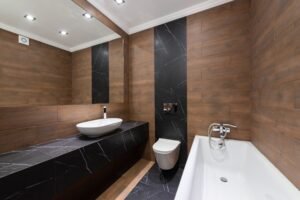
The first bathroom example above demonstrates exactly why the combination works. There is a considerable amount of dark material, but the warm brown walls stop the room from becoming cold.
White sanitaryware then provides another layer of contrast.
You could recreate the effect without covering the entire bathroom in wood-effect tile. A timber vanity against black tiles can provide enough warmth in a smaller room.
2. Create a black and white bathroom
Black and white remains one of the easiest dark bathroom combinations to work with.
Try:
- black walls with a white bath;
- black vanity with a white basin;
- black floor with white walls;
- white marble-effect tiles with black fittings;
- black shower framing against pale tiles.
The contrast makes each element much more defined.
If you want the bathroom to feel predominantly black, use white mainly through the bath, basin and toilet.
For a brighter scheme, reverse the proportions and use white as the main colour with black accents.
3. Choose black marble-effect tiles
Black marble-effect surfaces can add movement to an otherwise very dark scheme.
Instead of using a completely flat black tile, choose one containing white, grey or warm veining.
The pattern breaks up the surface and can make a feature wall feel much more luxurious.
Good locations include:
- behind a freestanding bath;
- inside a shower;
- behind the vanity;
- around a wall-hung toilet.
Large-format tiles can make the veining particularly noticeable while reducing the number of grout lines.
For a high-contrast design, combine black marble effect with white or cream stone elsewhere in the room.
4. Create a black feature wall behind the bath
You do not need to make the entire bathroom black.
One dark feature wall can provide much of the drama while keeping the remaining surfaces lighter.
A wall behind a freestanding bath is an ideal location.
Consider:
- black marble effect;
- matt black tile;
- textured black tile;
- charcoal stone;
- dark microcement-effect porcelain.
A white bath against a dark wall immediately becomes a focal point.
This approach can also be easier to use in a small bathroom because the dark colour is concentrated rather than surrounding the whole room.
5. Pair black with white marble
Black and white marble-effect surfaces can create a dramatic contemporary bathroom without relying on lots of decorative accessories.
The contrast works especially well when one material is dominant and the other is used to frame specific areas.
For example:
White marble-effect walls + black marble shower
creates a dramatic shower feature.
Or:
Black marble wall + pale stone floor
gives the room depth without making every surface dark.
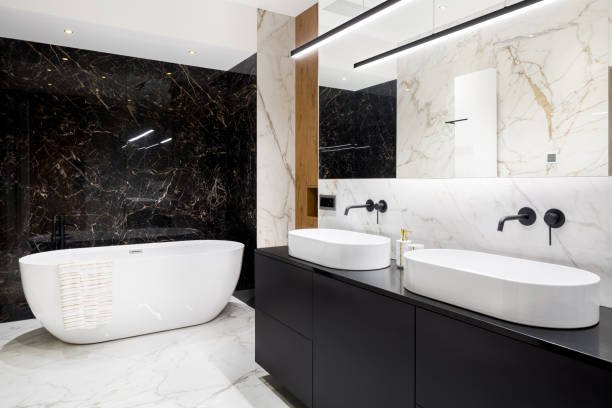
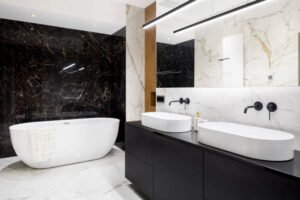
In the example above, the black feature surface behind the bath contrasts strongly with the pale floor and surrounding white marble effect.
The black vanity then repeats the darker colour elsewhere, making the whole room feel connected.
6. Try a black vanity unit
If floor-to-ceiling black feels too dramatic, start with the vanity.
A black vanity creates a strong focal point while allowing the walls and flooring to remain lighter.
It works particularly well with:
- white countertop basins;
- marble-effect worktops;
- timber;
- brass taps;
- black taps;
- warm beige tiles.
Wall-hung black vanities can look particularly clean because keeping the floor visible reduces their visual weight.
A floating vanity also gives you an opportunity to introduce low-level lighting underneath.
7. Use matt black taps and shower fittings
Black bathroom fittings are one of the easiest ways to introduce the colour without committing to black tiles.
You could use:
- basin taps;
- shower controls;
- shower head;
- bath taps;
- towel rails;
- toilet-roll holders;
- hooks;
- shower-screen frames.
Repeating the same finish throughout the bathroom can create a more intentional look.
Avoid adding black fittings randomly.
If the tap is black but every other metal surface is chrome, it may look accidental rather than coordinated.
You do not necessarily need every detail to match, but decide deliberately which finishes you want to repeat.
8. Combine black with brass or gold
Black and gold is one of the strongest combinations for creating a luxurious bathroom.
Black provides the dark background while brass or gold-toned finishes introduce warmth.
Use the metallic finish selectively through:
- taps;
- shower controls;
- mirror frames;
- wall lights;
- cabinet handles;
- accessories.
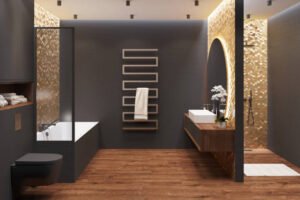
The second supplied bathroom image takes the idea further by using warm metallic feature surfaces and lighting against charcoal walls.
The result feels much warmer than an equivalent room using only black, grey and chrome.
You do not need as much gold to achieve the effect at home.
Even a few brushed-brass details can completely change a black bathroom.
9. Use black with warm beige
Black does not have to be paired with stark white.
Beige can create a softer alternative.
Try:
- black vanity + beige tiles;
- black shower frame + warm stone;
- charcoal walls + cream floor;
- black taps + sand-coloured porcelain.
This works particularly well if you want a contemporary bathroom without the sharpness of a completely monochrome palette.
Warm lighting reinforces the effect.
10. Create a black shower enclosure
The shower is an ideal place to introduce a concentrated dark feature.
You could use black tiles across the shower walls while keeping the rest of the bathroom pale.
Alternatively, use:
- black-framed shower screen;
- black shower tray;
- black controls;
- dark niche;
- black marble-effect feature wall.
This visually defines the shower as its own zone.
In a larger bathroom, the contrast can also help divide bathing, showering and vanity areas without constructing additional walls.
11. Use black tiles in a small bathroom
There is a common assumption that small bathrooms must always be white.
They don’t.
Black can work in compact rooms when it is balanced properly.
Consider using dark tiles on:
- one wall;
- the shower;
- the lower half of the room;
- the floor;
- behind the vanity.
Then introduce lighter elements through:
- basin;
- toilet;
- ceiling;
- mirror;
- worktop.
Large mirrors are particularly useful because they reflect both natural and artificial light.
Good lighting becomes more important as the amount of dark surface increases.
12. Try black bathroom flooring
A black floor can anchor a bathroom without making the walls dark.
Options include:
- matt black porcelain;
- charcoal stone effect;
- black marble effect;
- patterned black-and-white tile;
- dark terrazzo effect.
Black floors work especially well with white sanitaryware and warm neutral walls.
Consider maintenance when selecting the exact finish.
Some very dark uniform surfaces can make dust, limescale or water marks more visible.
A slightly varied stone or marble effect may be more forgiving.
13. Use black tiles halfway up the wall
Half-height tiling is another way to introduce black without overwhelming the bathroom.
For example:
Lower wall: black tile
Upper wall: warm white paint
This creates contrast while keeping the upper part of the room lighter.
It can work particularly well behind:
- toilets;
- vanities;
- baths.
You could also reverse the idea and use a dark painted upper wall with lighter tiles below, provided the paint and wall finish are appropriate for the location.
14. Create a black spa bathroom
Black can work beautifully in spa-inspired interiors when it is combined with natural materials.
Use:
- charcoal stone;
- warm timber;
- soft lighting;
- large tiles;
- simple sanitaryware;
- minimal accessories.
Avoid filling the room with lots of shiny decorative objects.
Texture becomes much more important in a limited palette.
For example, combine:
smooth black vanity + textured stone wall + timber + white bath.
The different surfaces prevent the design from feeling flat even though the colour palette remains restrained.
15. Use black in a period bathroom
Black is not restricted to ultra-modern interiors.
It can work extremely well in Victorian and other period-inspired bathrooms.
Try combining:
- black-and-white floor tiles;
- roll-top bath;
- traditional basin;
- dark painted walls;
- wall panelling;
- brass fittings.
Deep charcoal rather than absolute black can create a slightly softer effect.
A traditional bathroom also gives you more freedom to introduce decorative mirrors, wall lights and patterned surfaces.
16. Add a large mirror to a dark bathroom
Mirrors become particularly valuable in black bathrooms.
A large mirror reflects:
- windows;
- ceiling lighting;
- wall lighting;
- lighter surfaces.
This helps distribute light around the room.
A wall-width mirror above the vanity can be especially effective.
For a very modern design, choose a frameless mirror.
For more contrast, use:
- brass frame;
- timber frame;
- illuminated mirror.
Backlit mirrors can also introduce a softer glow around the vanity rather than relying solely on overhead lighting.
17. Use lighting to make black surfaces work
Dark bathrooms need thoughtful lighting.
Black and charcoal surfaces absorb more light than white or pale tiles, so a lighting plan that works perfectly in a bright bathroom may feel inadequate once the surfaces become dark.
Consider several layers:
General lighting
Recessed or suitable ceiling lighting for overall brightness.
Mirror lighting
Dedicated task lighting for grooming.
Feature lighting
Lighting around niches, textured walls or beneath floating furniture.
Mood lighting
Softer illumination for baths and evening use.
Our guide to bathroom lighting ideas explains how to combine these layers while taking bathroom electrical requirements into account.
Are black bathrooms a good idea?
They can be an excellent choice if you want a bathroom with more depth and character than a conventional pale scheme.
Black works particularly well when you:
- have good natural or artificial light;
- introduce contrasting surfaces;
- vary textures;
- include some lighter elements;
- use mirrors effectively.
The biggest mistake is treating black as the entire design.
A room where the walls, floor, furniture and fixtures are all exactly the same flat black can lose definition.
Variation makes the scheme work.
Think in terms of:
black + contrast + texture + light.
Do black bathrooms make a room look smaller?
They can make boundaries appear darker, but that does not automatically mean the bathroom will feel unpleasantly small.
Dark colours can sometimes create visual depth because corners and edges become less obvious.
The final effect depends heavily on:
- natural light;
- artificial lighting;
- ceiling colour;
- mirror size;
- amount of black;
- room proportions.
In a tiny bathroom, you may prefer one black feature wall rather than four.
Another approach is to keep the ceiling light, which prevents the entire room feeling enclosed.
Are black bathrooms hard to keep clean?
The colour itself is not inherently harder to clean, but some black surfaces can show certain marks more easily.
These may include:
- limescale;
- soap residue;
- water spots;
- dust;
- fingerprints.
This is particularly noticeable on smooth matt-black taps, glossy black tiles and very uniform dark surfaces.
If you live in a hard-water area, consider how much maintenance you are comfortable with before installing large amounts of very dark material around wet areas.
Patterned stone and marble effects can sometimes disguise minor water marks more effectively than completely flat black.
Always follow the manufacturer’s cleaning instructions for taps and surfaces, as abrasive products can damage some finishes.
What colours go with a black bathroom?
Black is surprisingly flexible.
Black and white
Crisp and dramatic.
Black and wood
Warm and contemporary.
Black and beige
Soft and luxurious.
Black and brass
Rich and sophisticated.
Black and green
Moody and natural.
Black and blush pink
Softer and more decorative.
Black and marble
High contrast and luxurious.
Black and grey
Very contemporary, but requires good lighting.
Our guide to bathroom colour ideas can help you compare these combinations before committing to tiles and furniture.
What colour towels work in a black bathroom?
Towels are an easy way to soften a dark scheme.
Good options include:
- white;
- cream;
- beige;
- sage green;
- terracotta;
- warm grey;
- muted pink.
White towels create the strongest contrast and can reinforce a hotel-style appearance.
Cream and beige feel warmer.
If your bathroom already contains timber or brass, warm neutral towels can help connect those materials with the rest of the room.
What colour vanity works with black tiles?
Several approaches can work.
Black vanity
Creates a seamless, dramatic scheme.
White vanity
Provides strong contrast.
Timber vanity
Introduces warmth and natural texture.
Beige or taupe vanity
Creates a softer contemporary look.
Green vanity
Can create a richer, more characterful palette.
If the walls and floor are both dark, a timber or lighter vanity can help prevent the furniture disappearing completely into the background.
Should black bathroom taps match everything?
They do not have to match every single object, but repetition usually makes the design feel more deliberate.
For example:
Black taps + black shower frame + black towel rail
creates a clear theme.
You could then introduce brass through lighting or cabinet handles if you deliberately want mixed metals.
Try not to use chrome, black, brass and brushed nickel randomly throughout one small room.
Limiting the number of metal finishes usually creates a calmer result.
Black bathroom: matt or gloss?
Both can work.
Matt black
Feels softer and more contemporary.
It works particularly well on:
- vanity units;
- taps;
- large-format tiles;
- wall finishes.
Gloss black
Reflects more light and can feel more dramatic.
It works well with:
- glazed tiles;
- marble effects;
- decorative surfaces.
You can also combine the two.
A matt-black vanity against glossy black tiles creates subtle contrast without introducing another colour.
What tiles work with a black bathroom?
You do not need black tiles everywhere.
Good complementary options include:
- white marble effect;
- warm stone effect;
- terrazzo;
- timber-effect porcelain;
- white metro tiles;
- beige large-format tiles;
- black-and-white patterned flooring.
The strongest schemes usually combine a limited number of materials.
If you have dramatic black marble on the walls, you may not need equally dramatic patterned flooring.
Let one major surface take the lead.
How do you stop a black bathroom looking gloomy?
Use four things strategically:
1. Light surfaces
White sanitaryware, pale floors or a light ceiling provide contrast.
2. Mirrors
Large mirrors redistribute available light.
3. Warm materials
Timber, beige stone and brass prevent the room feeling cold.
4. Layered lighting
Ceiling, mirror and accent lighting make dark surfaces much easier to live with.
Lighting should be planned before the renovation reaches the tiling stage.
Moving electrical points afterwards can make a relatively simple change much more disruptive.
Are black bathrooms expensive?
The colour does not determine the renovation cost.
A black bathroom can be created using relatively affordable tiles and standard sanitaryware, or it can become extremely expensive through natural stone, bespoke cabinetry and premium brassware.
The overall cost depends more on:
- bathroom size;
- sanitaryware;
- tiles;
- labour;
- plumbing changes;
- electrical work;
- vanity furniture;
- shower specification;
- structural alterations.
If you are planning the entire room, see our 2026 bathroom renovation cost guide before setting the budget for decorative finishes.
Black bathroom ideas on a budget
You do not need to replace everything.
For a lower-cost update, consider introducing black through:
- paint in suitable areas;
- mirror frame;
- shelving;
- accessories;
- towel hooks;
- cabinet handles;
- one tiled feature area.
If your existing bathroom is mainly white, even a small amount of black can create a completely different appearance.
Changing every tap and shower fitting purely for colour can become expensive, so prioritise the elements that make the biggest visual difference.
Common black bathroom mistakes
Making every surface identical
Use different textures and tones to create depth.
Forgetting lighting
Dark surfaces need a properly planned lighting scheme.
Using too many competing materials
Black marble, terrazzo, patterned tiles, timber and gold all together can become overwhelming.
Ignoring water marks
Consider maintenance before choosing completely flat dark surfaces around showers and basins.
Making a small room unnecessarily dark
Use black strategically rather than automatically covering every wall.
Forgetting warmth
Timber, beige, brass and warm lighting can prevent black feeling harsh.
Choosing fittings independently
Plan taps, shower hardware, mirror frames and accessories as one scheme.
Frequently asked questions
Are black bathrooms still in style?
Yes. Black remains a versatile bathroom colour because it can be used in modern, industrial, spa-inspired and traditional interiors. Using it selectively can also make the scheme easier to update over time.
Is black good for a small bathroom?
Yes, provided lighting and contrast are considered. One dark wall, black vanity or dark shower can introduce depth without making every surface black.
What colour goes best with black in a bathroom?
White provides the strongest contrast, while timber and beige add warmth. Brass can create a more luxurious look, while green gives the room a richer natural palette.
Are black bathroom taps difficult to maintain?
Some black finishes show limescale and water spots readily. Regular gentle cleaning and following the manufacturer’s care instructions can help protect the finish.
What colour floor goes with a black bathroom?
White marble effect, beige stone, timber effect, pale grey and black-and-white patterned floors can all work depending on the style.
Does a black bathroom need more lighting?
Dark surfaces generally reflect less light than pale surfaces, so thoughtful artificial lighting becomes particularly important. Combining ceiling, mirror and feature lighting can prevent the room feeling gloomy.
Can I mix black and gold in a bathroom?
Yes. Black and warm brass or gold-toned finishes can create a strong luxury-inspired combination. Use the metallic finish selectively rather than covering every detail.
Should the ceiling be black too?
It can be in a deliberately dark, dramatic room, but keeping the ceiling lighter is often an easier way to maintain brightness, particularly in small bathrooms.
Final thoughts: designing a black bathroom that actually works
The strongest black bathroom ideas are not simply the darkest ones.
Black works best when it has something to contrast with.
That might be:
black + white for a sharp contemporary bathroom;
black + timber for warmth;
black + marble for drama;
black + beige for a softer spa-inspired room;
or black + brass for a richer luxury look.
The three supplied bathroom examples demonstrate this particularly well. None relies on black alone: one introduces extensive warm wood, another combines charcoal with timber and warm metallic lighting, and the third balances dramatic black marble with white stone and sanitaryware.
Lighting then becomes crucial. Dark finishes need enough illumination to reveal their texture and prevent the bathroom feeling flat. Our bathroom lighting ideas can help you plan ceiling, mirror and feature lighting together.
For more colour combinations, explore our bathroom colour ideas.
If you’re planning to create the look as part of a complete refurbishment, our 2026 bathroom renovation cost guide can help you understand the wider budget before choosing tiles, fittings and furniture.
And when you’re ready to bring the design to life, you can use The Right Guy to find local bathroom fitters, plumbers, tilers and electricians for your project.