
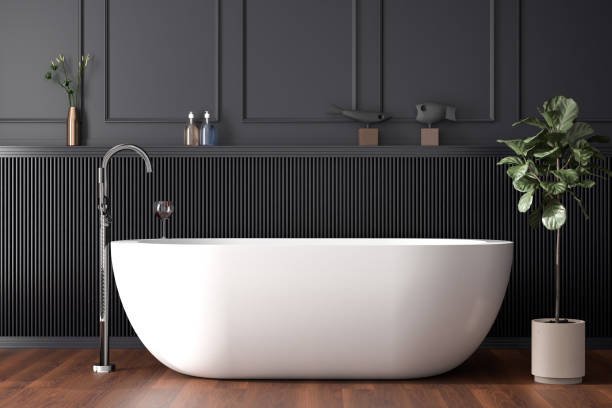
A freestanding bath can completely change the character of a bathroom. Instead of feeling like a purely practical fixture pushed against a wall, the bath becomes part of the room’s design.
The best freestanding bath ideas balance appearance with practicality. A sculptural oval bath can create a luxurious hotel-style feel, while a compact back-to-wall model may suit a smaller UK bathroom where space is limited. Traditional roll-top baths can work beautifully in period homes, whereas matt white, black and stone-effect designs suit more contemporary interiors.
But before choosing one, think carefully about the room around it. A freestanding bath needs enough space to look intentional, comfortable access for cleaning and properly planned taps, plumbing and storage.
If you are planning a complete refurbishment rather than simply replacing your existing bath, our guide to how much a bathroom renovation costs in 2026 can help you understand how the bath fits into the wider budget.
1. Choose a classic oval freestanding bath
An oval freestanding bath is one of the easiest designs to incorporate into a modern bathroom.
Its curved shape softens the straight lines created by:
- tiles;
- vanity units;
- shower screens;
- cabinets;
- mirrors.
A white oval bath works particularly well in neutral bathrooms because it creates a strong focal point without introducing another colour.
You could place it:
- against a feature wall;
- beneath a window;
- between two symmetrical walls;
- in front of decorative panelling.
For a minimalist look, pair it with large-format tiles and simple wall-mounted or freestanding taps.
2. Put the bath beneath a window
Positioning a freestanding bath below a window can create one of the most relaxing bathroom layouts.
Natural light helps make the bathing area feel more open, and the bath becomes visually connected with the brightest part of the room.
This works especially well where the window overlooks a private garden or countryside.
Privacy obviously needs consideration.
Options might include:
- frosted glass;
- shutters;
- suitable blinds;
- privacy film.
Avoid selecting window coverings that are difficult to maintain in a humid environment.
The plumbing position also needs to be considered before deciding that the bath must sit beneath the window.
3. Create a spa-style bathroom
A freestanding bath is ideal for creating a calmer, spa-inspired bathroom.
Instead of filling the room with decorative accessories, keep the palette restrained.
Combine the bath with:
- warm stone-effect tiles;
- timber or timber-effect furniture;
- soft neutral colours;
- large towels;
- warm lighting;
- simple greenery.
Beige, warm white and pale greige work particularly well.
The aim is to make the materials feel calm rather than clinical.
If you are still choosing the overall palette, our guide to bathroom colour ideas includes combinations that can help the bath sit naturally within the rest of the design.
4. Try a back-to-wall freestanding bath
You do not necessarily need a huge bathroom to achieve the freestanding look.
A back-to-wall freestanding bath combines the sculptural front and sides of a freestanding design with one edge positioned against the wall.
This can offer several advantages in compact rooms:
- less wasted space behind the bath;
- easier cleaning;
- simpler positioning of wall-mounted taps;
- more practical use of the room.
It can be a good compromise if you love the appearance of freestanding baths but do not have enough space for one sitting completely independently in the centre of the room.
5. Choose a compact freestanding bath
Not every freestanding bath needs to be enormous.
Compact baths can work well in smaller UK bathrooms, particularly where the layout has been designed carefully.
Shorter models may still provide a deep bathing experience because they are often more upright than conventional fitted baths.
Before ordering one, check both:
- external dimensions;
- internal bathing dimensions.
A compact bath that looks perfect on a floor plan still needs to be comfortable to use.
Also leave enough space around it so the bathroom does not become difficult to move through.
6. Use a freestanding bath as the centrepiece
In a larger bathroom, the bath does not need to sit against a wall.
Placing it more centrally can turn it into the focal point of the entire room.
This works especially well in:
- large master bathrooms;
- loft conversions;
- bedroom-and-bathroom suites;
- wide rectangular bathrooms.
The strongest designs usually give the bath plenty of breathing room.
If the bath is simply floating awkwardly in the middle of a cramped room, the effect can feel impractical rather than luxurious.
Consider sightlines too.
When you enter the room, what do you see first?
If the freestanding bath is intended to be the main feature, position it where it can actually be appreciated.
7. Choose a roll-top bath for a traditional bathroom
A roll-top bath works particularly well in period properties.
The curved rim and traditional silhouette can complement:
- Victorian-style tiles;
- wall panelling;
- patterned flooring;
- heritage paint colours;
- traditional taps.
A classic white roll-top bath with decorative feet can create a strong vintage appearance.
You can also modernise it.
For example:
Traditional bath + contemporary wall colour + simple lighting
can feel much fresher than trying to recreate an entirely historical bathroom.
8. Use a black freestanding bath
A black bath creates immediate contrast.
It works particularly well in bathrooms with:
- pale stone;
- white walls;
- warm timber;
- brass details;
- terrazzo;
- soft beige.
A completely black bath feels bold and modern, while a design with a black exterior and white interior gives you contrast without making the entire fixture visually heavy.
Dark baths can become a very strong focal point, so the surrounding design often works best when kept relatively simple.
Consider maintenance too, as some dark finishes may show water marks more readily than white.
9. Try a matt white bath
Gloss white is traditional, but matt white can create a softer, more contemporary appearance.
The lack of shine makes the bath feel almost sculptural.
Matt finishes work particularly well with:
- textured stone;
- microcement-style finishes;
- timber;
- brushed brass;
- warm neutral tiles.
The combination can create a high-end look without needing dramatic colour.
Before buying, check the manufacturer’s cleaning recommendations because matt surfaces may require different care from traditional glossy acrylic or enamel.
10. Add freestanding floor-mounted taps
Floor-mounted taps can reinforce the freestanding appearance.
Rather than attaching the taps to the bath or wall, the tap rises directly from the floor beside it.
This creates a very clean, luxurious look.
However, the plumbing needs to be planned carefully.
It is much easier to accommodate floor-mounted taps during a renovation when floors are already being altered than after the bathroom is finished.
Position them where they are easy to reach from inside the bath but do not obstruct access around it.
11. Use wall-mounted taps for a cleaner look
Wall-mounted taps can be a more space-efficient alternative.
They work particularly well when the bath sits close to a wall.
The absence of tap fittings on the bath rim keeps the fixture visually clean.
Wall-mounted taps also leave more usable surface around the bath.
But their position needs to be correct.
The spout must project far enough over the bath, and the controls should be reachable without requiring awkward stretching.
Planning before tiling is essential because pipework is normally concealed behind the finished wall.
12. Create a feature wall behind the bath
A freestanding bath naturally draws attention, making the wall behind it an ideal place for a feature.
You could use:
- marble-effect porcelain;
- textured tiles;
- colour;
- wall panelling;
- decorative stone;
- terrazzo;
- patterned tiles.
For a calmer bathroom, keep the feature subtle.
For example, use one large-format stone-effect wall behind a white bath.
For a stronger design, choose deep green, navy or charcoal.
The important thing is not to compete with too many other features elsewhere in the room.
13. Add wall panelling behind the bath
Wall panelling can introduce architectural detail, particularly in bathrooms where plain tiles might feel too cold.
Traditional-style panelling works beautifully with roll-top baths, while simpler vertical panels can complement modern freestanding designs.
Bathrooms are high-moisture spaces, so the materials, construction and finish need to be suitable for the environment.
Do not assume ordinary interior wall panelling can simply be installed beside a bath without proper consideration of moisture exposure.
14. Pair the bath with warm neutral colours
Warm neutral bathrooms can make a freestanding bath feel particularly luxurious.
Instead of bright white and cold grey, consider:
- warm white;
- beige;
- taupe;
- sand;
- mushroom;
- soft greige.
These colours create less contrast between the bath and the surrounding room.
Add natural textures such as timber or stone-effect surfaces to prevent the design feeling flat.
You can then introduce small amounts of black, brass or bronze through taps, lighting and accessories.
15. Use green for a more characterful bathroom
Green works beautifully with white baths because it introduces colour without overwhelming the room.
Options include:
- sage;
- olive;
- eucalyptus;
- forest green;
- muted blue-green.
A freestanding bath against a dark green wall can become an immediate focal point.
For a softer look, use sage green cabinetry or tiles with warm white walls.
Green also works particularly well with wood and brass.
16. Add a small table beside the bath
A completely freestanding bath often lacks the ledge provided by a conventional built-in bath.
That means you need somewhere for:
- soap;
- a book;
- a drink;
- towel;
- toiletries.
A small side table or bath stool can solve this while adding another material to the room.
Timber works well in spa-style bathrooms, while stone or metal can create a more contemporary effect.
Choose something compact enough that it does not interfere with movement around the bath.
17. Build storage around the bath without cluttering it
A luxurious-looking freestanding bath still needs practical storage nearby.
Avoid surrounding it with random bottles and baskets.
Instead, use deliberate storage such as:
- recessed niches;
- wall shelves;
- vanity drawers;
- tall cabinets;
- built-in cupboards;
- small bath tables.
Everyday bathing products should be convenient, but bulk toiletries do not need to be visible.
Our guide to bathroom storage ideas includes more ways to introduce practical storage without making the bathroom feel crowded.
Are freestanding baths practical?
They can be, but practicality depends heavily on the room and the particular bath.
Advantages include:
- strong visual impact;
- flexible positioning;
- wide choice of styles;
- luxurious appearance;
- ability to create a focal point.
Potential disadvantages include:
- harder cleaning behind some models;
- needing more floor space;
- limited surfaces for toiletries;
- potentially more complicated plumbing;
- additional cost.
A well-positioned freestanding bath can be just as usable as a fitted bath.
A poorly positioned one can become frustrating.
How much space do you need around a freestanding bath?
There is no universal decorative clearance that every freestanding bath must have because the required space depends on:
- bath dimensions;
- room layout;
- access;
- cleaning requirements;
- taps;
- surrounding fixtures.
As a practical design principle, you should leave enough room to walk comfortably around any exposed sides and clean the floor.
A tiny gap between the bath and wall can be particularly annoying because it collects dust and moisture but is difficult to reach.
If space is limited, a back-to-wall freestanding bath may provide a more practical solution than forcing a fully freestanding model into the room.
Can you put a freestanding bath in a small bathroom?
Yes, if the proportions work.
A smaller bathroom can still accommodate a freestanding bath when:
- the bath is compact;
- the room has a simple layout;
- storage is wall-mounted;
- fixtures are appropriately sized;
- walkways remain comfortable.
Do not judge the bath in isolation.
A 1500mm bath may technically fit, but if the toilet, vanity and door are then squeezed into awkward positions, the overall bathroom will not work.
Create a floor plan before ordering anything.
Are freestanding baths comfortable?
Many are very comfortable, but shape matters more than appearance.
Check:
- internal length;
- depth;
- backrest angle;
- width;
- overflow position.
Some sculptural baths look large externally but have surprisingly limited internal space because of thick sides.
If possible, sit in the bath before buying.
It may feel slightly ridiculous in a showroom, but it is much better than discovering after installation that the backrest is uncomfortable.
What material is best for a freestanding bath?
Several materials are available.
Acrylic
Acrylic is common because it is relatively lightweight and available in a huge range of designs.
Advantages include:
- lower weight;
- broad choice;
- generally accessible pricing.
Stone resin
Stone-resin or mineral-composite baths can feel more substantial and often provide a premium matt finish.
They tend to be heavier.
Cast iron
Traditional roll-top baths may use cast iron.
These can be extremely heavy, so structural considerations are important, particularly on upper floors.
Solid surface materials
Premium freestanding baths may use various composite solid-surface materials.
These can create very smooth sculptural forms but tend to sit higher in the budget.
Whatever material you choose, check the actual weight of the bath — especially when filled with water and occupied.
Can my floor support a freestanding bath?
Weight should be considered, particularly with very heavy baths.
A freestanding bath contains a substantial volume of water and must also support the person using it.
Materials such as cast iron and some stone-composite designs can add significant additional weight before the bath is even filled.
If there is any uncertainty about the suitability of the floor structure, particularly in an older property or upper-floor bathroom, seek appropriate professional advice before installation.
This is not something to guess purely from the bath’s appearance.
Do freestanding baths cost more?
They can.
A straightforward acrylic freestanding bath can be relatively affordable, while premium stone-resin, cast-iron and designer models can cost significantly more.
The bath itself is only part of the project.
The total cost may include:
- bath;
- waste;
- taps;
- plumbing alterations;
- floor-mounted tap installation;
- flooring;
- wall finishes;
- labour.
If moving the bath to a completely new part of the room requires drainage and water supplies to be relocated, installation can become more expensive.
For a full picture of renovation expenses, use our 2026 bathroom renovation cost guide.
Freestanding bath or built-in bath: which is better?
Neither is universally better.
Freestanding bath
Best if you value:
- visual impact;
- flexibility;
- luxury appearance;
- contemporary or traditional statement design.
Built-in bath
Best if you value:
- efficient use of space;
- easier shower-over-bath installation;
- built-in ledges;
- straightforward cleaning around the perimeter;
- potentially lower cost.
For a compact family bathroom where the bath also needs to function as the main shower, a conventional fitted bath may be more practical.
For a larger bathroom with a separate shower, a freestanding bath becomes easier to justify.
Can you have a shower over a freestanding bath?
It is possible in some situations, but it is usually more complicated than installing a shower over a conventional fitted bath.
You need to think about:
- water containment;
- shower screen or curtain;
- floor protection;
- bath positioning;
- drainage;
- waterproofing.
If a powerful daily shower is the priority, a dedicated shower enclosure may be a better solution.
Freestanding baths generally work most naturally as baths rather than trying to make them perform exactly like a standard shower-bath combination.
Where should you put freestanding bath taps?
Common positions include:
- at one end;
- centrally on one side;
- wall-mounted behind the bath;
- floor-mounted beside the bath.
The ideal position depends on the bath shape.
If two people may use the bath, placing taps centrally can avoid one person sitting against the fittings.
For a single-ended bath, taps at one end may make more sense.
Always consider practical reach.
You should be able to operate the controls without stretching dangerously across a wet floor.
How do you clean around a freestanding bath?
This is worth considering before installation.
If the bath is completely freestanding, leave enough room to reach around it.
If it sits close to a wall, avoid creating a very narrow inaccessible gap.
A back-to-wall design can eliminate this problem altogether.
Smooth flooring and sensible positioning also make maintenance easier.
The most photogenic arrangement is not always the easiest one to live with.
What flooring works with a freestanding bath?
Bathroom flooring needs to cope with moisture while complementing the bath.
Popular options include:
- porcelain tile;
- ceramic tile;
- suitable luxury vinyl;
- natural stone where appropriate;
- other bathroom-rated surfaces.
Large-format stone-effect porcelain works particularly well beneath sculptural baths because it creates a relatively continuous background.
Patterned tiles can suit traditional roll-top baths.
The flooring should be selected based on practical bathroom suitability first, with appearance coming second.
What colours work best with a freestanding bath?
White baths offer enormous flexibility.
White and beige
Soft, warm and spa-like.
White and green
Natural and characterful.
White and navy
Bold and traditional.
White and black
Clean, dramatic and contemporary.
White and pale grey
Simple and understated.
White and terracotta
Warm and Mediterranean-inspired.
If your bath itself is coloured, keep the surrounding palette more restrained unless you deliberately want a highly decorative room.
Use our bathroom colour ideas to plan walls, tiles, cabinetry and fixtures as one complete palette.
Common freestanding bath mistakes
Choosing a bath that is too large
A beautiful bath will not feel luxurious if you have to squeeze around it.
Measure carefully.
Forgetting cleaning access
Do not leave impossible-to-reach gaps.
Selecting taps too late
Tap type affects plumbing and bath positioning.
Plan it early.
Ignoring bath weight
Heavy materials may require additional consideration.
Forgetting storage
A bath still needs somewhere for toiletries and towels.
Prioritising looks over comfort
Sit in the bath before buying if possible.
Ignoring the wider layout
The bath should work with the toilet, shower, vanity and door rather than being designed in isolation.
Frequently asked questions
Are freestanding baths still fashionable?
Yes. Freestanding baths remain popular because they work across modern, spa-inspired and traditional bathroom styles. The exact bath shape and surrounding materials determine whether the finished room feels contemporary or more classic.
Can a freestanding bath go against a wall?
Yes. Some models are specifically designed as back-to-wall freestanding baths, while others can sit relatively close to a wall if enough access is maintained.
Are freestanding baths good for small bathrooms?
They can be, particularly compact or back-to-wall models. The overall room layout is more important than the bath style alone.
Are freestanding baths hard to clean around?
They can be if installed with very narrow gaps around them. Leaving usable cleaning access or choosing a back-to-wall design can make maintenance much easier.
What is the most practical freestanding bath shape?
Oval and gently curved rectangular designs are highly versatile. Back-to-wall models can be particularly practical when space is limited.
Do freestanding baths need special plumbing?
They still require normal water supply, waste and drainage connections, but their position and tap type can make installation more involved than simply replacing an existing fitted bath.
Are floor-mounted taps worth it?
They can create an impressive finish, especially with a fully freestanding bath, but plumbing needs to be properly planned and installation can add cost.
Is a freestanding bath better than a normal bath?
It depends on the bathroom. Freestanding baths offer more visual impact, while fitted baths often use space more efficiently and make shower-over-bath arrangements easier.
Final thoughts: choosing the right freestanding bath
The best freestanding bath ideas are the ones that look impressive without making the bathroom harder to use.
Start with the size and layout of the room.
A large bathroom can accommodate a sculptural bath positioned as a centrepiece. A compact space may work better with a shorter or back-to-wall model.
Then think about the style you want.
An oval matt-white bath suits minimalist and spa-inspired interiors. A roll-top bath can bring character to a period property. Black and stone-effect designs create much stronger contemporary statements.
Finally, plan the practical details early: taps, drainage, flooring, cleaning access and storage.
If you’re still working on the overall scheme, our guide to bathroom colour ideas can help you coordinate the bath with the rest of the room, while our bathroom storage ideas can help prevent toiletries and towels from undermining the clean freestanding look.
For a complete refurbishment, our 2026 bathroom renovation cost guide can help you put the cost of the bath into the context of the entire project.
If you need help installing a new bath or completing a bathroom renovation, you can use The Right Guy to find local bathroom fitters, plumbers, tilers and other relevant tradespeople.

Author: The Right Guy Team
UK service guides published by The Right Guy Ltd.