
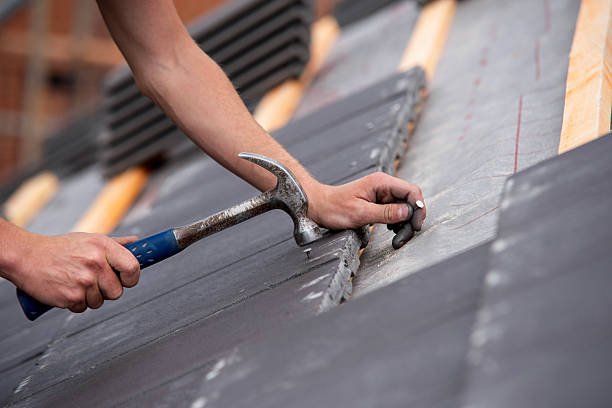
A damaged roof does not always mean you need a completely new one. A slipped tile, damaged flashing or small localised leak can often be repaired without replacing thousands of pounds’ worth of roofing.
The difficulty is knowing when repeated repairs are no longer solving the underlying problem.
Some of the most important signs your roof needs replacing include widespread missing or damaged tiles, recurring leaks, sagging sections, deteriorating roof coverings, daylight entering the loft and extensive problems appearing across several areas of an ageing roof.
The decision should be based on the condition of the whole roof, not simply its age.
If you’re wondering whether another repair will do or whether it is finally time for a replacement, these are the warning signs worth investigating.
1. Your roof keeps leaking in different places
One isolated roof leak doesn’t automatically justify a replacement.
Water could be entering through:
- one cracked tile;
- damaged flashing;
- a failed roof penetration;
- a problem around a chimney;
- damaged pointing;
- a local defect around a valley.
Those problems may be repairable.
The situation becomes more concerning when you repeatedly fix one leak only for another to appear elsewhere.
Multiple leaks across different parts of the roof can suggest that the covering or underlying roof system is deteriorating more generally.
Look inside the loft after prolonged or heavy rain if it is safe to do so. Water staining, damp timbers and wet insulation can sometimes reveal problems before visible water reaches the rooms below.
Don’t assume the stain directly underneath a roof defect identifies the entry point, though. Water can travel along rafters, membranes and other surfaces before becoming visible.
2. Large numbers of roof tiles are cracked, slipped or missing
A single missing tile after a storm is normally a repair issue.
A roof where tiles are repeatedly slipping, cracking or failing across several elevations deserves a more thorough assessment.
Individual tiles can often be replaced, but widespread deterioration may make continuous patch repairs increasingly uneconomical.
The condition of the fixings and supporting structure matters too.
If tiles repeatedly move despite repairs, a roofer should investigate why rather than simply replacing the visible missing tile every time.
[INSERT IMAGE 2 HERE – UK tiled roof showing multiple cracked, slipped or missing roof tiles]
Alt text: Damaged and missing roof tiles showing signs a roof may need replacing
3. The roof is visibly sagging
A visibly sagging roof deserves prompt professional investigation.
Stand outside and look at the roofline from a safe distance.
The ridge and roof planes should generally appear consistent rather than noticeably dipping or bowing.
Sagging doesn’t tell you exactly what is wrong. Possible causes can involve the roof structure, prolonged moisture problems or excessive loading.
Because this can potentially involve structural components rather than simply the roof covering, it isn’t something to diagnose by climbing onto the roof yourself.
If you can see an obvious change in the roof’s shape, arrange an assessment by an appropriately experienced roofing professional or structural specialist where necessary.
4. You can see daylight through the roof from the loft
Go into the loft during daylight and switch off the lights.
Small areas of visible daylight can sometimes indicate gaps or defects that need investigation.
However, don’t mistake intentional ventilation openings for damage.
If you can clearly see daylight through an area where the roof covering should be continuous — particularly alongside signs of water penetration — there may be a defect in the tiles, slates, underlay or surrounding roof construction.
You may also notice:
- water staining;
- damp rafters;
- damaged membrane;
- debris beneath damaged tiles;
- wet insulation.
Finding a small defect doesn’t automatically mean replacing the entire roof, but several deteriorating areas may support the case for more extensive work.
5. Roof repairs are becoming a regular expense
This is one of the strongest practical signs that replacement should at least be considered.
Imagine spending:
£300 on one repair.
Then £450 several months later.
Then another £600 the following winter.
Each individual repair may appear cheaper than replacing the roof, but over several years you could spend thousands maintaining a roof that continues to deteriorate.
At some point, the question changes from:
“Can this roof be repaired?”
to:
“Does repairing this roof still represent good value?”
Ask a roofer to assess the roof as a complete system and estimate whether the remaining areas are likely to require significant work soon.
If you’re beginning to compare the cost of repeated repairs against full replacement, our guide to how much a new roof costs in the UK in 2026 explains the main factors affecting the final price.
6. The roof covering is deteriorating across a large area
Different roofing materials deteriorate differently.
Concrete and clay tiles can crack or become damaged.
Slates can slip or break.
Flat-roof membranes can split, blister or deteriorate.
Metal roofing can develop corrosion or problems at joints and fixings.
The important distinction is between localised damage and widespread deterioration.
A competent roofer may be able to replace a limited damaged area while leaving the remainder untouched.
But if deterioration is appearing throughout the roof, repairing individual sections may simply delay the inevitable.
[INSERT IMAGE 3 HERE – close view of an ageing tiled or slate roof with widespread surface deterioration]
Alt text: Ageing roof covering with widespread deterioration on a UK home
7. Your roof has reached an advanced age
Age matters, but there is no universal expiry date for a roof.
A well-installed and well-maintained roof can perform for many years, while another roof may develop serious problems much earlier because of workmanship, weather exposure, material quality or lack of maintenance.
Different materials also have different expected service lives.
This is why statements such as “every roof must be replaced after exactly 25 years” aren’t particularly useful.
Instead, roof age should be treated as context.
If an older roof remains dry, structurally sound and in good condition, age alone isn’t necessarily a reason to replace it.
If an ageing roof is also leaking, losing tiles and requiring increasingly frequent repairs, its age becomes much more relevant.
8. The roof underlay is failing
The visible tiles aren’t the whole roofing system.
Beneath tiled and slated roofs there is typically an underlay or membrane, together with battens and the structural roof components.
Older underlays can deteriorate over time.
You may see signs from inside the loft such as:
- torn material;
- sagging underlay;
- brittle sections;
- holes;
- extensive staining.
A damaged underlay doesn’t necessarily mean the entire roof structure is defective, but accessing and replacing it can involve removing the covering above.
That can significantly change the economics of repair.
If large areas need stripping anyway, it may make sense to compare the cost of substantial repair work with a more comprehensive roof replacement.
9. You have widespread damp or mould near the roof
Damp patches on upstairs ceilings or walls can sometimes indicate roof problems — but be careful here.
Not every damp patch is caused by a leaking roof.
Condensation, plumbing leaks, inadequate ventilation and insulation problems can create similar symptoms.
For example, poor insulation can leave surfaces colder and increase the risk of condensation under certain conditions. That is why improving a home’s thermal envelope, including measures such as appropriate cavity wall insulation, needs to be considered alongside ventilation and moisture management.
If damp appears after heavy rain or follows the shape of the roof, water penetration becomes more likely.
But diagnose the source before paying for roofing work.
Replacing an entire roof will be a very expensive way to discover that the real problem was condensation or a leaking pipe.
10. Flashing and roof junctions are failing repeatedly
Some of the most vulnerable parts of a roof aren’t the large flat areas of tiles.
They’re the junctions.
Pay particular attention around:
- chimneys;
- valleys;
- rooflights;
- dormers;
- abutments;
- vent pipes;
- extensions.
These areas often rely on flashing and careful detailing to prevent water entering.
A local flashing failure can usually be repaired without replacing the entire roof.
But if an ageing roof has failing junctions and widespread problems elsewhere, a comprehensive replacement may make more sense than repeatedly repairing each weak point.
11. The roof has suffered major storm damage
Strong winds can dislodge tiles and slates, while falling trees and debris can cause much more substantial damage.
After severe weather, inspect the roof from ground level where possible.
Look for:
- missing tiles;
- displaced ridge tiles;
- debris;
- damaged gutters;
- visibly distorted sections;
- material on the ground.
Don’t climb onto a wet, damaged or unstable roof yourself.
Minor storm damage may require only repair.
Major damage affecting a large area or structural components may make partial or full replacement necessary.
If the damage may be covered by buildings insurance, check your policy and contact the insurer before authorising substantial work unless emergency measures are necessary to prevent further damage.
12. Several roof problems are appearing at once
Often, no single symptom makes the replacement decision obvious.
Instead, homeowners see a combination:
The roof is old.
Several tiles are missing.
There is staining in the loft.
The underlay is deteriorating.
Flashing has already been repaired twice.
Another leak has appeared.
Taken individually, each problem might be repairable.
Together, they suggest that the roof as a whole deserves a proper assessment.
This is when replacement can become more economical than continuing to chase individual failures.
Does a leaking roof always need replacing?
No.
This is worth emphasising because homeowners can understandably panic when water appears through the ceiling.
A leak may be caused by a relatively small defect.
For example, repairing flashing around a chimney could potentially solve the problem without touching most of the roof.
Similarly, replacing several storm-damaged tiles doesn’t mean you need a completely new covering.
A full replacement becomes more likely when the leak is part of widespread deterioration, the underlying roof system is failing or repairs are no longer economically sensible.
Can a roof be repaired instead of replaced?
Very often, yes.
Repair is particularly worth considering when:
- damage is confined to a small area;
- most tiles or slates remain in good condition;
- the roof structure is sound;
- the underlay remains serviceable;
- the roof isn’t repeatedly leaking elsewhere;
- the repair cost is proportionate.
Roof replacement becomes more attractive as the number and extent of defects increase.
Ask the contractor to explain both options where possible.
A useful question is:
“If we repair this section now, what condition is the rest of the roof in?”
That helps distinguish a genuine isolated repair from simply postponing another large bill.
How much does a new roof cost?
Roof replacement is a major home-improvement project, and there isn’t one meaningful fixed UK price.
The final cost depends on:
- roof size;
- roof shape;
- tile or slate choice;
- scaffolding;
- labour;
- location;
- roof access;
- structural repairs;
- insulation work;
- chimney work;
- valleys and rooflights;
- waste removal.
A straightforward terraced-house roof and a large detached property with multiple valleys, dormers and chimneys are completely different projects.
For detailed UK budgeting figures, see our 2026 new roof cost guide before requesting quotations.
Should you replace roof insulation at the same time?
Potentially.
If substantial roofing work exposes parts of the building that would otherwise be difficult to access, it can be sensible to consider energy-efficiency improvements at the same time.
However, the appropriate insulation strategy depends on the roof construction.
A conventional cold loft insulated at ceiling level is different from a warm-roof construction or converted loft where insulation follows the roof slope.
Don’t simply add insulation wherever there appears to be space.
Ventilation, moisture movement and Building Regulations requirements need to be considered as part of the roof design.
Do you need Building Regulations approval for a replacement roof?
Potentially, yes.
In England, replacing a significant proportion of a roof covering can bring the work within Building Regulations requirements relating to the renovation of thermal elements.
Government Approved Document L provides guidance on conservation of fuel and power in existing dwellings and renovation of thermal elements.
Structural alterations may create additional requirements.
Requirements also vary across England, Wales, Scotland and Northern Ireland, so the contractor should identify what applies to your project rather than assuming every reroof is treated identically.
Planning permission is a separate issue.
Straightforward like-for-like reroofing often won’t require a planning application, but significant alterations, listed buildings and properties subject to particular restrictions can be different.
Should you replace gutters when replacing the roof?
Not automatically.
But reroofing provides a useful opportunity to inspect them.
Check:
- gutter condition;
- joints;
- brackets;
- downpipes;
- fascia boards;
- soffits;
- drainage.
If the guttering is already deteriorating and scaffolding is being erected anyway, completing both jobs together could avoid paying for difficult access twice.
Don’t replace perfectly functional components purely because someone has bundled them into the quotation, though.
Ask why each additional item is necessary.
Can a new roof make your home warmer?
Potentially, particularly if the project includes appropriate insulation improvements and the existing roof has significant defects.
But the tiles themselves aren’t usually the main thermal insulation layer.
A beautiful new tiled roof installed above poorly insulated ceilings won’t automatically transform the home’s energy performance.
If you’re reroofing, ask how the existing insulation will be affected and whether improving it at the same time would be practical.
What should you look for when hiring a roofer?
Roof replacement is expensive enough that contractor selection matters enormously.
Don’t choose solely from the lowest number written on a quotation.
Ask for a detailed description of:
- materials;
- tile/slate specification;
- membrane;
- battens;
- insulation where applicable;
- flashing;
- ridge system;
- scaffolding;
- waste disposal;
- making good;
- VAT;
- guarantees;
- estimated timescale.
You should also check the business independently.
Our guide to choosing a trustworthy builder covers practical checks that are equally useful when comparing roofing contractors, including quotations, insurance, references and avoiding suspiciously cheap offers.
Why getting several roof quotes matters
Roofing quotations can differ dramatically because contractors aren’t necessarily proposing identical work.
One roofer might quote to:
remove the existing covering → replace battens and membrane → install new tiles → renew flashing → remove waste.
Another might have excluded scaffolding, insulation, timber repairs or certain finishing work.
The cheaper quote could become considerably more expensive once those extras appear.
Ask each contractor to separate predictable work from provisional costs that depend on what is discovered after the old roof is stripped.
That makes comparison much easier.
Warning signs of a suspicious roofing quote
Be cautious if someone:
- appears unexpectedly and claims your roof needs immediate replacement;
- pressures you to agree immediately;
- refuses to provide a written quotation;
- demands an unusually large cash payment upfront;
- cannot explain what materials will be used;
- recommends full replacement without explaining the defects;
- won’t provide business details;
- gives a dramatically lower quote than everyone else without explaining why.
A legitimate roofer should be able to explain what is wrong and what they propose doing about it.
For a major project, “trust me, the whole thing is gone” isn’t a sufficient diagnosis.
Should you climb onto the roof to check it?
Generally, no.
Many of the initial warning signs can be inspected from:
the ground
or
inside the loft.
Roof work carries a serious fall risk, particularly on wet, damaged or steep surfaces.
Use binoculars or a zoomed phone/camera from a safe position to inspect tiles if necessary.
For closer investigation, use an appropriately equipped professional.
[INSERT IMAGE 4 HERE – professional roofer inspecting a tiled roof using appropriate access and safety equipment]
Alt text: Professional roofer inspecting a UK tiled roof for damage
Frequently asked questions
How do I know if my roof needs replacing?
Common signs include widespread tile or slate deterioration, repeated leaks in different areas, failing underlay, visible sagging and increasingly frequent repairs. A professional inspection can determine whether problems are localised or affect the roof more broadly.
Does one roof leak mean I need a new roof?
No. Many leaks are caused by local defects that can be repaired. Replacement becomes more likely where leaks recur or form part of widespread deterioration.
How old should a roof be before replacing it?
There is no single age at which every roof must be replaced. Material, installation quality, exposure, maintenance and roof design all affect service life. Condition matters more than age alone.
Can I replace only half of my roof?
Partial replacement can sometimes be appropriate when deterioration is genuinely confined to one section. Whether it makes practical and financial sense depends on the existing roof and how the old and new sections can be integrated.
Is a sagging roof dangerous?
Sagging can indicate a structural or moisture-related problem and should be professionally investigated. Avoid climbing onto a visibly compromised roof.
Can you live in a house while the roof is being replaced?
Often, yes. Many reroofing projects can be completed while the property remains occupied, although noise, dust, scaffolding and temporary disruption should be expected. The contractor should explain how the property will be protected during the work.
Is replacing a roof worth it before selling?
It depends on the roof’s condition and likely sale implications. Replacing a functioning roof purely to sell may not return the entire investment. A visibly failing or leaking roof, however, can become a significant issue during surveys and negotiations.
How many roof quotes should I get?
There is no mandatory number, but obtaining several comparable written quotations is sensible for a major project. Compare the scope, materials and exclusions rather than simply choosing the lowest total.
Signs your roof needs replacing: repair or start again?
The most important signs your roof needs replacing aren’t necessarily dramatic.
Sometimes the decision becomes obvious after major structural damage.
More often, it happens gradually.
Another tile slips.
Another leak appears.
The underlay is deteriorating.
Flashing needs repairing again.
The roof is increasingly expensive to maintain.
When several of those problems start appearing together, it becomes sensible to compare the cost of continuing repairs against replacing the roof properly.
But don’t replace a roof purely because it is old or because one contractor says you should.
Get the condition assessed, understand which components are actually failing and compare detailed quotations.
If replacement is recommended, our UK new roof cost guide can help you understand the likely budget before making a decision.
When you’re ready to get the roof professionally inspected or quoted, you can find local roofers, builders and other home-improvement professionals through The Right Guy. For a major reroofing project, comparing the proposed scope of work can be just as important as comparing the final price.

Author: The Right Guy Team
UK service guides published by The Right Guy Ltd.