
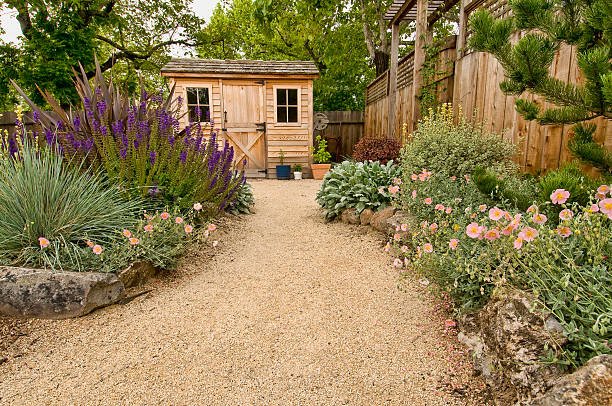
If you have spent hours pulling weeds only to find them returning a few weeks later, it is understandable to start searching for how to stop weeds permanently.
The frustrating truth is that there is no single treatment that can guarantee a garden will remain completely weed-free forever. Seeds can arrive on the wind, be carried by birds, remain dormant in soil or be introduced with new plants and materials.
But that does not mean endless weeding is inevitable.
The most effective long-term approach is to remove established weeds properly, prevent buried weeds from returning and make the soil or hard landscaping much less inviting for new ones. Done correctly, this can reduce the amount of regular weeding dramatically.
Here are 10 practical ways to get weeds under control in UK gardens — and keep them that way.
1. Remove existing weeds properly before doing anything else
If you want a long-term solution, start with the weeds already growing.
Simply snapping off the visible leaves is often not enough. Some perennial weeds can regrow from roots or underground structures left behind in the soil.
Whenever practical, remove as much of the root system as possible.
A hand fork or appropriate weeding tool can help loosen the soil around individual weeds so the root can be lifted rather than broken off near the surface.
This is particularly important before laying mulch, gravel or other coverings. Covering a badly infested area without dealing with established perennial weeds first can leave you fighting growth coming through your new surface.
The job is often easiest after rain or watering, when soil is moist enough for roots to release more readily without being waterlogged.
2. Learn whether you have annual or perennial weeds
Not all weeds behave in the same way.
Understanding what you are dealing with makes long-term control much easier.
Annual weeds complete their lifecycle relatively quickly and usually spread primarily through seed. Preventing them from flowering and setting seed can therefore make a substantial difference.
Perennial weeds survive for multiple years and may regenerate from established roots, rhizomes or other underground structures. Simply removing the leaves may achieve very little.
This is why one person’s “just pull them out” advice works beautifully in one garden and fails completely in another.
If the same weed repeatedly appears from exactly the same place despite being pulled, there may be an established underground system that needs more thorough treatment.
3. Use mulch to suppress weeds in borders
Mulching is one of the most useful ways to reduce weeds without turning your garden into a completely hard-landscaped space.
Mulch covers the soil surface, making conditions more difficult for many weed seedlings while also giving beds and borders a much tidier appearance.
Organic materials such as composted bark or wood-based mulch are commonly used around established garden plants.
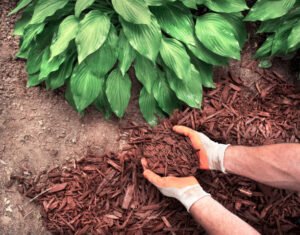
Remove existing weeds first, then apply the mulch across the exposed soil while keeping it appropriately clear of plant crowns and woody stems.
A very thin scattering is unlikely to provide much weed suppression. The mulch needs enough depth to form an effective covering, while the appropriate amount will depend on the material being used and the plants in the bed.
Organic mulch gradually decomposes, so it is not a one-time permanent treatment. It will need topping up periodically.
That maintenance is usually far easier than repeatedly clearing large areas of bare soil.
Mulching also fits naturally into a garden designed to demand less regular work. If that is your goal, our low-maintenance garden ideas include other ways to reduce repetitive garden jobs.
4. Stop leaving large areas of bare soil
Bare soil is effectively an invitation for weeds.
If nothing desirable is occupying the space, weeds have less competition when their seeds germinate.
One long-term strategy is therefore to cover more of the ground with plants.
Ground-cover plants and spreading perennials can gradually fill gaps between shrubs, reducing the amount of exposed soil available.
This does not mean planting everything centimetres apart. Plants still need appropriate spacing for their mature size and good growing conditions.
Instead, think about what the border should look like after two or three years rather than immediately after planting.
A newly created border often looks sparse because all the plants are young. Filling every gap with temporary plants or mulch while permanent planting develops can help suppress weeds during that establishment period.
5. Create a properly prepared gravel area
Gravel can be an excellent low-maintenance surface, but simply pouring gravel over existing soil is unlikely to solve a weed problem.
Preparation matters.
Existing weeds should be removed first, particularly troublesome perennial weeds. The ground then needs to be prepared appropriately for the intended use, with edging and suitable construction beneath the decorative surface.
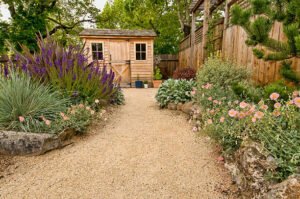
A suitable permeable membrane is sometimes used beneath decorative gravel to help separate the aggregate from the soil and reduce weed growth from below. Whether it is appropriate depends on the area and planting design.
Even a well-built gravel path is not permanently immune from weeds.
Over time, dust, leaves and organic matter can collect between stones. Seeds landing from above may then germinate in that material.
The solution is regular light maintenance: remove fallen leaves and young weeds before enough material accumulates to support significant growth.
That is much easier than rebuilding a neglected gravel path several years later.
6. Deal with weeds in paving before they become established
Patio and path weeds often appear in joints rather than growing directly through solid paving.
Seeds settle into joints containing soil, sand and organic debris and then germinate.
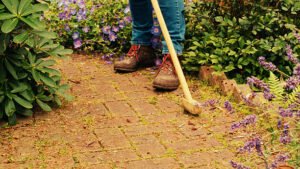
Regular sweeping is surprisingly useful because it removes some of the organic material that creates a suitable environment for seedlings.
If weeds are already established, remove the plants and as much root material as practical before addressing deteriorated joints.
Repeated weed problems can sometimes indicate that paving joints or parts of the surface need maintenance rather than simply another round of weed removal.
If your patio is old, uneven or heavily colonised by weeds, it may be worth considering whether repair or replacement would provide a better long-term result. Our patio design ideas explore different ways to create practical garden surfaces.
7. Pull weeds when they are young
Long-term weed control becomes considerably easier if you stop thinking of weeding as a huge annual project.
A tiny weed might take seconds to remove.
Leave it for months and it can become a large plant with an established root system — potentially producing large numbers of seeds depending on the species.

Walk around the garden occasionally and deal with new weeds while they are still small.
Pay particular attention before weeds flower and produce seed.
The old gardening principle that preventing weeds from seeding reduces future problems is simple but important. You are not only removing today’s weed; you are potentially preventing another generation.
8. Keep lawn weeds under control by improving the grass
A lawn full of weeds is not always solved by endlessly targeting individual weeds.
Sometimes the better long-term strategy is improving the lawn itself.
Healthy, reasonably dense grass leaves less space for weed seedlings to establish. Problems such as compacted soil, poor drainage, bare patches or inappropriate mowing can weaken grass and create opportunities for weeds.
Depending on the condition of the lawn, improvement might involve appropriate mowing, feeding, scarifying, aeration or overseeding.
The right treatment depends on the problem.
Avoid automatically reaching for a herbicide whenever you see a broad-leaved plant. First ask why weeds are succeeding in that particular part of the lawn.
If grass repeatedly fails because an area is extremely shaded, wet or heavily trafficked, changing the landscaping may ultimately make more sense than repeatedly trying to force a perfect lawn to grow there.
9. Use edging to stop plants creeping into unwanted areas
Not every “weed” arrives from a seed.
Some unwanted growth spreads sideways from lawns, neighbouring planting or vigorous plants elsewhere in the garden.
A defined edge between lawns and borders makes this much easier to manage.
Metal, stone, brick and other edging systems can create a physical boundary while also making the garden look more finished.
Regularly trimming lawn edges can achieve a similar visual result where permanent edging is not wanted.
Be aware that extremely vigorous plants can spread beneath or around shallow barriers, so edging should not be treated as a universal solution for invasive or persistent plants.
10. Design the whole garden to make weeds easier to control
If your garden requires hours of weeding every month, the problem may partly be the design.
Large areas of exposed soil, inaccessible corners, broken paving, poorly defined borders and numerous tiny gaps can create perfect conditions for unwanted growth.
A lower-maintenance design might use:
- denser established planting in borders;
- mulch around shrubs and perennials;
- properly constructed paths;
- defined lawn edges;
- accessible beds;
- gravel or paving where planting is not required.
The aim is not necessarily to cover the entire garden in concrete.
A well-planted garden can actually suppress weeds more effectively than an empty border because desirable plants occupy much of the available growing space.
For inspiration on combining easier maintenance with an attractive design, see our cheap garden makeover ideas and modern garden ideas.
What is the best way to stop weeds growing through gravel?
The best results begin before the gravel is installed.
Remove existing weeds thoroughly, prepare the ground correctly and use an appropriate construction for the type of path or area you are creating.
A suitable permeable landscaping membrane may help reduce weeds emerging from the soil below in some decorative gravel installations.
However, membrane does not prevent seeds arriving on top of the gravel.
Leaves, soil particles and other organic debris eventually collect between stones. Weed seeds can germinate in this material without ever reaching the original soil beneath.
That is why maintaining gravel is still necessary.
Regularly remove leaves and debris, and pull young weeds before they establish large root systems.
Does weed membrane stop weeds permanently?
No.
Weed-control membrane can be useful in the right situation, but it should not be marketed or thought of as a permanent guarantee against weeds.
It can suppress some growth coming from the ground beneath the membrane. However, weeds may eventually exploit damaged areas, edges and planting holes, while airborne seeds can germinate in material accumulating above it.
Membranes also need to be selected according to the intended use. A system appropriate beneath a gravel path may not necessarily be the best approach within a densely planted border that you expect to change regularly.
Think of membrane as one tool within a wider weed-management strategy rather than a magic layer that makes maintenance disappear forever.
Does bark mulch stop weeds?
Bark mulch can significantly suppress many weeds by covering the soil and limiting the conditions seedlings need to establish.
It works best when existing weeds have been removed before application.
Persistent perennial weeds may still push through, particularly if their root systems remain established underneath.
Mulch also breaks down over time and gradually becomes part of the soil, which is beneficial for some garden applications but means it needs replenishing.
For many planted borders, that trade-off is worthwhile because topping up mulch occasionally is far easier than constantly hoeing bare ground.
Can you permanently stop weeds between paving slabs?
You can dramatically reduce them, but guaranteeing that no weed will ever appear again is unrealistic.
Seeds can settle into extremely small joints and germinate wherever enough moisture and organic material accumulates.
Keeping paving swept and joints in good condition can substantially reduce the opportunity for weeds to establish.
If the joints have badly deteriorated, repairing them using a method and material suitable for the particular paving may provide a more durable solution than repeatedly pulling weeds.
Persistent growth accompanied by loose or moving paving may indicate that the patio itself needs attention.
Does boiling water kill weeds?
Very hot water can damage plant tissue and may kill small weeds, particularly young growth in cracks and hard-landscaped areas.
However, it is not necessarily a permanent solution for perennial weeds with substantial underground root systems. The visible leaves may die while the plant later regrows.
There is also an obvious risk of damaging nearby desirable plants, lawn or yourself.
Pouring boiling water around planted beds is therefore not a precise or particularly practical long-term weed-management strategy.
Does vinegar kill garden weeds?
You will often see homemade vinegar weed killers recommended online.
Acetic acid can damage plant foliage, but household DIY mixtures should not automatically be treated as harmless simply because the ingredients seem familiar.
In the UK, products used as herbicides are regulated, and homemade pesticide or weedkiller mixtures are not a good substitute for products authorised for their intended use.
If you decide that chemical weed control is necessary, choose an authorised product suitable for the particular application and follow its label exactly.
For difficult weeds, professional advice can be more useful than repeatedly experimenting with stronger homemade mixtures.
Should you use weedkiller?
It depends on the weed, location and scale of the problem.
Many ordinary garden weeds can be controlled through pulling, digging, mulching, improving planting density and maintaining hard surfaces.
There are situations where an appropriately authorised herbicide may form part of a control strategy, particularly for difficult weeds.
If using one, identify the plant first, choose a product authorised for the intended use and follow the manufacturer’s label instructions carefully.
Avoid assuming that “more product” means better results. The label specifies how the product should be used.
Also take particular care around ponds, wildlife areas, edible plants and neighbouring vegetation.
What about difficult weeds such as bindweed, horsetail or Japanese knotweed?
Some weeds require a completely different level of persistence.
Bindweed, for example, can regenerate from underground roots, making casual pulling frustratingly ineffective if significant root material remains.
Horsetail is also notorious for its extensive underground system and can be difficult to eradicate quickly.
Japanese knotweed deserves particular attention because it is subject to specific controls in the UK and should not be treated like an ordinary garden weed. If you suspect you have Japanese knotweed, identify it correctly and check current official guidance before cutting, moving or disposing of material.
For persistent or potentially invasive plants, professional identification can save a great deal of wasted effort.
How do you clear a badly overgrown garden?
Do not try to make it perfect in a single afternoon.
Start by identifying anything you definitely want to keep. Then remove obvious annual weeds and unwanted growth before tackling established perennial weeds.
Once the area is clear enough to understand its layout, decide which parts will become:
planting → lawn → paths → patio → gravel → other hard landscaping.
That matters because each area requires a different long-term weed strategy.
For example, mulching may be ideal for a shrub border but inappropriate for the middle of a path. Dense planting may suppress weeds beautifully in a flower bed but obviously cannot solve weeds between old paving slabs.
If you are starting from an almost blank garden and are new to planting, our guide to the best plants for beginners can help you choose straightforward plants to fill newly cleared borders.
Can you actually stop weeds permanently?
Not completely — and any method claiming to guarantee a permanently weed-free outdoor garden should be treated with caution.
A garden is a living environment. Seeds travel, plants spread and organic material accumulates.
But you can stop weeds from being a constant problem.
The most effective long-term combination is:
- Remove established weeds correctly.
- Prevent weeds from setting seed.
- Cover bare soil with planting or mulch.
- Construct gravel and paved areas properly.
- Keep hard surfaces clean.
- Deal with new weeds while they are tiny.
- Address persistent perennial weeds appropriately.
Do those things consistently and the amount of time spent weeding can fall dramatically.
Stop fighting weeds and change the conditions instead
Learning how to stop weeds permanently is really about understanding why they keep returning.
If you repeatedly pull weeds while leaving bare soil, deteriorating paving or established underground roots untouched, the cycle continues. If you change the conditions that allow weeds to thrive, maintaining the garden becomes much easier.
Mulch planted borders. Fill unnecessary gaps with appropriate plants. Maintain paving joints. Prepare gravel areas properly. Remove weeds before they seed. And when a particularly persistent plant appears, identify it before deciding how to control it.
The goal does not have to be a biologically impossible garden where another weed never germinates. It should be a garden where weeds are occasional five-minute jobs rather than something that takes over every spring.
If your garden is heavily overgrown or needs more substantial clearing, landscaping, new paths or redesigned borders, you can find local gardeners and landscapers through The Right Guy. Professional help can be particularly worthwhile when you are dealing with persistent weeds or want to redesign an area so that it requires much less maintenance in future.

Author: manager
Company test