
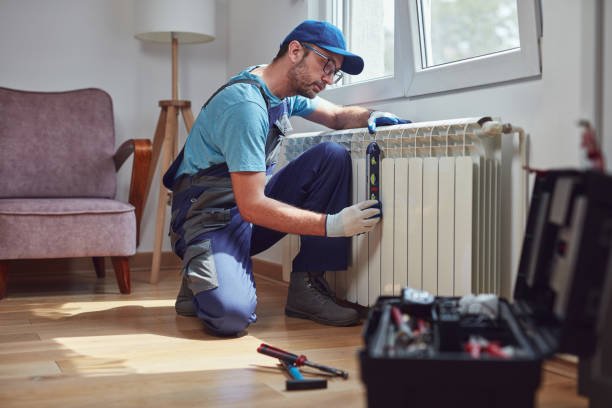
A radiator that no longer heats properly, has started leaking or simply looks badly dated can often be replaced without making major changes to the rest of your central heating system. But the price depends heavily on whether you are making a straightforward like-for-like swap or moving and resizing the radiator at the same time.
So, how much does radiator replacement cost in the UK?
In 2026, replacing a standard double-panel radiator typically costs around £200, while replacing a larger radiator can be closer to £300. Labour to fit a radiator commonly falls around £200–£300 once factors such as size, valves, draining and minor pipework are considered. Moving an existing radiator to a new position averages around £275.
The radiator itself, however, is only part of the calculation. Designer models, new thermostatic radiator valves (TRVs), altered pipework and central-heating system work can all increase the final bill.
Here is what UK homeowners should budget for in 2026.
Radiator replacement costs in the UK at a glance
Current UK pricing provides the following useful starting points:
| Radiator work | Typical 2026 cost |
|---|---|
| Remove a small radiator | Around £80 |
| Remove and repair a radiator | Around £125 |
| Replace a double-panel radiator | Around £200 |
| Replace a large radiator | Around £300 |
| Move a radiator | Around £275 |
| Typical radiator fitting/labour | Around £200–£300 |
| Remove up to six radiators and flush system | Around £350 |
These are ballpark figures rather than fixed national prices. Current estimates indicate that a straightforward fitting can start around £150–£180 for labour, while £200–£300 becomes more typical once radiator size, valves, system draining or balancing and minor pipework are taken into account.
Your actual quote will depend on the radiator, your heating system, location and complexity of the work.
What affects radiator replacement cost?
Replacing one radiator can be a relatively small plumbing job, but several factors determine whether you pay closer to £150 or several hundred pounds.
Radiator size and type
A small standard panel radiator is usually inexpensive compared with a large column or designer radiator.
Common choices include:
- single-panel radiators;
- double-panel radiators;
- triple-panel radiators;
- vertical radiators;
- column radiators;
- towel radiators;
- designer radiators.
Larger radiators generally cost more to purchase and can take longer to install.
Whether the pipework needs changing
A true like-for-like replacement is usually cheapest.
If the new radiator has connections in compatible positions, the installer may be able to reuse much of the existing arrangement.
Change the radiator’s width or position, however, and the pipes may need extending, shortening or rerouting.
That adds materials and labour.
Whether the heating system needs draining
Depending on the system and work required, the installer may need to isolate and drain part or all of the central-heating system before replacing the radiator.
The system then needs refilling and checking afterwards.
Additional work such as balancing the radiators or flushing the system can also affect the price.
Where you live
Labour prices vary around the UK, with London and parts of the South East often costing more.
If you want to understand how the labour element compares with other plumbing jobs, our guide to how much a plumber costs in the UK in 2026 covers typical hourly rates, call-outs and day rates in more detail.
How much does it cost to replace a standard radiator?
For an ordinary double-panel radiator, a current UK benchmark is approximately £200 for removal and replacement, assuming the job takes around one to two hours and does not involve substantial complications.
A larger radiator is closer to £300 on average.
These figures are useful for straightforward jobs, but your quote may rise if the installer discovers:
- damaged valves;
- corroded pipework;
- awkward access;
- incompatible pipe spacing;
- sludge within the system;
- damaged wall fixings;
- a need to rebalance the heating system.
If you are purchasing the radiator separately, make sure you know whether the installer’s quote includes valves and other fittings.
How much does the actual radiator cost?
The price of the radiator itself varies enormously.
A relatively simple panel radiator can be inexpensive, particularly in a standard size. Large radiators, unusual finishes and premium designer products can cost hundreds of pounds.
The important point is that retail price and installation price are separate.
A £70 radiator might still cost £200 or more overall once labour and fittings are included.
Equally, a £500 designer radiator might not cost dramatically more in labour if it uses compatible connections and can be installed without modifying the pipework.
When budgeting, therefore, calculate:
radiator + valves/fittings + labour + any pipework alterations + disposal/making good.
That gives you a much more realistic figure.
How much does it cost to replace a large radiator?
Current 2026 UK estimates put the replacement of a large radiator at around £300, compared with roughly £200 for a standard double-panel unit.
The difference is not simply because the radiator costs more.
Larger radiators can be heavier, may require stronger or repositioned wall brackets and could involve different pipe spacing.
If you are deliberately increasing radiator size because the room struggles to get warm, make sure the replacement has been properly sized for the room rather than simply buying the largest radiator that fits the wall.
How much does it cost to move a radiator?
Moving a radiator is more expensive than swapping one in the same position because the pipework needs to move with it.
Current UK estimates put the average cost of moving a radiator at approximately £275.
However, the real price depends on where you want it moved.
Moving a radiator slightly along the same wall may be relatively straightforward.
Moving it across the room can require floorboards to be lifted, pipework extended and flooring or walls made good afterwards.
Concrete floors can make rerouting more complicated.
If you are renovating, decide on radiator positions before new flooring and decoration are completed. Paying someone to open a freshly finished floor because the radiator was an afterthought is an avoidable expense.
Should you replace a radiator that is cold at the bottom?
Not necessarily.
A radiator that is cold at the bottom but warmer at the top can be associated with sludge or debris restricting circulation rather than a radiator that has reached the end of its life.
Replacing it immediately could therefore be unnecessary.
Our guide explaining why a radiator is cold at the bottom and how to fix it covers the common causes and helps you work out whether cleaning, system attention or replacement is more appropriate.
If several radiators show similar symptoms, it is particularly worth considering whether the problem lies with the wider heating system rather than several radiators independently failing at once.
What if the radiator is cold at the top?
A radiator that is cold at the top but warmer lower down may have trapped air inside it.
In that situation, replacement is unlikely to be the first solution.
Bleeding the radiator releases trapped air so hot water can circulate through more of the radiator.
If you have never done it before, follow our simple step-by-step guide to bleeding a radiator before assuming the radiator itself needs replacing.
If bleeding does not solve the problem or the radiator repeatedly fills with air, further investigation may be appropriate.
When should a radiator actually be replaced?
Poor heating performance does not automatically mean replacement.
There are, however, situations where a new radiator becomes a sensible option.
The radiator is leaking because of corrosion
A leaking valve or connection can often be repaired.
A radiator body that has corroded through is different.
Once the metal itself is deteriorating and leaking, replacement is usually more sensible than trying to treat the symptom.
The radiator is badly rusted
Minor surface corrosion does not necessarily make a radiator unusable.
Extensive corrosion — particularly around seams, valves and the bottom of the radiator — deserves closer inspection.
The radiator is damaged
Dents are often cosmetic, but physical damage affecting connections or the radiator’s integrity may justify replacement.
It is incorrectly sized for the room
A perfectly functional radiator can still be the wrong radiator.
If its heat output is insufficient for the room, replacing it with an appropriately sized unit may improve comfort.
You are changing the heating system
Moving from a conventional boiler system to a heat pump can change radiator requirements considerably.
More on that below.
You are renovating the room
Sometimes there is nothing mechanically wrong with the old radiator.
A homeowner may simply want a slimmer panel, vertical radiator or another design that fits the renovated room better.
That is perfectly reasonable — just distinguish a cosmetic upgrade from a necessary heating repair when budgeting.
How do you know what size replacement radiator you need?
Do not choose purely according to physical dimensions.
A radiator needs enough heat output for the room it serves.
The required output depends on factors including room size, insulation, glazing, external walls and the temperature at which the heating system operates.
A heating professional can calculate the room’s heat loss and use that to select an appropriate radiator output.
This becomes especially important when changing heating technology.
A radiator that worked adequately with a high-temperature boiler system may not necessarily produce the same useful output when supplied with lower-temperature water.
Do you need bigger radiators with a heat pump?
Sometimes — but not always.
Heat pumps typically send water to radiators at lower temperatures than conventional fossil-fuel heating systems. Energy Saving Trust says typical heat-pump water temperatures can be around 35–45°C, and increasing radiator surface area allows the room to receive sufficient heat at these lower temperatures.
That does not necessarily mean installing enormous radiators across every wall.
A single-panel radiator can sometimes be replaced with a double or triple-panel model, increasing the available surface area without dramatically increasing its width.
Nor does every radiator automatically need replacing when a heat pump is installed. The installer should calculate the property’s heating requirements and determine whether existing radiators are adequate.
If you are considering a wider change to your heating emitters, our guide to how much underfloor heating costs in the UK in 2026 compares another option that can work particularly well with lower-temperature heating systems.
Single-panel vs double-panel radiators: is upgrading worth it?
A double-panel radiator provides more surface area than a comparable single-panel design, allowing it to deliver greater heat output.
That can be useful where:
- the room does not get warm enough;
- wall space is limited;
- you are lowering heating flow temperatures;
- the existing radiator is undersized;
- you are preparing for a heat pump.
Triple-panel radiators provide still more surface area, although they project further into the room.
Do not automatically upgrade every radiator simply because “bigger is better”. Correct sizing is preferable to unnecessary oversizing, particularly when you are spending hundreds of pounds across multiple rooms.
How much does it cost to replace all the radiators in a house?
This depends heavily on how many radiators you have and what you replace them with.
If a straightforward standard replacement costs around £200 each, replacing eight radiators gives a very rough starting calculation of £1,600.
But you should not assume eight radiators will automatically cost eight times the single-radiator price.
A plumber replacing several radiators in one visit can work more efficiently because the heating system only needs to be drained and refilled as part of the overall job rather than arranging multiple separate visits.
Conversely, the total can rise if you choose premium radiators, install new TRVs, alter pipework or need the heating system flushed.
For a whole-house replacement, ask for one itemised project quote rather than multiplying an online single-radiator average.
How much do designer radiators cost to install?
Designer radiators can make the heating system part of the room’s interior design rather than something you try to hide.
Vertical radiators are particularly popular where horizontal wall space is limited.
The installation itself may not be dramatically more complicated if the product uses conventional connections and existing pipework can be adapted easily.
But designer radiators can become considerably more expensive because of the product price.
Heavy column radiators may also require particularly secure wall fixings.
Before buying, check:
- required heat output;
- radiator weight;
- wall construction;
- pipe positions;
- dimensions;
- valve requirements;
- manufacturer installation requirements.
A beautiful radiator that cannot adequately heat the room is still the wrong radiator.
Should you replace radiator valves at the same time?
It can make sense, particularly if the existing valves are old, seized or leaking.
Current replacement estimates can also increase when TRVs or smart valves are added to the job.
Thermostatic radiator valves allow you to control individual radiator output rather than every room behaving identically.
If the existing valves are working correctly, however, they do not necessarily need replacing simply because the radiator is new.
Ask whether valve replacement is necessary or an optional upgrade.
Does a new radiator make a room warmer?
It can — if the existing radiator is undersized or no longer working properly.
Simply replacing one correctly functioning radiator with another of identical output will not magically reduce the heat loss of the room.
If a room is consistently cold, investigate the whole picture.
The radiator may be too small, but the room may also have significant heat loss through poorly insulated walls, windows, roof areas or floors.
Correct radiator sizing works alongside insulation rather than replacing it.
Can replacing radiators reduce heating bills?
Potentially, but be careful with claims that new radiators automatically slash energy bills.
A radiator transfers heat from your heating system into the room. Replacing an old radiator can improve heating performance if the original is badly restricted, incorrectly sized or unsuitable for a lower-temperature system.
Better controls can also help you manage room temperatures.
But replacing a perfectly functional, correctly sized radiator purely because it is old does not automatically produce dramatic energy savings.
The biggest benefit may be comfort, appearance, control or compatibility with a new heating system rather than a guaranteed reduction in bills.
Is it cheaper to repair or replace a radiator?
For minor problems, repair is usually cheaper.
Current UK estimates put removing and repairing a radiator at around £125, compared with approximately £200 for replacing a double-panel radiator and £300 for a large replacement.
A leaking valve, trapped air or balancing problem may not require replacement at all.
Replacement becomes more attractive when the radiator body is corroded, damaged or incorrectly sized.
Consider the age and condition of the rest of the heating system too.
Spending repeatedly on an old radiator that continues developing problems may not make sense if a new standard radiator can be installed for a few hundred pounds.
Can you replace a radiator yourself?
A competent DIYer may be able to replace a straightforward radiator, but there is more involved than removing two valves and hanging another unit on the wall.
You need to:
- isolate the radiator;
- deal with water inside it;
- disconnect it without damaging pipework;
- fit suitable brackets;
- connect the replacement securely;
- refill the system where required;
- bleed the radiator;
- check carefully for leaks;
- ensure the heating system operates correctly afterwards.
Different radiator dimensions can also mean the existing pipes no longer align.
Water leaking onto flooring or through a ceiling can turn the saving on professional labour into an expensive repair.
For many homeowners, a plumber or heating engineer is worthwhile, particularly when pipework needs altering.
How long does radiator replacement take?
Current estimates suggest approximately one to two hours for replacing a standard double-panel radiator, with around two hours for a large radiator or relocation.
That assumes there are no major complications.
A job can take longer when:
- pipework must be altered;
- old valves are seized;
- the system is difficult to drain;
- the wall needs additional preparation;
- several radiators are being replaced;
- the heating system requires flushing or balancing.
Do not judge a quote solely by multiplying the plumber’s hourly rate by one hour. Preparation, travel, system draining and recommissioning all form part of the job.
Should you flush the heating system when replacing radiators?
Not automatically.
If the system is clean and only one healthy radiator is being changed for cosmetic reasons, a major flush may be unnecessary.
But visible sludge or persistent circulation problems can justify further investigation.
Current pricing estimates put removing up to six radiators and flushing the central heating system at around £350.
Ask the heating engineer why a flush is being recommended.
If several radiators are cold at the bottom, that provides more reason to investigate contamination than a single radiator being replaced because you dislike its appearance.
What hidden costs should you consider?
Radiator replacement can reveal issues that were previously concealed.
Common additional costs include:
Pipework alterations. New radiator dimensions may not match existing connections.
Valves. Old valves may need replacement.
Wall repairs. New brackets may sit in different positions.
Flooring. Moving pipework can require floors to be lifted.
Decoration. A smaller replacement may reveal unpainted wall behind the old radiator.
System flushing. This may be recommended if contamination is discovered.
Disposal. Check whether removal of the old radiator is included.
Balancing. The heating system may need adjustment after changes.
A clear quote should tell you which of these are included.
How can you keep radiator replacement costs down?
The simplest way is to keep the installation straightforward.
Choose a radiator with suitable output and dimensions that work with the existing location and pipework where possible.
If several radiators need replacing, consider having them completed together rather than booking multiple separate visits.
Ask for an itemised quote and establish whether valves, fittings, disposal and balancing are included.
For non-urgent work, compare quotes from several professionals.
But avoid choosing a radiator purely because it is cheap. The correct heat output and compatibility with your heating system are more important than saving £30 on the unit.
Questions to ask before accepting a radiator replacement quote
Before booking the work, establish exactly what you are paying for.
Useful questions include:
- Is the radiator included?
- Are new valves included?
- Will existing pipework need altering?
- Is draining and refilling the system included?
- Will the heating system be balanced afterwards if necessary?
- Is removal and disposal of the old radiator included?
- Does the price include VAT where applicable?
- Will any wall or floor making-good be required?
- Is the replacement correctly sized for the room?
These questions make it much easier to compare two quotes fairly.
A £180 quote excluding the radiator, valves and pipe alterations may ultimately cost more than a £280 all-inclusive quote.
Frequently asked questions about radiator replacement costs
How much does radiator replacement cost in the UK?
Current 2026 estimates put replacement of a standard double-panel radiator at around £200, while replacing a large radiator averages approximately £300. More complex installations can cost more.
How much does a plumber charge to fit a radiator?
A straightforward fitting may start at approximately £150–£180 for labour, while around £200–£300 is more typical once radiator size, valves, draining, balancing and minor pipework are considered.
How much does it cost to move a radiator?
Current UK estimates put the average at around £275, although moving pipework across a difficult floor or to another part of the room can cost more.
Is it worth replacing a 20-year-old radiator?
Age alone does not mean a radiator needs replacing. If it heats correctly, does not leak and is appropriately sized, replacement may be unnecessary. Extensive corrosion, repeated leaks or inadequate output are stronger reasons.
Do new radiators heat a room better?
They can if the old radiator is restricted, damaged or undersized. The replacement still needs to have appropriate heat output for the room and heating system.
Do I need bigger radiators for a heat pump?
Not always. However, because heat pumps generally operate with lower water temperatures, some homes benefit from radiators with greater surface area. A heat-pump installer should calculate the heating requirements before recommending replacements.
Can I replace one radiator without replacing the others?
Yes. There is generally no reason to replace every radiator simply because one needs changing, provided the remaining radiators are suitable and in good condition.
Should I bleed a radiator before replacing it?
If the radiator is cold at the top, bleeding it may resolve the problem without replacement. A radiator that is leaking from corrosion, physically damaged or incorrectly sized presents a different situation.
How much should you budget for radiator replacement in 2026?
For a normal like-for-like radiator replacement, around £200 is a useful starting benchmark for a standard double-panel radiator, while a larger replacement can be closer to £300. Moving a radiator averages approximately £275.
But the cheapest replacement is not necessarily the best one.
Before buying a radiator, establish why the existing one is not performing properly. A cold radiator might simply need bleeding. Coldness at the bottom may point towards circulation or sludge problems. A radiator that is genuinely undersized needs to be replaced with something offering the correct output — not merely something that fits the same gap.
And if you are upgrading to a heat pump, radiator sizing becomes part of the design of the entire heating system. Energy Saving Trust advises that larger-surface-area radiators are often recommended because heat pumps typically operate at lower water temperatures.
If replacement is the right option, you can find local plumbers and heating engineers through The Right Guy. Compare what each quote includes, check that the new radiator is correctly sized for the room, and establish whether valves, pipe alterations, balancing and removal of the old radiator are included before work starts.

Author: manager
Company test