
A professional deep clean typically costs around £25–£37 per hour in the UK, with a current average of about £31 per hour. For a one-off whole-house deep clean taking around six hours, that works out at roughly £186 as a useful starting point. Current UK marketplace data also puts complete deep-clean jobs around £160–£325, averaging approximately £227, depending on the size and condition of the property.
But there is no single fixed price for a deep clean.
A tidy one-bedroom flat that needs extra attention in the kitchen and bathroom is completely different from a four-bedroom house that has not been thoroughly cleaned for months. Grease, limescale, pet hair, clutter, carpet cleaning, appliance interiors and the number of cleaners required can all affect the final quote.
So when asking how much does a deep clean cost in the UK, the most useful question is not just the hourly rate. You need to know how many hours the cleaner expects the property to take and exactly what is included.
This guide explains typical 2026 deep-cleaning prices, what a professional deep clean normally covers, how costs change by property size and how to avoid paying extra for services you assumed were included.
How much does a deep clean cost in the UK in 2026?
Current UK cost guidance gives the following useful starting figures:
| Deep-cleaning service | Typical cost |
|---|---|
| Professional deep cleaning | £25–£37 per hour |
| Current average hourly rate | Around £31 per hour |
| Approx. six-hour deep clean | Around £186 |
| Typical complete deep-clean job | £160–£325 |
| Current average project price | Around £227 |
| After-builders cleaning | £30–£35 per hour |
Current Checkatrade guidance puts standard professional deep cleaning at £25–£37 per hour, averaging £31, and estimates around six hours for a representative one-off house deep clean. Its current local-market data gives a broader complete-project range of £160–£325, averaging about £227.
Treat these as budgeting figures rather than guaranteed prices.
The actual cost depends heavily on your home.
Why does a deep clean cost more than regular cleaning?
A regular cleaner usually maintains areas that are already being cleaned reasonably frequently.
That might include vacuuming, mopping, dusting, cleaning bathrooms and wiping kitchen surfaces.
A deep clean goes further.
The cleaner spends time on areas that do not normally receive attention every week, such as skirting boards, detailed bathroom descaling, built-up kitchen grease, doors, switches and areas behind or beneath accessible furniture.
This additional labour is why a deep clean typically costs more than routine domestic cleaning.
Current 2026 data puts ordinary house cleaning at around £25 per hour for an independent cleaner and £25–£30 through an agency, compared with roughly £31 per hour on average for deep cleaning.
For a broader comparison, see our guide to how much a cleaner costs per hour.
What is included in a professional deep clean?
There is no compulsory universal checklist, so always confirm this before booking.
However, a typical deep clean may include much more detailed attention to the main areas of the house.
Kitchen deep cleaning
A kitchen deep clean may include:
- worktops;
- sinks and taps;
- cupboard fronts;
- accessible cupboard interiors if agreed;
- splashbacks;
- tiles;
- hob;
- extractor exterior;
- appliance exteriors;
- microwave;
- fridge or freezer where included;
- floors;
- skirting boards;
- doors and handles.
Current Checkatrade guidance says deep kitchen cleaning can include areas such as the fridge, freezer, microwave, oven, extractor hood, washing machine, dryer and sink, although actual packages vary.
This is exactly why you need a written checklist.
One cleaner may include the oven in their deep-clean package.
Another may charge for specialist oven cleaning separately.
Bathroom deep cleaning
Bathrooms often require more time than their floor area suggests.
A professional deep clean may involve:
- bath;
- shower enclosure;
- toilet;
- basin;
- taps;
- tiles;
- grout;
- shower screens;
- limescale removal;
- mirrors;
- floors;
- skirting;
- accessible fixtures.
Current UK guidance specifically lists limescale removal, cleaning tiles and grout, toilet sanitation and descaling showerheads among common deep-cleaning tasks.
A bathroom with heavy limescale and soap residue can therefore take much longer than one maintained regularly.
Bedrooms and living areas
A deeper clean can include:
- detailed dusting;
- vacuuming;
- mopping suitable flooring;
- skirting boards;
- doors and handles;
- switches;
- shelves;
- accessible furniture;
- window sills;
- internal glass where included;
- built-in storage where agreed.
Current guidance lists areas such as skirting boards, shelves, blinds, handles, bannisters and cleaning beneath accessible furniture as typical deep-clean targets.
The important distinction is the level of detail.
A normal clean might vacuum around the furniture.
A deep clean might involve reaching the dust and grime that have been missed for months.
What is usually NOT included in a deep clean?
This is where unexpected bills often begin.
Depending on the business, the standard quote may exclude:
- carpet extraction;
- upholstery cleaning;
- exterior window cleaning;
- oven cleaning;
- inside fridge/freezer;
- inside cupboards;
- heavy mould treatment;
- rubbish removal;
- heavily soiled or specialist cleaning;
- moving very heavy furniture;
- exterior areas.
Checkatrade identifies carpet and upholstery cleaning, internal window cleaning and fridge/freezer cleaning among services that may be optional add-ons rather than automatically included in every package.
Do not assume that the phrase “full deep clean” literally means every cleanable object in the property.
Ask for the list.
How much does a deep clean cost for a one-bedroom flat?
A one-bedroom flat in relatively normal condition might require around three to five cleaner-hours, although this varies considerably.
At roughly £25–£37 per hour, that could put the total somewhere around £75–£185.
But the word cleaner-hours matters.
If two cleaners attend for two hours, the job has used four labour hours.
A heavily soiled one-bedroom property can therefore cost more than a well-maintained three-bedroom home.
The number of bedrooms is useful, but condition is often the bigger variable.
How much does a deep clean cost for a two-bedroom home?
For a typical two-bedroom flat or house, you might budget approximately £120–£220 as a broad starting point.
The lower end is more realistic where the property is already reasonably maintained.
Costs can increase if the cleaner needs to tackle:
- two bathrooms;
- heavy kitchen grease;
- significant pet hair;
- appliance interiors;
- detailed cupboard cleaning;
- heavily marked floors.
Ask for an estimated number of hours rather than selecting a cleaner purely from an hourly rate.
A £26-per-hour cleaner needing eight hours costs more than a £32-per-hour team completing equivalent work in five cleaner-hours.
How much does a deep clean cost for a three-bedroom house?
For many three-bedroom properties, around £160–£300 is a sensible broad budgeting range.
Again, this is not a fixed tariff.
A three-bedroom new-build occupied by two adults may be relatively straightforward.
A three-bedroom family house with multiple bathrooms, pets, children and several months of accumulated cleaning may require considerably more work.
Current complete-project marketplace data averaging around £227 provides useful context for an ordinary domestic deep clean.
How much does a deep clean cost for a four-bedroom house?
For a larger four-bedroom property, it would be sensible to expect the cost to move above smaller-home pricing, often £200–£400+ depending on bathrooms, floor area and condition.
The number of bedrooms is only one factor.
A four-bedroom home with:
- three bathrooms;
- a large kitchen;
- utility room;
- conservatory;
- multiple reception rooms;
contains considerably more cleanable area than a compact four-bedroom house.
For larger properties, asking the cleaner for a fixed quotation after seeing photographs or visiting the home can be more useful than relying exclusively on an hourly estimate.
Hourly rate or fixed price: which is better?
Both can work.
Hourly deep-cleaning rate
You pay according to the time used.
The advantage is flexibility.
The disadvantage is uncertainty about the final total.
Fixed-price deep clean
The company assesses the property and quotes a total amount.
This gives you more certainty, but you need to confirm exactly what work is included.
A fixed £220 quote may represent excellent value if it includes appliance interiors and detailed cleaning throughout.
A £180 quote might turn out to exclude several things you expected.
Compare the scope and total, not simply the charging method.
How long does a house deep clean take?
Current 2026 guidance uses around six hours as a rough average for a one-off full-house deep clean, but actual duration depends on property size and condition.
A small, tidy property may take less.
A larger or heavily soiled house may require considerably longer.
Also clarify whether a company means:
six hours of labour
or
three hours with two cleaners.
Both represent six cleaner-hours.
This matters when comparing quotations from businesses sending different team sizes.
Deep cleaning vs regular cleaning: what’s the difference?
Regular cleaning is primarily about maintenance.
Deep cleaning is about dealing with areas and grime that routine cleaning does not normally cover.
A regular service might include:
vacuum → dust → mop → bathroom → kitchen surfaces.
A deep clean may add:
skirting → doors → detailed tiles/grout → limescale → appliance areas → cupboards → built-up grease → overlooked surfaces.
The deeper service therefore takes more time.
If you’re unsure which one you actually need, our deep cleaning vs regular cleaning guide explains exactly when paying extra for a deep clean makes sense.
Do I need a deep clean before starting a regular cleaner?
It can be a very sensible approach.
If a property has not been professionally cleaned for a long time, asking a regular cleaner to maintain it within a two-hour weekly appointment may create unrealistic expectations.
A one-off deep clean can establish a better baseline.
Then the regular cleaner only needs to maintain that condition.
This can be particularly useful if:
- the kitchen has built-up grease;
- bathrooms have significant limescale;
- skirting and detailed areas have been neglected;
- floors need more intensive cleaning;
- you are starting a regular cleaning arrangement after a long gap.
Ask whether the cleaner offers an initial deep clean followed by a lower-cost recurring service.
Is deep cleaning the same as end-of-tenancy cleaning?
They overlap, but they are not necessarily identical.
A normal deep clean is intended to clean an occupied home much more thoroughly than a regular maintenance clean.
An end-of-tenancy clean is specifically associated with preparing a rental property at the end of an occupancy.
It may involve additional attention to areas such as:
- empty cupboards;
- appliance interiors;
- inside wardrobes;
- skirting;
- fixtures;
- limescale;
- detailed kitchen cleaning.
Because the property is often empty, cleaners may also have access to areas that are normally covered by furniture and belongings.
If you are moving out, use our end-of-tenancy cleaning checklist rather than assuming an ordinary deep-clean package covers everything expected.
How much does end-of-tenancy cleaning cost?
Current UK guidance puts professional end-of-tenancy cleaning broadly around £100–£500, with an average of approximately £300.
The range is wide because a studio flat and a large family home cannot reasonably cost the same.
Extras such as carpet cleaning and appliances can also affect the total.
If the property is being cleaned specifically for checkout, tell the cleaning business that when requesting the quote.
Do not book a generic domestic deep clean and only afterwards explain that you expected a full tenancy-changeover service.
How much does after-builders cleaning cost?
Current 2026 UK guidance puts after-builders cleaning at around £30–£35 per hour, averaging roughly £32.50.
This can cost more than ordinary domestic cleaning because builders’ dust is extremely fine and can settle on almost every exposed surface.
The cleaner may need to address:
- plaster dust;
- construction debris;
- paint splashes;
- adhesive residue;
- repeated dust settling.
A property that looks “just dusty” after renovation can take surprisingly long to clean properly.
Also distinguish builders’ cleaning from construction-waste removal. A domestic cleaning company may not remove rubble or large quantities of building waste unless that service has specifically been agreed.
Does a deep clean include carpet cleaning?
Not automatically.
Vacuuming carpets is normally straightforward.
Professional carpet extraction or wet cleaning is a different service and may require specialist equipment.
Current 2026 general house-cleaning guidance puts professional carpet cleaning at around £50–£75 per small room, averaging £62.50.
If the carpet is one of the main reasons you are booking the clean, tell the company.
Otherwise, you may pay for a full deep clean and still find that the carpet received only a thorough vacuum.
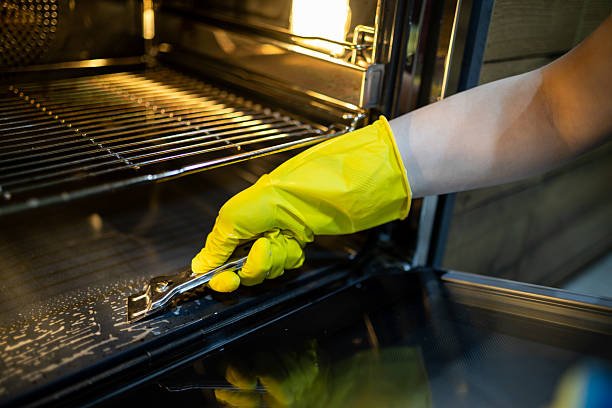
Does a deep clean include oven cleaning?
Sometimes.
Check before booking.
The outside of the oven and hob may be included while intensive internal oven cleaning is charged separately.
A heavily carbonised oven can take a substantial amount of time and may require specialist products or processes.
Ask specifically:
“Does the quoted price include cleaning inside the oven, trays and racks?”
That question is much clearer than asking whether “the kitchen” is included.
Does deep cleaning include windows?
Internal windows may be included by some cleaners, while others treat them as an extra.
Exterior windows are even more likely to be handled separately, particularly where specialist access or equipment is required.
Clarify:
inside glass
outside glass
frames
sills
rather than assuming the word “windows” means all four.
Does a deep clean include inside cupboards?
Again, it depends on the package.
Cleaning cupboard fronts is relatively straightforward.
Cleaning every cupboard internally requires significantly more time — especially if you expect the cleaner to remove and replace the contents.
Some cleaning companies will clean empty cupboard interiors as part of deep or end-of-tenancy packages but charge extra for occupied cupboards.
If this matters to you, include it when requesting the quote.
Does deep cleaning include moving furniture?
Usually only light, safely movable items.
A cleaner may vacuum underneath chairs and move relatively small furniture where practical.
Do not assume a domestic cleaning team will move extremely heavy wardrobes, beds or appliances.
There are safety and damage considerations.
If you want a specific large item moved, discuss it beforehand rather than expecting the cleaner to discover it when they arrive.
Why did my deep-clean quote increase after the cleaner arrived?
Often because the property’s actual condition differs from what was described.
Suppose you request a quote saying:
“Three-bedroom house, needs a deep clean.”
That tells the cleaner very little.
One three-bedroom home may need six labour hours.
Another might need 15.
Photographs can help.
Show the cleaner:
- kitchen;
- bathrooms;
- floors;
- difficult areas;
- heavy staining;
- clutter where relevant.
The more accurate the information, the more realistic the quotation.
Does clutter increase deep-cleaning cost?
Potentially, yes.
Cleaners need access to surfaces.
If every worktop, table and floor is covered with belongings, a substantial amount of time can be spent moving items before actual cleaning starts.
A cleaning service is also not automatically a professional decluttering or organising service.
You can save money by clearing obvious clutter yourself beforehand.
That allows the cleaner to spend paid time cleaning, rather than repeatedly moving your belongings from one surface to another.
Does pet hair cost extra?
It can.
Heavy pet hair embedded in upholstery and carpets requires much more labour than ordinary dust and loose debris.
Some cleaning businesses include normal pet-related cleaning within their hourly rate.
Others charge additional amounts for particularly difficult jobs.
If you have several pets or significant hair accumulation, mention this when booking.
Surprising the cleaner rarely leads to a cheaper invoice.
Does heavy limescale cost more?
Potentially.
Ordinary bathroom cleaning is different from removing substantial mineral deposits that have accumulated over a long period.
The cleaner may need more products and more labour.
Some severe deposits may not be fully removable without risking damage to the surface underneath.
A reputable cleaner should not promise that every old mark will disappear regardless of the material.
If your bathroom has significant limescale, include photographs when requesting a quote.
Can cleaners remove mould during a deep clean?
Some superficial mould or mildew on suitable cleanable surfaces may be addressed as part of cleaning, depending on the business.
But persistent mould is not simply a cleanliness problem.
It can be associated with condensation, ventilation problems, leaks or other moisture sources.
Cleaning the visible surface without addressing the cause may result in the mould returning.
If mould is extensive or repeatedly reappears, investigate why moisture is accumulating rather than simply booking increasingly aggressive cleaning.
Should cleaning products be included in the price?
Often, professional cleaning companies provide their own equipment and products.
Independent cleaners may sometimes expect you to supply certain items.
Neither arrangement is inherently wrong.
Just establish it beforehand.
Ask:
Do you bring all cleaning products and equipment?
If not, request a list.
A cheaper hourly rate may become less attractive if you need to purchase £40 of specialist cleaning products immediately before the appointment.
Is VAT included in deep-cleaning quotes?
It depends on the business.
A VAT-registered company may quote prices either inclusive or exclusive of VAT depending on how the quotation is presented.
For household customers, always ask for the total amount you will actually pay.
Do not compare a £180 inclusive price with a £170 price that later has VAT added.
The same principle applies to virtually every home service.
Is it cheaper to hire an independent cleaner?
Potentially.
Current 2026 UK guidance gives approximately £25 per hour for an independent cleaner, compared with around £25–£30 per hour through an agency for ordinary house cleaning.
Deep-cleaning prices can differ because specialist work and equipment may be involved.
An agency or cleaning company may also provide advantages such as:
- multiple cleaners;
- replacement staff;
- business insurance;
- specialist equipment;
- easier scheduling.
An independent cleaner can still provide excellent service.
Compare experience, scope and total cost rather than deciding purely according to business structure.
Can two cleaners make a deep clean cheaper?
Not necessarily cheaper, but potentially quicker.
Two cleaners working three hours provide six labour hours.
One cleaner working six hours also provides six labour hours.
The total labour cost may therefore be similar.
The advantage of a team is that your home can be completed much faster.
This can matter when preparing for:
- guests;
- moving day;
- property viewings;
- tenancy checkout.
Always ask whether a quoted hourly rate is per cleaner.
That detail can make a major difference to the calculation.
Is deep cleaning worth paying for?
It can be, particularly where the property needs a significant reset rather than routine maintenance.
A professional deep clean can be especially useful:
- before starting regular cleaning;
- after a busy period;
- before hosting an event;
- after moving into a property;
- before selling;
- when preparing to move out;
- after certain building works;
- where kitchens and bathrooms need intensive attention.
But you do not necessarily need to deep-clean professionally every month.
Once the home has been thoroughly cleaned, regular maintenance can usually keep it in much better condition at lower cost.
How often should you deep clean your house?
There is no universal timetable.
A household with children and pets may need detailed cleaning more frequently than a lightly occupied home.
Many people choose a deeper clean:
- seasonally;
- once or twice per year;
- before or after major events;
- when beginning regular cleaning;
- when moving.
The most efficient approach is to clean based on condition.
If weekly maintenance is keeping the house in excellent shape, paying for an intensive deep clean every few months may add little value.
Is it cheaper to deep clean yourself?
Financially, usually yes.
Your main cost will be cleaning products, equipment and your time.
A full-house deep clean can easily consume most of a day or an entire weekend, particularly if you are cleaning alone.
Professional cleaning becomes valuable because you are buying:
- labour;
- experience;
- equipment;
- speed;
- convenience.
If two professional cleaners can complete the job while you work or take care of other responsibilities, the value may justify the expense even though DIY has a lower direct cost.
How can you reduce the cost of a professional deep clean?
The easiest saving is preparation.
Before the cleaners arrive:
- remove obvious rubbish;
- put away clothes and personal items;
- clear kitchen worktops where possible;
- move small clutter from floors;
- wash dishes;
- identify priority areas.
Do not spend professional cleaning time on tasks you can complete in minutes yourself.
You can also ask for a priority-based clean if your budget is limited.
For example, instead of deep-cleaning an entire four-bedroom house, you might concentrate on:
kitchen + bathrooms + living room.
Bedrooms that are already tidy could receive a normal clean.
Should you get multiple quotes?
For a larger one-off deep clean, yes.
But give every cleaner the same information.
If one company thinks you want carpets extracted and another thinks you only want vacuuming, their quotes are not comparable.
Tell them:
- property size;
- number of bathrooms;
- current condition;
- whether it is furnished;
- whether pets live there;
- appliance cleaning required;
- carpets/upholstery required;
- windows required;
- preferred date.
Then compare the actual service.
What should you ask before booking a deep cleaner?
The single most useful question is:
“Can you send me a list of exactly what is included for the quoted price?”
Then confirm:
- hourly or fixed price;
- number of cleaners;
- estimated duration;
- oven;
- fridge/freezer;
- inside cupboards;
- windows;
- carpets;
- upholstery;
- products/equipment;
- VAT where applicable;
- any minimum booking fee.
This removes most of the ambiguity around the phrase deep clean.
How much should you budget for a deep clean?
For a typical UK property in 2026, £160–£325 is a reasonable broad starting budget for a professional deep clean, with current marketplace data averaging around £227.
If you are being charged hourly, current guidance suggests around £25–£37 per hour, averaging £31.
A smaller, tidy property may cost less.
A large or particularly dirty home can cost substantially more.
The smartest way to budget is therefore:
hourly rate × estimated cleaner-hours + any specialist extras.
That calculation tells you far more than the hourly rate alone.
Deep cleaning cost UK: the verdict
So, how much does a deep clean cost in the UK?
In 2026, current UK pricing suggests around £25–£37 per hour, with an average rate close to £31. A typical whole-property deep clean can cost roughly £160–£325, with an average around £227, although property size and condition can move the final price significantly.
Before booking, decide what you actually mean by deep cleaning.
Do you expect the oven cleaned internally?
The fridge?
Carpets shampooed?
Inside cupboards?
Windows?
Those details determine whether two quotes represent the same service.
If your home needs a thorough one-off clean, you can find local cleaners and deep-cleaning professionals through The Right Guy. Tell the cleaner the size and condition of your property and ask for a clear list of what’s included so you can compare quotes properly before booking.

Author: The Right Guy Team
UK service guides published by The Right Guy Ltd.