
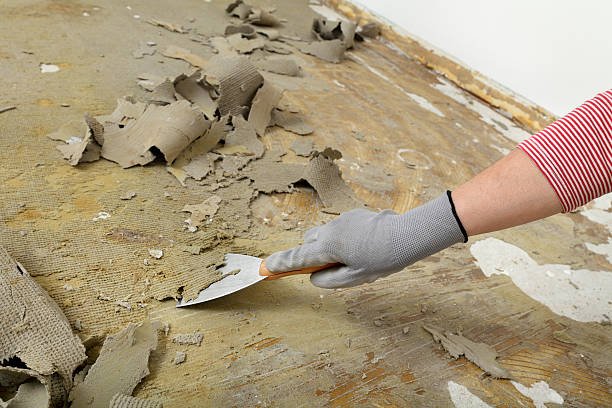
Artex and other textured coatings were once extremely common on UK ceilings and walls. Today, many homeowners want the swirls, stipples and fan patterns replaced with a smooth modern finish — especially during renovations.
The complication is that older textured coatings can contain asbestos.
That means the cost of removing Artex depends on more than the size of the ceiling. You first need to establish what the coating contains, how it will be disturbed and whether removal is even the best option.
So, how much does Artex removal cost in the UK in 2026?
For ordinary non-asbestos Artex, current UK estimates put removal at roughly £12–£50 per m² depending on the method, with simple steam removal towards the lower end and chemical stripping higher. Current MyJobQuote data puts many complete non-asbestos removal jobs around £250–£750.
If asbestos is confirmed, the cost can increase sharply. Current 2026 figures range from approximately £17–£127 per m² depending on the method and specification, while Checkatrade’s dedicated asbestos guide puts professional removal of an asbestos-containing Artex ceiling of around 20m² at approximately £2,750–£6,000.
As a practical starting point:
| Artex work | Typical UK cost |
|---|---|
| Non-asbestos steam removal | £14–£47 per m² |
| Non-asbestos chemical removal | £16–£50 per m² |
| Non-asbestos sanding/removal | £12–£23 per m² |
| Skim/plaster over existing Artex | Roughly £250–£700 for many rooms |
| Board over Artex | Roughly £400–£1,000 for many rooms |
| Asbestos-containing Artex removal | Roughly £17–£127 per m² depending on method |
| 20m² asbestos Artex ceiling removal | Around £2,750–£6,000 |
| Asbestos sample/testing | Often around £50–£100 per sample |
| Broader professional asbestos survey | Often around £200–£350+ |
The huge variation is not an error.
There is a major difference between skimming over a sound textured ceiling, chemically removing non-asbestos Artex and carrying out controlled work on a confirmed asbestos-containing coating.
What Is Artex?
Artex is a trade name that became commonly associated with textured decorative wall and ceiling finishes.
The Health and Safety Executive describes textured coatings as hard decorative finishes used on ceilings and walls, often in peaks, swirls or other patterns. Various trade names were used over the years, including Artex.
These finishes became particularly popular because they could:
- create decorative patterns;
- hide imperfect plaster;
- disguise minor surface defects;
- avoid the need for an absolutely flat plaster finish.
Modern textured coatings do not need to contain asbestos.
The issue concerns older materials.
Does Artex Contain Asbestos?
Some older textured coatings do.
Asbestos was historically incorporated into certain decorative coatings, so you should not assume an old textured ceiling is safe to sand or scrape simply because it looks like ordinary plaster.
The HSE specifically lists textured decorative coatings, commonly referred to as Artex, among materials in which asbestos may be found.
Asbestos was fully prohibited in the UK in 1999. Therefore, textured coatings installed before 2000 deserve particular caution if their composition is unknown.
The appearance alone cannot reliably tell you whether asbestos is present.
Two ceilings can look almost identical while one contains asbestos and the other does not.
That means testing is often the sensible first step before destructive removal.
How Much Does Asbestos Testing for Artex Cost?
Current UK market pricing puts laboratory asbestos testing at around £50–£100 per sample in many cases.
A more extensive professional survey naturally costs more.
Current Checkatrade Artex-removal guidance uses indicative figures of approximately:
£250 for a one- or two-bedroom flat
and around:
£350 for larger houses
for an asbestos survey.
The correct approach depends on what you are planning.
If you simply need one suspect ceiling checked, targeted sampling may be enough.
If you are undertaking significant renovation work throughout an older property, a more comprehensive survey may be appropriate.
HSE guidance says refurbishment and demolition surveys are designed to locate asbestos-containing materials that could be disturbed during major work.
Spending a relatively small amount identifying the material before starting can prevent a much more serious and expensive mistake later.
Non-Asbestos Artex Removal Cost
If testing confirms that the coating does not contain asbestos, you have several options.
Steam removal
Current 2026 MyJobQuote pricing puts non-asbestos steam removal around:
£14–£47 per m²
or approximately:
£250–£700 for many complete jobs.
Steam softens the coating before it is scraped from the surface.
The difficulty depends heavily on:
- coating thickness;
- how many times it has been painted;
- the substrate underneath;
- age;
- area.
Chemical removal
Chemical stripping products can soften textured coatings so they can be scraped away.
Current pricing is around:
£16–£50 per m²
with complete jobs commonly around:
£280–£750.
Checkatrade’s older but still useful specialist estimate puts chemical Artex removal at approximately £22.60–£32.54 per m².
Chemical removal can be useful where direct mechanical removal would be difficult, but the job remains labour-intensive.
Sanding
Where the coating is confirmed asbestos-free and the substrate is suitable, sanding may sometimes be used.
Current MyJobQuote pricing puts this at approximately:
£12–£23 per m², or roughly £220–£350 for some typical jobs.
Do not sand a suspect textured coating before you know it is asbestos-free.
Sanding is exactly the type of process that can generate fine airborne dust.
How Much Does Asbestos Artex Removal Cost?
Once asbestos is confirmed, the project needs to be treated differently.
Current 2026 MyJobQuote figures put asbestos-containing Artex work at approximately:
| Method | Approximate cost |
|---|---|
| Steam removal | £17–£107 per m² |
| Chemical removal | £18–£110 per m² |
| Sealing/encapsulation | £19–£67 per m² |
| Plaster over | £17–£97 per m² |
| Boarding over | £25–£127 per m² |
Checkatrade’s current asbestos-removal guide gives an even more useful real-world benchmark for complete controlled removal:
approximately £2,750–£6,000 for a 20m² Artex ceiling containing asbestos.
Why such a difference from ordinary removal?
Because asbestos work can require:
- specialist risk assessment;
- controlled working methods;
- respiratory protection;
- protective clothing;
- restricted access;
- special cleaning procedures;
- compliant waste packaging;
- hazardous-waste transport and disposal;
- additional administrative requirements.
You are no longer simply paying someone to make the ceiling smooth.
You are paying for controlled work with a hazardous material.
Does Asbestos Artex Always Need a Licensed Asbestos Contractor?
Not necessarily — and this is an important distinction.
The HSE classifies many tasks involving asbestos-containing textured decorative coatings as non-licensed asbestos work, provided the material and method meet the relevant conditions and workers are appropriately trained.
However, some work becomes notifiable non-licensed work (NNLW).
For example, HSE states that large-scale removal of textured decorative coatings using steaming or gelling methods is normally notifiable non-licensed work.
Higher-risk situations can require licensed asbestos contractors — for example where a textured coating covers asbestos insulating board or where more hazardous asbestos materials are involved.
So the correct rule is not simply:
“Artex contains asbestos = licensed contractor automatically required.”
It depends on:
- asbestos material;
- condition;
- extent of disturbance;
- removal method;
- scale of work.
For a homeowner, the practical answer is still straightforward: use a competent professional who understands asbestos regulations and can determine the correct classification before work begins.
Can You Leave Asbestos Artex in Place?
Yes, potentially.
Asbestos-containing material does not automatically need removing merely because it exists.
If it is in good condition and unlikely to be disturbed, leaving it in place or encapsulating it can sometimes be the safer and cheaper approach.
Current Checkatrade asbestos pricing puts encapsulation at around £33 per m² on average.
HSE also lists encapsulation and sealing of asbestos-containing materials in good condition among lower-risk forms of non-licensed asbestos work.
This matters if your only problem with the ceiling is aesthetic.
You may not need to physically strip every millimetre of textured coating away to achieve a flat modern ceiling.
Is It Cheaper to Plaster Over Artex?
Often, yes.
Skimming can avoid the labour involved in stripping the entire coating.
Current Checkatrade guidance puts plastering over Artex at approximately:
£9.65–£31.71 per m² in its Artex-removal cost model.
Its current general plaster-skimming data puts a medium 3m × 3m room at around:
£430–£550, with roughly £480 a useful mid-point.
That means a homeowner faced with:
£3,000+ asbestos removal
may understandably investigate whether the existing coating can be safely sealed and overboarded or skimmed instead.
But there is an important caveat.
The substrate needs to be suitable.
A plasterer should assess:
- whether the coating is securely bonded;
- whether the ceiling is sagging;
- existing cracks;
- condition of the plasterboard;
- thickness of the texture;
- asbestos status.
Simply covering a failing ceiling does not fix the underlying problem.
How Much Does It Cost to Skim Over an Artex Ceiling?
For a medium-sized room, roughly £430–£550 is a useful current plaster-skimming benchmark, with the Artex preparation potentially pushing it slightly higher than a straightforward smooth ceiling.
If you’re considering this route, our full guide to how much it costs to plaster a room in the UK covers current plastering and skimming prices in more detail.
A plasterer may first need to:
- remove loose high points where safe;
- seal or prime the surface;
- apply a bonding product;
- apply finishing plaster.
The exact method depends on the existing ceiling.
Where asbestos is suspected or confirmed, any preparation that would disturb it needs to follow the appropriate asbestos precautions.
How Much Does It Cost to Board Over Artex?
Overboarding means installing new plasterboard beneath the existing textured ceiling and then plastering the new board.
Current MyJobQuote 2026 estimates put boarding over Artex around:
£400–£1,000 for non-asbestos situations
and:
£450–£2,000 where asbestos-containing Artex is involved, depending on area and specification.
Checkatrade’s detailed material model gives approximately:
£16.59–£18.90 per m² for plasterboard
plus about:
£18.81 per m² for a plaster finish.
Overboarding can be attractive where:
- the ceiling is difficult to skim directly;
- the texture is extremely deep;
- the existing finish needs encapsulating;
- you want a completely new smooth substrate.
The trade-off is that you slightly reduce the ceiling height, although usually only by a small amount.
Removal vs Skimming vs Overboarding: Which Is Cheapest?
For a sound ceiling, the rough order is often:
Skimming / encapsulation → overboarding → complete controlled asbestos removal
from least to most expensive.
Consider a 20m² ceiling.
Option 1: skim over
Potentially several hundred pounds depending on condition.
Option 2: overboard and plaster
Potentially around £600–£1,000+ depending on specification.
Option 3: asbestos-containing Artex removal
Current Checkatrade benchmark:
£2,750–£6,000.
That is a huge cost difference.
But cost cannot be the only consideration.
Removal may be preferable where:
- the coating is damaged;
- future structural work will disturb it;
- the ceiling itself needs replacing;
- you are carrying out extensive renovation;
- managing the asbestos in place would complicate future works.
Encapsulation can make better financial sense when the material is stable and the only objective is a smoother appearance.
What Makes Artex Removal More Expensive?
Asbestos
This is the biggest cost factor.
Confirmed asbestos fundamentally changes how the job must be managed.
Size of the area
Removing 8m² from a small bedroom is obviously cheaper than removing textured coatings throughout an entire three-bedroom house.
Ceiling vs walls
Ceiling work is generally more awkward because tradespeople work overhead.
Coating thickness
Deep peaks and heavily textured finishes take longer to remove or cover.
Multiple layers of paint
Years of repainting can make the coating harder to soften and remove.
Surface underneath
If the original plaster or plasterboard is damaged during removal, extra repair work follows.
Access
High ceilings, stairwells and awkward landings increase labour and access requirements.
Waste
Asbestos-containing waste requires controlled disposal.
Location
Labour prices vary considerably across the UK.
London and the South East are generally more expensive.
How Much Does Artex Removal Cost for One Room?
For a straightforward non-asbestos ceiling, approximately £250–£750 is a realistic range depending on method and size.
If the coating contains asbestos, a typical room can cost substantially more.
MyJobQuote gives a broad average of around £1,500 for asbestos Artex removal, while Checkatrade’s 20m² ceiling benchmark is approximately £2,750–£6,000.
The discrepancy demonstrates just how important the removal method and job specification are.
Ask whether the quote includes:
- testing;
- removal;
- waste;
- reinstatement;
- plastering;
- decorating.
A £1,500 asbestos-removal quote that leaves an unfinished ceiling is not directly comparable with a £3,000 quote that includes controlled removal and complete reinstatement.
What About Removing Artex From a Whole House?
This can become a significant renovation expense.
Imagine four rooms plus a hallway containing textured ceilings.
Even without asbestos, several days of:
- removal;
- preparation;
- plastering;
- decorating
can push the project into thousands of pounds.
With confirmed asbestos, costs can rise much more sharply.
This is where renovation budgeting becomes important.
A property that looks like it only needs:
new kitchen + paint + flooring
can suddenly reveal:
asbestos testing + controlled Artex work + new ceilings + plastering + decorating.
That is exactly the kind of unexpected expenditure covered in our guide to hidden renovation costs that can blow your budget.
Older properties especially need contingency money.
Should You Remove Artex During a Renovation?
Sometimes it makes sense to deal with it while other work is already happening.
For example, if:
- rooms are empty;
- electricians are altering ceiling wiring;
- plastering is already planned;
- ceilings need repairs;
- you are replacing lighting;
dealing with the textured finish at the same time can avoid reopening the room later.
But do not automatically remove asbestos-containing material purely because you’ve discovered it.
If it can safely remain encapsulated and undisturbed, removal may not offer enough benefit to justify the cost.
This is why professional advice before demolition is valuable.
Can You Remove Artex Yourself?
If it is confirmed not to contain asbestos, DIY removal is technically possible.
But it can be:
- messy;
- slow;
- physically tiring;
- difficult overhead.
You also risk damaging the plasterboard beneath.
Where asbestos may be present, do not begin scraping, sanding or drilling simply to “see how easily it comes off”.
The HSE advises people who are not trained for non-licensed asbestos work not to attempt asbestos repair or removal themselves.
That is especially important with sanding.
Fine dust is exactly what you want to avoid generating when the composition of the coating is unknown.
Why Sanding Suspect Artex Is a Bad Idea
Imagine the surface contains asbestos.
Dry sanding converts a bonded decorative finish into huge quantities of fine dust.
That is fundamentally different from leaving the coating intact.
The HSE’s asbestos guidance is based heavily on reducing fibre release by controlling how asbestos-containing materials are disturbed.
If the coating has not yet been tested, treat it as suspect rather than assuming:
“It’s probably fine.”
Testing costs very little compared with the consequences of uncontrolled disturbance.
Do You Need an Asbestos Survey Before Plastering Over Artex?
It can be sensible because plaster preparation may disturb the textured coating.
Even where the final plan is encapsulation, tradespeople need to know what they are working with so they can select an appropriate method.
Checkatrade recommends determining asbestos status before Artex repair or removal work.
For larger refurbishment work, HSE guidance becomes even clearer: refurbishment surveys should identify asbestos-containing materials that could be disturbed by the planned works.
If the ceiling is from an older property and its history is unknown, spend the money identifying it before someone starts scraping high points off.
Does Asbestos Artex Need Removing Before Selling a House?
Not automatically.
The presence of asbestos-containing material does not automatically make a property unmortgageable or require immediate removal.
Condition and management matter.
A stable textured coating that remains sealed and undisturbed is a very different situation from damaged asbestos-containing material falling from a ceiling.
However, known asbestos can affect:
- buyer confidence;
- renovation plans;
- surveys;
- negotiations.
If you are selling, having accurate information about what was tested and what work has been undertaken can be much more useful than vague statements such as:
“We think it’s asbestos.”
Keep survey reports and contractor documentation.
Can You Paint Over Artex?
Yes, if the ceiling is stable and you simply want to refresh the appearance.
Painting does not create a smooth finish.
The pattern will remain.
But where asbestos-containing Artex is in good condition, leaving it sealed and undisturbed can sometimes be preferable to unnecessary removal.
HSE lists encapsulation and sealing as recognised approaches for asbestos-containing materials that are in good condition.
If you hate the texture rather than the colour, overboarding or skimming will normally produce a much bigger visual improvement.
Is Artex Removal Worth It?
It depends on why you’re doing it.
It can be worthwhile when:
- you strongly prefer smooth ceilings;
- the coating is damaged;
- significant renovation will disturb it;
- you need to replace the ceiling anyway;
- you want to remove a known asbestos material rather than manage it long term.
It may be poor value when:
- the coating is stable;
- it contains asbestos;
- you only dislike the appearance;
- safe encapsulation and skimming can achieve the same visual result for far less.
Spending £4,000 removing an otherwise stable ceiling merely to replace it with a smooth one may not be the smartest use of a limited renovation budget.
Our guide to renovating on a budget without cutting the wrong corners explains the broader principle: save money by changing the specification intelligently, not by compromising safety.
Choosing safe encapsulation instead of unnecessary asbestos disturbance can be exactly that kind of decision.
How Long Does Artex Removal Take?
For an ordinary room, non-asbestos Artex removal often takes around one to two days depending on method.
Current MyJobQuote guidance gives:
- steam removal: 1–2 days for simpler non-asbestos jobs;
- chemical removal: 1–2 days;
- plastering over: 1–2 days;
- boarding over: 1–2 days.
Asbestos work can take longer because of the additional controls and preparation.
Larger multi-room projects can extend towards a week or more.
And remember: removal is not necessarily the end.
You may then need:
- plastering;
- drying;
- sanding;
- mist coating;
- painting.
The room may be disrupted significantly longer than the removal phase alone suggests.
What Happens After the Artex Is Removed?
The surface underneath is unlikely to be ready for painting immediately.
Depending on the removal method, you might be left with:
- plasterboard;
- old plaster;
- adhesive residue;
- damaged areas;
- uneven surfaces.
The next stage can involve:
- repairs;
- plaster skim;
- drying;
- mist coat;
- finish paint.
This is why an apparently cheap removal quote can become expensive once you add reinstatement.
Ask for the finished-ceiling cost, not only the stripping cost.
How to Get an Accurate Artex Removal Quote
Before contacting contractors, gather:
- approximate ceiling dimensions;
- photographs;
- age of the property;
- whether the coating has been tested;
- any asbestos report;
- whether the ceiling is cracked or sagging;
- whether you want removal or simply a smooth finish.
For example:
“I have a textured ceiling approximately 4m × 4m in a 1970s house. It has not been tested for asbestos. I want a smooth painted ceiling. Please quote for the safest suitable option and explain whether testing is required first.”
That gives the professional much more useful information than:
“How much to remove Artex?”
Questions to Ask Before Hiring Someone
Ask:
Has the coating been tested for asbestos?
If not, should it be tested before work begins?
Are you proposing removal, encapsulation, skimming or overboarding?
Why is that method suitable?
If asbestos is present, how is the work classified?
Do you have the appropriate asbestos training and competence for this work?
Does the quotation include hazardous-waste disposal where applicable?
Will the finished ceiling be ready for decorating?
Is plastering included?
Is decorating included?
What happens if the plasterboard beneath is damaged?
Is VAT included where applicable?
For asbestos-related work, method and competence matter far more than simply finding the cheapest person with a scraper.
Frequently Asked Questions
How much does Artex removal cost in the UK?
For non-asbestos Artex, current 2026 pricing commonly ranges from around £12–£50 per m², depending on the removal method. Many standard room jobs cost approximately £250–£750.
Asbestos-containing Artex can cost substantially more.
How much does asbestos Artex removal cost?
Current figures vary widely. MyJobQuote gives approximately £17–£127 per m² depending on the method, while Checkatrade’s current asbestos guide puts a 20m² Artex ceiling at around £2,750–£6,000 for professional removal.
How much does it cost to test Artex for asbestos?
Individual samples often cost around £50–£100, while broader professional surveys can cost a few hundred pounds.
Is all Artex asbestos?
No.
Some older textured coatings contained asbestos, while modern products do not. The appearance alone cannot reliably confirm whether asbestos is present.
Is it cheaper to skim over Artex?
Usually.
Current general skimming costs are around £430–£550 for a medium 3m × 3m room, and covering a sound Artex surface can often cost far less than complete removal.
Can you plaster over asbestos Artex?
Potentially, because encapsulation can be an accepted way of managing asbestos-containing materials in good condition. However, the work must be assessed properly and any preparation must avoid uncontrolled disturbance.
Does asbestos Artex have to be removed?
No. Stable asbestos-containing material can sometimes remain in place and be managed or encapsulated rather than removed.
Can I remove Artex myself?
Only consider DIY removal once you know the coating does not contain asbestos and you understand the work involved.
The HSE advises people who are not trained in non-licensed asbestos work not to attempt asbestos removal themselves.
Does asbestos Artex require a licensed contractor?
Not in every case. HSE classifies many textured-coating tasks as non-licensed work, while larger-scale removal can become notifiable non-licensed work. Certain higher-risk situations can require a licensed contractor.
How long does Artex removal take?
A simple room can take around one to two days, while asbestos work or multiple rooms can take significantly longer. Plastering and decorating afterwards add additional time.
So, How Much Should You Budget for Artex Removal?
For a straightforward non-asbestos textured ceiling in 2026, a sensible starting budget is roughly:
£250–£750 for many single-room removal jobs
or approximately:
£12–£50 per m² depending on the method.
If asbestos is confirmed, expect the cost to increase substantially. A useful current benchmark for complete professional removal of a 20m² asbestos-containing Artex ceiling is around £2,750–£6,000.
But complete removal is not always the best-value solution.
If the coating is stable and the objective is simply to create a modern smooth ceiling, encapsulation, skimming or overboarding may achieve the result with substantially less disturbance and cost.
The correct order is therefore:
identify the material → assess its condition → choose the safest appropriate method → price the finished ceiling, not just the removal.
And if your renovation budget is already tight, do not assume the cheapest destructive method is the smartest one. Asbestos is exactly the type of renovation issue where spending a little on proper investigation first can prevent a very expensive mistake later.
If you need professional help, The Right Guy can help you discover local plasterers, decorators and other property professionals. For suspected asbestos-containing coatings, make sure the person undertaking the work has the appropriate competence for the specific type of asbestos work involved.

Author: The Right Guy Team
UK service guides published by The Right Guy Ltd.