
Hallway Paint Ideas: 15 Colours and Schemes That Make an Entrance
The hallway is usually the first part of your home anyone sees, yet it’s often one of the last rooms we think about decorating.
And hallways can be awkward.
They’re often narrow, short on natural light and full of doors, which means a colour that looks beautiful in a bright living room can look completely different in your entrance hall.
The good news is that you don’t have to automatically reach for white.
From warm neutrals and earthy browns to dramatic charcoal and soft green, here are 15 hallway paint ideas and practical ways to choose a colour that works with your space.
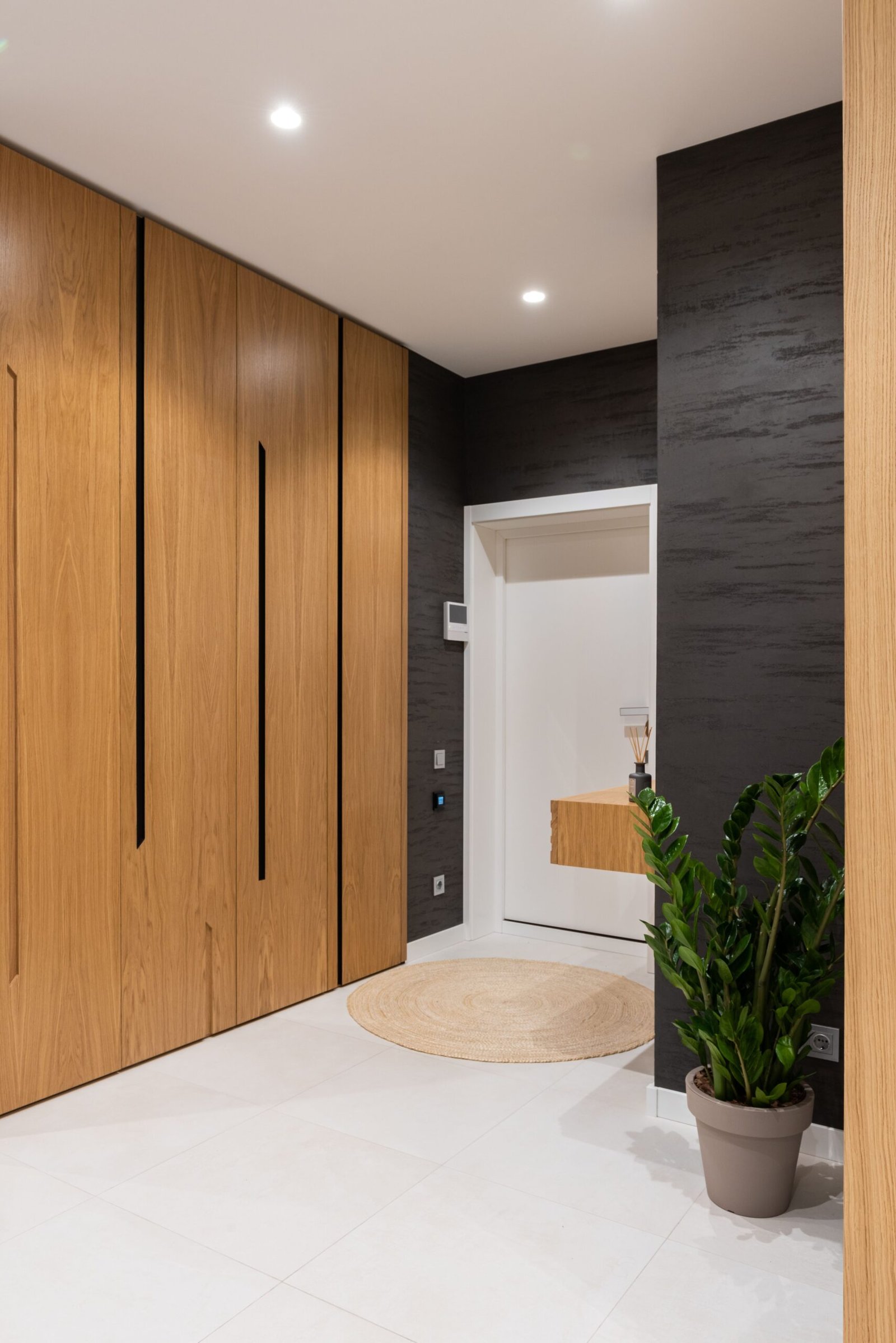
1. Charcoal walls with warm oak

The dark charcoal creates depth, while the large oak cupboards introduce warmth.
The white floor, ceiling and door stop the whole space from becoming excessively dark.
This combination works particularly well if you want a contemporary hallway:
Charcoal + oak + white + natural green
2. Warm white with walnut

If your hallway already contains a lot of timber, you may not need a strong wall colour at all.
Warm white provides a clean background without competing with the wood.
Notice how much colour is actually coming from the doors, flooring and decorative wall panels.
That’s worth remembering when choosing paint: your walls are only one part of the colour scheme.
3. Soft white, taupe and natural wood
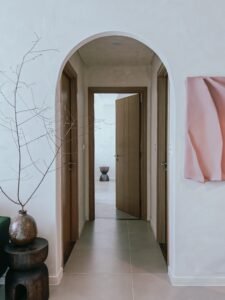
This is a softer alternative to a traditional white hallway.
The palette is essentially:
Soft white + taupe + medium wood + muted brown
It’s especially effective if you like warm minimalist interiors.
The arched opening also demonstrates how architectural details can provide interest even when the colour scheme itself is restrained.
4. Greige for a small entrance hall
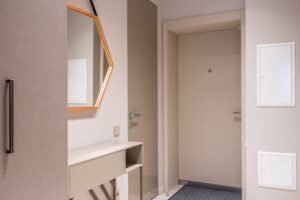
Greige — somewhere between grey and beige — is useful in hallways because it’s extremely easy to coordinate.
Here, several very similar neutral shades prevent the small entrance from looking busy.
This approach works especially well where you have lots of doors, cupboards and other interruptions to the walls.
5. Warm white
White is the obvious hallway colour for a reason.
It reflects available light and provides a neutral backdrop for almost everything.
But there’s an important distinction between brilliant white and warm white.
If your flooring, doors or furniture contain warm timber, a slightly creamy or warm white will often sit more comfortably beside them than a very blue-toned white.
Try it with:
Oak + warm white + black details
or
Walnut + warm white + brass.
6. Soft beige
Beige is useful when white feels too clinical but you still want the hallway to remain bright.
Rather than yellow-heavy beige, look at softer shades influenced by stone, sand and oatmeal.
These work particularly well with:
- Natural timber
- Travertine
- Cream
- Black accents
- Brass
- Woven accessories
The result can feel much warmer than a conventional grey hallway.
7. Greige
If you can’t decide between grey and beige, greige gives you something in the middle.
It’s particularly practical if your hallway connects several rooms with different colour schemes.
Because it’s relatively neutral, it can act as a transition between them rather than introducing another dominant colour.
8. Sage green
Green is one of the easiest colours to bring into an entrance hall.
Muted sage works beautifully alongside wood and natural materials.
Try:
Sage walls + oak console + cream runner + brass mirror.
If you don’t want green across the entire hallway, use it on the lower portion of the wall with a lighter neutral above.
9. Olive green
Olive gives you considerably more depth than sage.
It can work especially well in period properties, where stronger colour often suits traditional mouldings, panelling and deeper skirting boards.
Pair it with warm white rather than icy white to soften the contrast.
Dark timber and aged brass can make the combination even richer.
10. Deep blue
A hallway doesn’t necessarily need to look larger.
Sometimes embracing a narrow space creates a much stronger result.
Deep navy or inky blue can make an entrance feel intentionally dramatic.
Keep some lighter elements — perhaps the ceiling, flooring or woodwork — if you want stronger contrast.
Alternatively, take the colour across the walls, doors and trim for a more enveloping effect.
11. Terracotta
Terracotta brings immediate warmth.
You don’t have to use a particularly strong orange shade either.
Look for muted clay, cinnamon or plaster-inspired colours.
They pair naturally with:
Cream + oak + walnut + rattan + warm metals.
Terracotta is particularly useful for north-facing spaces where colder colours can sometimes appear even cooler.
12. Chocolate brown
Brown has become an interesting alternative to dark grey.
Deep chocolate can look surprisingly sophisticated in a hallway, especially with white ceilings and warm timber.
If painting every wall feels excessive, use chocolate on one end wall, panelling or built-in cabinetry.
13. Dusty pink
Pink doesn’t have to make a hallway feel childish.
Muted plaster, dusty rose and brownish pinks behave almost like warm neutrals.
Combine them with dark wood, cream and brass rather than bright white for a more sophisticated palette.
14. Colour drenching
Instead of choosing one colour for the walls and automatically painting every door, skirting board and architrave white, consider using the same colour across several surfaces.
This is commonly known as colour drenching.
Using one shade — or closely related shades — across the walls and woodwork can reduce the visual clutter created by lots of doorframes.
That’s particularly useful in hallways, where you may have four or five doors within a relatively small area.
15. Two-tone hallway walls
A two-colour treatment can also work well.
For example:
Dark green below + warm white above
Taupe below + cream above
Navy below + pale greige above
The darker lower section can visually ground the hallway while the lighter upper portion keeps things brighter.
It’s also a natural option if your hallway already has dado rails or wall panelling.
Best hallway colour combinations
| Style | Colour combination |
|---|---|
| Contemporary | Charcoal + oak + warm white |
| Warm minimalist | Greige + walnut + cream |
| Natural | Sage + oak + warm white |
| Dramatic | Navy + walnut + brass |
| Earthy | Terracotta + cream + oak |
| Traditional | Olive + warm white + dark timber |
| Soft neutral | Oatmeal + taupe + oak |
| Sophisticated | Chocolate + ivory + walnut |
| Subtle colour | Dusty pink + cream + dark wood |
What colour makes a narrow hallway look wider?
If making the hallway appear more open is your priority, lighter colours are usually the easiest starting point.
Consider:
Warm white, cream, pale greige, light beige or very soft sage.
But don’t expect paint alone to transform the dimensions of the room.
Lighting, mirrors, flooring direction and visual clutter can have a substantial effect too.
A large mirror can be particularly useful because it reflects both light and the surrounding space.
What is the best colour for a dark hallway?
There’s an interesting choice to make here.
You can either try to brighten the space or deliberately embrace its darkness.
For the first approach, choose warm whites, pale neutrals and reflective finishes.
For the second, consider charcoal, forest green, navy or chocolate.
A deliberately dark hallway can look much more intentional than a naturally dark hallway painted in a pale colour that never receives enough light to look bright anyway.
Should the hallway be the same colour as the living room?
Not necessarily.
However, because hallways connect multiple rooms, it’s useful to think about how the colours look together.
They don’t need to match.
They simply shouldn’t feel completely disconnected.
For example, a warm greige hallway can transition easily into a green living room, cream kitchen and muted blue bedroom because the undertones remain relatively soft.
Should hallway doors be white?
No.
White doors create contrast and are easy to coordinate, but they’re far from your only option.
You could:
Paint the doors the same colour as the walls
Choose natural timber doors
Paint them darker than the walls
or
Use the doors as an accent colour.
If your hallway contains lots of doors, matching them to the wall colour can actually make the space look calmer.
What hallway colours hide marks?
Hallways are high-traffic areas.
Very pale colours can show scuffs, fingerprints and marks more easily, particularly around switches and doorways.
Mid-tone colours such as taupe, muted green, greige and some warmer neutrals can be more forgiving.
However, the paint finish matters just as much as the colour.
Choose a durable, washable interior paint appropriate for busy areas rather than selecting your colour purely because you hope it will hide dirt.
Don’t choose your hallway paint in another room
This is one of the easiest decorating mistakes to make.
A paint colour you love beside a sunny living-room window may behave completely differently in a hallway with almost no natural light.
Put samples on several walls.
Then check them:
In the morning
During the afternoon
With the hallway lights switched on
A neutral can suddenly appear much warmer, cooler, greener or greyer depending on the light.
Remember the floor
Before choosing your hallway paint, look down.
Your flooring occupies a huge visual area.
Warm oak, cool grey tile, patterned Victorian flooring and beige carpet will each interact differently with exactly the same wall colour.
If the floor has a strong warm undertone, your paint doesn’t necessarily have to match it, but the two should look intentional together.
Frequently Asked Questions
What hallway colours are popular in 2026?
Warm neutrals, earthy browns, muted greens and richer colours such as burgundy, navy and chocolate fit the broader move towards warmer and more characterful interiors.
What is the safest hallway colour?
Warm white, pale greige and soft beige are among the easiest colours to coordinate because they work with a wide range of flooring, furniture and adjoining rooms.
Can I paint a small hallway dark?
Absolutely. Dark paint won’t physically make the hallway smaller. It will change how the boundaries of the room are perceived, however, so good artificial lighting becomes particularly important.
Should the ceiling match hallway walls?
It can. Keeping the ceiling white creates clear contrast and can make the ceiling feel visually distinct. Taking the wall colour onto the ceiling produces a more enveloping effect.
Is grey still suitable for hallways?
Yes, although you may want to introduce warmer elements such as oak, walnut, cream, brass or natural textiles if the space is beginning to feel cold.
Final thoughts
Your hallway doesn’t need to be the most neutral part of your home simply because it connects everything else.
It can be.
But it can also be the place where you introduce charcoal, olive, navy, terracotta or even chocolate brown.
The important part is considering the entire space — flooring, doors, lighting, furniture and adjoining rooms — rather than choosing a wall colour in isolation.
And whatever shade you choose, test it in the actual hallway first.
Hallway lighting can change a colour dramatically.
Need help decorating your hallway?
If your hallway needs more than a tin of paint, The Right Guy can help you find local painters, decorators, carpenters and other tradespeople for your project.