
Car Valeting vs Car Detailing: What’s the Difference?
Car valeting vs car detailing can sound like two names for exactly the same thing.
Both involve cleaning a vehicle. Both can improve how the interior and exterior look. And many businesses use the terms differently, which makes the distinction even more confusing.
In practice, though, there is usually an important difference.
A car valet is mainly focused on cleaning and presenting the vehicle. A car detail normally goes further, using more intensive cleaning, restoration and protection techniques to improve the condition of individual surfaces.
A valet might leave your car clean, vacuumed and presentable in a couple of hours. A detail can involve paint decontamination, machine polishing, deep interior work and protective coatings, potentially taking a full day or even several days.
Neither is automatically better.
The right option depends on the condition of your vehicle, how much you want to spend and what result you actually expect.
Here is a complete comparison of car valeting vs car detailing, including what each service normally includes, typical UK costs and when it is worth paying extra for detailing.
Car valeting vs car detailing at a glance
| Car valeting | Car detailing | |
|---|---|---|
| Main purpose | Cleaning and presentation | Cleaning, restoration and protection |
| Exterior wash | Yes | Yes |
| Interior vacuum | Usually | Usually |
| Upholstery cleaning | Depending on package | Often more intensive |
| Paint decontamination | Sometimes | Common |
| Machine polishing | Sometimes/basic | Common in higher-level packages |
| Paint correction | Usually no | Available |
| Ceramic coating | Usually no | Often available |
| Typical duration | Around 1–4 hours | Several hours to multiple days |
| Typical cost | Usually lower | Usually higher |
| Best for | Routine cleaning | Restoration, protection and higher-end finish |
These are general distinctions rather than legal definitions.
There is no UK rule saying a “full valet” must contain a particular list of services or that every “detail” must include machine polishing.
Always read the actual package description.
What is car valeting?
Car valeting is primarily about cleaning the vehicle inside and outside.
Depending on the package, a professional valet might include:
- exterior washing;
- wheel cleaning;
- tyre dressing;
- drying;
- interior vacuuming;
- dashboard and trim cleaning;
- window cleaning;
- mats;
- boot vacuuming;
- upholstery cleaning;
- basic wax or paint protection.
A basic or mini valet may cover only the essentials.
A more comprehensive full valet can go much deeper, particularly inside the vehicle.
The overall objective is usually straightforward:
make the car clean, tidy and presentable again.
For a normally maintained family car, that may be everything you need.
What is car detailing?
Car detailing generally takes a more intensive and methodical approach.
A detailer is not simply trying to remove visible dirt. Depending on the service, they may also attempt to restore surfaces, correct paint defects and protect the vehicle afterwards.
An exterior detail could include:
- multi-stage washing;
- detailed wheel cleaning;
- tar removal;
- iron contamination removal;
- clay-bar or mechanical decontamination;
- machine polishing;
- paint correction;
- trim restoration;
- waxes, sealants or ceramic coatings.
An interior detail might involve:
- deep vacuuming;
- carpet extraction;
- upholstery shampooing;
- leather cleaning and protection;
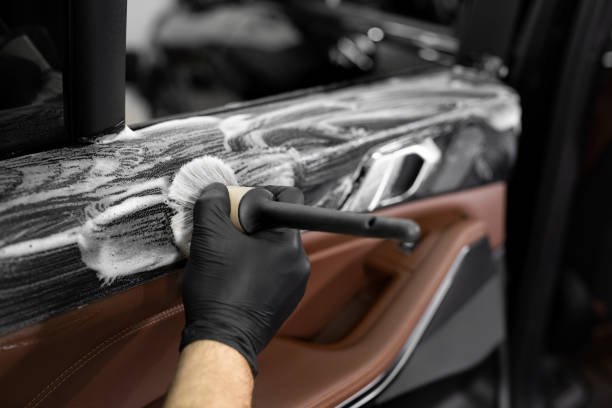
- brushes used around switches and vents;
- deep cleaning of small crevices;
- stain treatment;
- odour treatment;
- detailed cleaning of the boot and other areas.
The work can therefore become substantially more time-consuming than ordinary valeting.
If you are considering this level of work, our guide to how much car detailing costs in 2026 explains typical UK prices and the difference between basic, full and specialist detailing packages.
The biggest difference: cleaning vs correction
This is probably the easiest way to understand car valeting vs detailing.
A valet mainly removes:
dirt, dust, debris, grime and stains.
A detail can potentially go further and address:
contamination, faded finishes, swirl marks and other correctable cosmetic defects.
Imagine a black car covered in light swirl marks.
After a good valet, it may be extremely clean — but the swirls can still be visible in direct sunlight.
After professional paint correction as part of a detailing process, many of those defects may be significantly reduced or removed.
That is a completely different level of work.
Is a full valet basically the same as detailing?
Sometimes the services overlap significantly.
A very high-quality full valet may include deep interior cleaning, paint decontamination and some protection.
A basic detail may include similar processes.
The difference is often the depth of work and amount of time spent.
This is why service names can be misleading.
One business might advertise:
Full Valet — £100
while another advertises:
Maintenance Detail — £120
The only useful comparison is the actual checklist.
Ask exactly what will happen to the car.
How much does car valeting cost compared with detailing?
Car valeting is normally considerably cheaper.
As a broad UK guide:
| Service | Typical starting range |
| Basic or mini valet | Around £25–£60 |
| Full valet | Around £50–£120 |
| Deep/premium valet | Around £100–£200+ |
| Basic detail | Around £100–£250 |
| Full detail | Around £200–£500+ |
| Paint correction/detailing package | £300–£1,000+ |
| Specialist detailing with coatings | Can exceed £1,000 |
Actual prices vary significantly according to vehicle size, condition, location and the exact work included.
The most important point is that detailing should not be more expensive simply because the word sounds premium.
The higher price should correspond with more labour, specialist products or additional processes.
What does a mini valet include?
A mini valet is usually intended as a maintenance clean.
It might include:
- exterior wash;
- wheels;
- drying;
- vacuuming;
- dashboard wipe;
- interior windows.
It is suitable when the car is already reasonably well maintained but needs freshening up.
If there are severe stains, large amounts of pet hair or heavily contaminated bodywork, a mini valet is unlikely to provide the result you expect.
What does a full valet include?
A full valet can include much more comprehensive interior and exterior cleaning.
Depending on the provider, this could mean:
- pre-wash;
- thorough exterior wash;
- wheel cleaning;
- door-shut cleaning;
- vacuuming;
- shampooing seats and carpets;
- dashboard and trim cleaning;
- windows;
- boot;
- tyre dressing;
- wax or basic protective treatment.
But again, “full” is not standardised.
One company’s full valet may contain substantially more work than another’s.
What does a full detail include?
A comprehensive detail may include everything associated with a full valet plus specialist restoration and protection work.
For example:
Exterior detailing
The vehicle may be thoroughly washed and chemically decontaminated before bonded contamination is mechanically removed.
Paint can then be inspected and machine polished.
Trim, glass and wheels may receive separate protective treatments.
Interior detailing
Seats, carpets, leather, plastics and hard-to-access areas may receive more extensive cleaning than during a normal valet.
Paint protection
Depending on the package, the finish may be protected with wax, sealant or a ceramic coating.
A high-level detail therefore becomes much closer to cosmetic vehicle restoration than routine cleaning.
Does detailing remove scratches?
Some scratches can be improved through paint correction, but detailing cannot repair every type of scratch.
Light marks located within the clear coat may respond to machine polishing.
Deep scratches that have penetrated through the clear coat and colour layer require paint repair rather than polishing.
This distinction matters because some customers book an expensive detailing package expecting every scratch to disappear.
Ask the detailer what they realistically expect to correct before the work begins.
Does valeting remove scratches?
Normally, no.
A standard valet is primarily a cleaning service.
Some packages may include hand polishing or light machine polishing, which could improve very superficial marks.
But ordinary valeting should not be confused with professional paint correction.
A freshly cleaned car can actually make scratches more noticeable because dirt is no longer hiding them.
Does detailing remove dents?
No.
A dent is a physical deformation of the body panel.
It needs dent repair rather than detailing.
Paintless dent removal may be appropriate where the paint remains intact, while dents accompanied by paint damage can require bodyshop work.
A detailer may work alongside body-repair specialists, but polishing a vehicle cannot reshape a dented panel.
Is car detailing worth the extra money?
It depends entirely on what you want.
Detailing is more likely to be worthwhile if:
- the paint has obvious swirl marks;
- you own a valuable or enthusiast vehicle;
- the interior needs deep restoration;
- you want ceramic coating or another long-term protection product;
- you are preparing a high-value vehicle for sale;
- you want to restore rather than simply clean the car.
For a normal family car that mainly needs crumbs removed, carpets vacuumed and bodywork washed, a full valet may provide much better value.
Pay for the result you need, not the most expensive package available.
When is car valeting the better choice?
Choose valeting when the vehicle’s underlying condition is already reasonably good.
For example, your car might simply have:
- muddy exterior paint;
- dusty interior trim;
- food crumbs;
- dirty mats;
- ordinary road grime;
- lightly soiled seats.
These are primarily cleanliness problems.
A good valet can make an enormous difference without the expense of specialist detailing.
Valeting is also ideal for routine maintenance.
Instead of allowing the vehicle to become extremely dirty and paying for a major detail once a year, you might book periodic valets to keep it under control.
When is detailing the better choice?
Detailing becomes more appropriate when cleaning alone is not enough.
You may choose a detail if:
- paint feels rough after washing;
- swirl marks are visible;
- light scratches cover the paintwork;
- the car needs substantial interior restoration;
- you want paint protection;
- you have recently purchased a used car and want it thoroughly reset;
- you are preparing a special vehicle for an event or sale.
The more cosmetic restoration required, the stronger the case for detailing.
Which is better before selling a car?
For most ordinary used cars, a good full valet may provide the best return.
Buyers want to see a vehicle that looks clean and cared for.
Vacuuming, cleaning the upholstery, washing the bodywork and presenting the car properly can dramatically improve photographs and first impressions.
Spending hundreds of pounds on correction and coatings immediately before selling a low-value vehicle may be difficult to recover.
Detailing can make more sense for:
- premium cars;
- enthusiast cars;
- particularly valuable vehicles;
- cars with visibly poor but correctable paint.
Think about the value of the car before choosing the service.
Which is better for a brand-new car?
A new car may need neither intensive valeting nor detailing immediately.
However, enthusiasts sometimes book a new-car detail.
Why?
Because even new vehicles can collect contamination or light paint defects during transportation and dealership preparation.
A specialist may inspect the paint, carry out light correction where necessary and apply protection.
But do not assume every new car needs hundreds of pounds of work.
Inspect its condition first.
Is detailing worth it on an old car?
Age is less important than condition and value to you.
An older car with fundamentally sound paint can respond beautifully to professional detailing.
A neglected ten-year-old car may look dramatically newer after deep interior cleaning and machine polishing.
But if the paint is peeling, heavily rusted or missing in multiple areas, polishing cannot restore what physically no longer exists.
Sometimes body repair needs to happen before detailing.
What is paint decontamination?
Normal washing removes loose and ordinary surface dirt.
But some contaminants become bonded to the paint.
Detailers may use products or processes designed to remove things such as:
- tar;
- iron contamination;
- certain bonded particles.
A clay bar or similar medium may also be used where appropriate to remove remaining bonded contamination.
After proper decontamination, paint often feels considerably smoother.
This process is commonly associated with detailing rather than a basic valet.
What is paint correction?
Paint correction uses machine polishing to reduce defects within the painted surface.
It can target problems such as:
- swirl marks;
- light scratches;
- holograms;
- oxidation;
- some water spotting.
The process requires skill because correction involves removing a microscopic amount of clear coat.
More aggressive correction is not automatically better.
A good detailer balances appearance improvement against preserving the paint.
What is ceramic coating?
Ceramic coating is a liquid protective product applied to properly prepared surfaces and allowed to cure.
Depending on the product, it can provide benefits such as:
- hydrophobic behaviour;
- easier cleaning;
- chemical resistance;
- gloss enhancement.
It does not make the vehicle scratch-proof.
This is a common misconception.
Ceramic coating is often associated with detailing because the paint is normally thoroughly cleaned and prepared before application.
Is waxing considered detailing or valeting?
It can appear in both.
Many full valets include a basic wax or spray sealant.
Detailing packages may use more durable or specialist protective products.
The fact that one service includes “wax” does not automatically make it a detail.
Again, the level of preparation matters.
Applying protection to properly decontaminated and corrected paint is different from applying a quick protective product after a standard wash.
How long does a car valet take?
A mini valet might take approximately one to two hours, while a more comprehensive full valet can take two to four hours or longer depending on condition.
Extremely dirty interiors can require considerably more time.
Vehicle size matters too.
A seven-seat SUV containing pet hair is clearly a different job from a clean two-seat sports car.
How long does car detailing take?
Detailing can range from several hours to several days.
A straightforward maintenance detail may take half a day.
A comprehensive interior and exterior treatment can occupy a full day.
Multi-stage paint correction and ceramic-coating packages can require the vehicle for several days.
This labour time explains much of the price difference between valeting and detailing.
Mobile valeting vs detailing studio: which is better?
Mobile services are extremely convenient.
A mobile valeter or detailer can work at your home or workplace while you continue with your day.
Many routine valets and some detailing services are well suited to this format.
However, advanced paint correction and coating work can benefit from a controlled studio environment with:
- specialist lighting;
- protection from rain;
- stable temperature;
- reduced dust;
- secure indoor curing time.
Neither setup automatically guarantees better workmanship.
Choose according to the job and the provider’s expertise.
The same principle applies more broadly to automotive work, as explained in our mobile mechanic vs garage comparison.
Can a mobile valeter do detailing?
Yes.
Many mobile businesses actually offer both.
The distinction is the service being provided, not whether the technician works from a van.
A mobile detailer may offer:
- deep cleans;
- machine polishing;
- paint decontamination;
- protection;
- some coatings.
The limitations are mostly environmental.
Heavy rain, strong wind and direct sunlight can make high-level exterior correction difficult without suitable shelter.
Ask how weather-dependent the service is before booking.
Is a hand car wash the same as a valet?
Generally, no.
A basic hand car wash is usually designed for speed and volume.
The car is washed, perhaps vacuumed and moved on to the next customer.
A professional valet normally involves more time and attention to the individual vehicle.
Again, businesses can use terms differently.
Some hand-car-wash businesses offer full valeting packages that go considerably beyond an ordinary wash.
The package contents matter more than the business type.
Does an MOT include cleaning or valeting?
No.
An MOT is a roadworthiness test, not a cleaning service.
The condition of your seats or how shiny the bodywork is has no relevance to whether the vehicle passes its statutory test, except where cleanliness or clutter genuinely obstructs something the tester needs to inspect.
If your MOT is approaching, our guide to how much an MOT costs in 2026 explains the test fees and what inspectors actually check.
A spotless car can fail its MOT.
A dirty but roadworthy one can pass.
Is valeting included when your car is serviced?
Not normally.
Some garages and dealerships provide a complimentary basic wash or vacuum after servicing.
That is a customer-service extra rather than part of the mechanical service itself.
Mechanical servicing concerns oil, filters, brakes, tyres and other maintenance items.
Valeting concerns cleanliness.
Detailing concerns cosmetic condition and protection.
Treat all three as different categories when budgeting for vehicle ownership.
What should you ask a valeter before booking?
Ask for the exact service list.
Useful questions include:
- Is the exterior wash included?
- Are wheels cleaned?
- Is the boot included?
- Are seats shampooed?
- Does pet hair cost extra?
- Is stain treatment included?
- Is wax or protection applied?
- Do you bring water and electricity?
- How long will the service take?
- Is the price for my exact vehicle size?
These questions are especially useful with mobile services where the technician needs to know what they will find when they arrive.
What should you ask a detailer before booking?
For detailing, go further.
Ask:
- What preparation is included?
- Is paint decontamination included?
- Will you machine polish the car?
- How many correction stages?
- What defects do you expect to remove?
- What defects will remain?
- Is protection included?
- What product is being applied?
- How long do you need the vehicle?
- How should I maintain it afterwards?
A good detailer should be comfortable setting realistic expectations.
Why is one valet £40 and another £120?
Because they may be completely different services.
The £40 package could involve:
wash + vacuum + windows + dashboard.
The £120 package might involve:
detailed exterior clean + wheels + door shuts + deep vacuum + upholstery shampoo + stain removal + boot + protection.
Neither is automatically badly priced.
Compare the time and work involved.
Why is one detail £200 and another £800?
Exactly the same principle applies.
A £200 package could be a thorough clean with light machine polishing.
An £800 service could include:
- extensive decontamination;
- two-stage correction;
- detailed interior treatment;
- specialist wheel work;
- ceramic coating.
The phrase “full detail” does not guarantee identical content.
Never compare professional detailing purely by package names.
Can valeting damage car paint?
Poor cleaning technique can.
Dirt dragged across paint can introduce fine scratches.
Aggressive brushes, contaminated cloths and inappropriate chemicals can also cause problems.
This is one reason enthusiasts often prefer detailers using careful washing methods.
But that does not mean every valeter damages cars.
Many professional valeters use excellent methods and products.
Look at the business’s work and reputation rather than assuming one job title guarantees a particular standard.
Is detailing always safer for the paint?
Not automatically.
Detailing includes processes such as machine polishing that require more technical knowledge.
When performed correctly, correction can improve paint dramatically.
When performed poorly, polishing can create holograms, haze or remove excessive clear coat.
A £700 invoice does not automatically create expertise.
Choose an experienced professional and understand what they plan to do.
How often should you have a car valeted?
There is no correct interval for everyone.
You might book a valet:
- monthly;
- every few months;
- seasonally;
- only before selling.
It depends on how much the car is used and how well you maintain it yourself.
Frequent basic maintenance can prevent the interior from reaching the point where an expensive deep clean becomes necessary.
How often should you have a car detailed?
Usually much less frequently than routine valeting.
A proper detail might be carried out annually, occasionally or whenever the condition warrants it.
Paint correction in particular should not be treated like a monthly cleaning process because clear coat is finite.
Once paint has been corrected, good maintenance can preserve the result.
You do not want to repeatedly perform unnecessary aggressive correction simply because twelve months have passed.
Should you valet before detailing?
You normally would not need to pay for a separate valet immediately before professional detailing.
A detailer needs to thoroughly clean the vehicle as part of preparing surfaces for further work.
Paying one business to wash the car and then taking it to another detailer who must wash and decontaminate it again would usually duplicate work.
Ask the detailer what preparation their package already includes.
Can detailing restore alloy wheels?
Detailing can clean wheels extremely thoroughly and potentially improve their appearance.
But genuine kerb damage, peeling finishes or corrosion may require professional wheel refurbishment.
If your vehicle’s bodywork looks excellent but the alloys remain badly damaged, you may want to combine detailing with specialist repair.
Our guide to alloy wheel refurbishment costs in the UK explains what different refurbishment methods usually cost.
Car valeting vs detailing for a family car
For a typical family vehicle, regular valeting is probably more useful on a day-to-day basis.
Children, food, mud and normal use create cleaning problems rather than paint-correction problems.
You might therefore use:
routine DIY cleaning → occasional professional valet → detailing only when the condition justifies it.
That avoids paying premium detailing prices every time the footwells need vacuuming.
Car valeting vs detailing for a luxury or performance car
Here the balance may shift.
Owners of valuable vehicles may place more importance on:
- paint condition;
- washing technique;
- original finish;
- protection;
- cosmetic presentation.
Professional detailing may therefore be more attractive.
That does not mean the car needs constant multi-stage polishing.
In fact, a high-quality maintenance wash or valet after the vehicle has been professionally corrected and protected may be the better long-term approach.
Which service gives better value?
The service that solves your problem without doing unnecessary work.
If the car is dirty:
valet it.
If the interior needs serious restoration:
deep valet or interior detail.
If the paint is contaminated:
detail/decontaminate it.
If it is covered in correctable swirl marks:
consider paint correction.
If you just want it clean before Saturday:
do not pay for a £700 correction package.
Good value is not automatically the cheapest service or the most comprehensive one.
It is paying for the right level of work.
Car valeting vs car detailing: the verdict
So, what is the difference between car valeting vs car detailing?
Valeting is primarily about cleaning and presentation.
Detailing generally goes deeper into cleaning, restoration, correction and protection.
A valet is usually cheaper, quicker and perfect for routine vehicle maintenance.
Detailing costs more because the technician may spend substantially longer decontaminating surfaces, restoring the interior, machine polishing paint or applying specialist protection.
Most cars do not need high-level detailing every time they become dirty.
For many owners, occasional valeting combined with sensible maintenance is enough.
Detailing becomes worthwhile when you want to restore the vehicle rather than simply clean it.
If you’re looking for professional help, you can find local car valeters, detailers and other automotive professionals through The Right Guy. Compare the exact services included rather than relying on labels such as “full valet” or “premium detail”, and choose the package that matches the condition of your vehicle.