
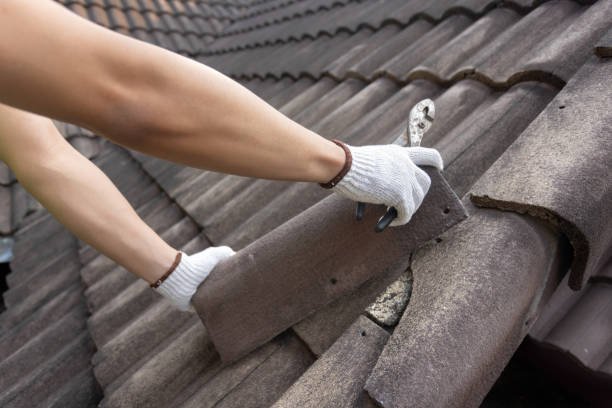
A roof repair in the UK can cost anywhere from around £100–£300 for a small, straightforward repair to £1,000–£3,000+ for substantial work involving larger damaged areas, structural repairs, scaffolding or difficult access.
For many common domestic roof repairs — such as replacing a handful of broken tiles, repairing flashing or dealing with a small localised leak — homeowners might realistically spend around £150–£600.
The problem with asking “how much does roof repair cost?” is that two roofs showing exactly the same symptom — such as water appearing on a bedroom ceiling — can require completely different repairs. One may have a slipped tile that takes relatively little time to fix. Another may have damaged underlay, rotten battens or failing flashing hidden beneath the roof covering.
The cost therefore depends on what has failed, how much of the roof is affected and how safely the roofer can reach it.
This 2026 UK guide explains typical roof repair prices, what affects the quote, when scaffolding may be needed and when repairing an ageing roof starts making less financial sense than replacing it.
How much does roof repair cost in the UK?
For initial budgeting, typical roof repair costs can look roughly like this:
| Roof repair | Typical UK cost |
|---|---|
| Minor roof repair | £100–£300 |
| Replace a few roof tiles | £100–£300+ |
| Small leaking roof repair | £150–£500+ |
| Flashing repair | £200–£600+ |
| Ridge tile repair/repointing | £250–£700+ |
| Roof valley repair | £300–£1,000+ |
| Flat roof local repair | £150–£500+ |
| Larger flat roof repair | £500–£1,500+ |
| Roof timber/batten repairs | £500–£2,000+ |
| Significant roof repair | £1,000–£3,000+ |
| Scaffolding | Potentially several hundred pounds or more |
These are broad budgeting ranges rather than fixed national prices.
Roof size, material, height, location and accessibility can move the price considerably.
A £150 repair that can be safely reached from appropriate access equipment is very different from the same physical defect on a three-storey property requiring substantial scaffolding.
What affects the cost of roof repairs?
Several factors determine the final price.
Type of damage
A slipped tile is usually much cheaper to deal with than damaged roof timbers.
Size of the damaged area
Localised problems require fewer materials and less labour.
Roof height
Working on a bungalow can be simpler than accessing the roof of a tall townhouse.
Roof pitch
Very steep roofs may require different access arrangements.
Roofing material
Slate, clay tiles, concrete tiles and different flat-roof systems have different material and repair requirements.
Access
Conservatories, extensions, narrow side access and neighbouring buildings can make work more difficult.
Scaffolding
This can become one of the largest costs on an otherwise modest repair.
Location
Roofing labour rates vary across the UK, with London and parts of the South East generally costing more.
The roofer needs to assess the complete situation rather than simply price the broken material.
How much does it cost to replace broken roof tiles?
Replacing a small number of accessible roof tiles might cost approximately £100–£300.
The tiles themselves may not be particularly expensive.
What you are paying for includes:
- travelling to the property;
- safely accessing the roof;
- removing damaged tiles;
- sourcing compatible replacements;
- installing them correctly;
- inspecting the surrounding area.
This explains why replacing one tile does not necessarily cost £20 simply because the replacement tile itself is inexpensive.
There is effectively a minimum cost for sending a professional to work safely at roof level.
How much does a leaking roof cost to repair?
A small roof leak may cost roughly £150–£500+ to repair, but the range can become much wider depending on the cause.
A leak might come from:
- cracked or missing tiles;
- damaged flashing;
- failed roof valleys;
- deteriorated flat roofing;
- damaged underlay;
- poor previous repairs;
- chimney details;
- roof penetrations.
Water also travels.
The wet patch visible inside your house does not necessarily sit directly beneath the point where rain is entering.
That is why diagnosing the source properly is more important than simply sealing whatever happens to look suspicious from ground level.
Does every roof leak mean an expensive repair?
No.
Some leaks have surprisingly simple causes.
A storm may dislodge one tile.
A small section of flashing may fail.
A local defect might be repaired without disturbing the rest of the roof.
But a leak can also be the visible symptom of wider deterioration.
If the roof is old and several areas are failing, repeatedly patching individual leaks may become expensive.
Our guide to the warning signs your roof may need replacing can help you distinguish an isolated repair from symptoms of broader roof deterioration.
How much does emergency roof repair cost?
Emergency or urgent roof work can cost more than a normal scheduled repair.
This is especially likely when you need:
- same-day attendance;
- evening or weekend work;
- temporary weatherproofing;
- urgent storm-damage protection.
The initial visit may not permanently repair the roof.
A roofer might first make the property watertight using a temporary measure and return later when conditions are suitable for permanent work.
If this happens, ask whether the emergency charge covers only the temporary work or contributes towards the later permanent repair.
How much does roof flashing repair cost?
A straightforward flashing repair might cost approximately £200–£600+.
Flashing is used where roofing meets features such as:
- chimneys;
- walls;
- roof junctions;
- penetrations.
Its job is to direct water away from vulnerable joints.
Failed flashing can therefore produce leaks even when the surrounding tiles appear perfectly sound.
The price depends heavily on how much flashing needs replacing and how easy the area is to access.
Chimney flashing on a tall property requiring scaffolding can cost considerably more than a small accessible repair.
How much does chimney flashing repair cost?
Allow roughly £250–£700+ as an initial budgeting range for many chimney-flashing repairs.
Costs increase where:
- the chimney is large;
- several sides require work;
- lead needs extensive replacement;
- mortar also requires attention;
- scaffolding is necessary.
A leak around a chimney can also come from more than the flashing itself.
The roofer may need to inspect the chimney stack, pointing and surrounding roof covering before recommending the correct repair.
How much does ridge tile repair cost?
Repairing or rebedding ridge tiles might cost approximately £250–£700+, depending on how many need attention.
Older roofs may have ridge tiles bedded in mortar.
Over time, this can crack or deteriorate.
Modern dry-ridge systems use mechanical fixing arrangements rather than relying solely on traditional mortar bedding.
The appropriate repair depends on the existing roof.
If only one small section has failed, the job can remain relatively modest. If the entire ridge requires attention, expect the price to increase.
How much does roof valley repair cost?
Roof valley repairs can cost approximately £300–£1,000+ depending on the problem and length involved.
Valleys handle substantial volumes of rainwater because they sit where two roof slopes meet.
Problems can develop from:
- damaged valley materials;
- cracked tiles;
- blockages;
- poor detailing;
- deterioration over time.
Because the surrounding tiles may need lifting to complete the repair properly, valley work can involve more labour than its visible size suggests.
How much does a flat roof repair cost?
A local flat-roof repair may cost roughly £150–£500.
Larger repairs could cost £500–£1,500+, particularly if significant areas of the covering or underlying deck are affected.
Flat roofs can use several systems, including:
- traditional felt;
- EPDM;
- GRP/fibreglass;
- other membrane systems.
The repair method needs to be compatible with the existing roof.
A tiny puncture in otherwise healthy material is very different from a roof where the covering has deteriorated across the entire surface.
Is it worth repairing an old flat roof?
Sometimes.
If the roof is generally sound and the defect is genuinely localised, repair can be perfectly sensible.
But repeatedly patching an old covering that is failing in several areas can become false economy.
Suppose you spend:
£350 this year
then:
£450 next year
then:
£300 six months later.
You have spent £1,100 without solving the underlying problem.
Ask the roofer whether they believe the defect is isolated or part of wider deterioration.
How much does it cost to repair roof felt?
Localised repairs involving underlay or felt can start from a few hundred pounds, but costs rise quickly if roof tiles must be removed across a larger area.
The difficulty is access.
The damaged material sits underneath the roof covering.
A roofer may therefore need to:
- remove tiles;
- remove damaged battens where necessary;
- repair or replace the membrane;
- install suitable battens;
- relay the roof covering.
What sounds like “a small hole in the felt” can therefore involve significantly more labour than replacing one visible tile.
How much does it cost to replace roof battens?
Localised batten replacement may form part of a repair costing several hundred pounds, while extensive deterioration can push the project into £1,000+ territory.
Battens sit underneath tiles and provide their fixing support.
If moisture has caused significant deterioration, tiles need to be removed to reach them.
The roofer should determine why the battens have failed rather than simply replacing rotten timber without addressing the source of moisture.
How much does roof timber repair cost?
Structural timber repairs vary enormously.
A small localised repair may cost several hundred pounds.
More substantial work involving rafters or other structural components can cost £1,000–£3,000+, potentially much more where extensive structural work is required.
At this point, the job may involve more than a straightforward roofer.
Depending on the nature of the problem, structural assessment or additional professional input may be appropriate.
Do not use broad internet averages as a substitute for inspecting structural roof damage.
How much does storm-damaged roof repair cost?
Storm damage can range from one missing tile to a large section of roof being compromised.
Minor damage:
£100–£500
More extensive damage:
£500–£2,000+
Major structural or widespread damage:
potentially several thousand pounds.
If the roof has been damaged during severe weather, avoid climbing onto it yourself to investigate.
Photographs from ground level or from safe internal areas can help a roofer understand the problem before attending.
You may also want to check whether your home insurance potentially covers qualifying storm damage under your policy.
Does home insurance cover roof repairs?
It depends on why the roof was damaged and what your individual policy covers.
Insurance may potentially cover sudden insured events such as qualifying storm damage.
It generally should not be assumed to cover ordinary:
- wear and tear;
- age-related deterioration;
- poor maintenance.
Check your policy wording and contact your insurer where appropriate before authorising major work if you believe you may have a valid claim.
Do not delay necessary emergency measures if doing so would allow further damage, but follow your insurer’s requirements where possible.
How much does scaffolding add to roof repair costs?
Scaffolding can add several hundred pounds or more to a roof repair.
For larger, taller or complicated properties, the cost can move well beyond that.
The price depends on:
- building height;
- scaffold length;
- number of elevations;
- access;
- hire period;
- complexity.
This creates an interesting situation.
The physical roof repair might cost only £250.
But safe access might cost £600.
Your final project becomes £850.
That does not mean the roofer is charging £850 to replace three tiles — the majority of the cost may relate to accessing those tiles safely.
Does every roof repair need scaffolding?
No.
The access method depends on the property, work and risk assessment.
Some small repairs may be possible using suitable ladders, towers or other equipment.
Other jobs require scaffolding.
A homeowner should not pressure a roofer to avoid appropriate access equipment simply to save money.
If one contractor includes scaffolding and another does not, ask how each intends to access the work safely before comparing the quotes.
Does roof height affect repair cost?
Yes.
Working on:
- a bungalow;
- a two-storey house;
- a three-storey townhouse;
creates very different access requirements.
Height can affect:
- scaffolding;
- equipment;
- labour;
- setup time.
The roof design matters too.
A simple low pitched roof may be easier to work on than a steep, complicated roof containing several dormers and valleys.
Does roof type affect repair cost?
Yes.
Common UK roofing materials include:
- concrete tiles;
- clay tiles;
- natural slate;
- synthetic slate;
- flat-roof membranes.
Replacement materials have different prices and installation requirements.
Natural slate can be particularly specialist, especially where matching existing older slates matters.
If you own a period property, finding a compatible material may be more difficult than simply buying a standard modern concrete tile.
How much does slate roof repair cost?
Small slate repairs might begin around £150–£400, but larger work can become considerably more expensive.
Natural slate can require specialist skills and suitable replacement material.
Older roofs can also have:
- failing fixings;
- deteriorated battens;
- widespread slipped slates.
If many slates are failing rather than one isolated section, ask whether the issue is becoming systemic.
Repeated individual slate repairs can eventually stop being economical.
How much does tiled roof repair cost?
For an ordinary tiled roof, small repairs might cost around £100–£500.
Larger localised repairs may move into £500–£1,500+.
Concrete and clay tiles are common across UK housing, but the exact tile profile needs to be considered when replacements are required.
Older discontinued tiles can be harder to match.
A roofer may be able to source reclaimed or compatible replacements where appropriate.
Does roof age affect repair cost?
Indirectly, yes.
Older roofs are more likely to reveal additional problems once work begins.
For example, lifting several damaged tiles might expose:
- brittle underlay;
- rotten battens;
- corroded fixings;
- previous poor repairs.
This does not mean every old roof needs replacing.
A well-maintained older roof can remain serviceable.
But when defects become widespread, continuing to patch them can become increasingly uneconomical.
Repair or replace: when does a new roof make more sense?
This is one of the most important questions.
Repair usually makes sense when:
- damage is localised;
- most of the roof remains sound;
- the repair has a reasonable expected life;
- replacement is not otherwise approaching.
Replacement becomes worth considering when:
- leaks appear repeatedly;
- tiles or slates are failing across several areas;
- battens or underlay are widely deteriorated;
- structural issues are extensive;
- repair bills keep accumulating.
If you are reaching this stage, compare your repair quote with our guide to how much a new roof costs in 2026.
A £700 repair on an otherwise healthy roof is one thing.
Repeated £700 repairs on a roof approaching full replacement are another.
How much does a new roof cost compared with repairs?
A complete roof replacement generally costs thousands rather than hundreds of pounds.
The exact figure depends on:
- roof size;
- materials;
- roof design;
- scaffolding;
- timber condition;
- insulation requirements;
- waste;
- location.
That means repair is normally preferable when the existing roof remains fundamentally sound.
You should not replace a perfectly serviceable roof because three tiles have slipped.
Equally, spending thousands repeatedly patching a fundamentally failing roof can be poor value.
The decision should be based on condition, not simply age.
Can roof repairs reveal additional damage?
Yes.
Some roof components cannot be properly inspected until tiles or other coverings are lifted.
A contractor may discover:
- damaged battens;
- deteriorated membrane;
- rotten timber;
- hidden water damage.
This is why larger repair quotes sometimes include a contingency or explain how unforeseen work will be priced.
Before work starts, ask:
“If you find additional damage, will you contact me before doing work that increases the price?”
A professional contractor should be able to explain how unexpected problems are handled.
How quickly should a leaking roof be repaired?
A roof actively allowing water into the property should be assessed promptly.
Water ingress can damage:
- ceilings;
- plaster;
- insulation;
- timber;
- decoration;
- electrical installations.
That does not mean every small leak requires panic or an immediate full roof replacement.
It means allowing an active leak to continue through repeated rainfall is rarely sensible.
Temporary weatherproofing may be appropriate when permanent repair cannot safely be completed immediately.
What should I do if my roof starts leaking?
First, protect the interior where it is safe to do so.
Move possessions away from the affected area and use containers to catch dripping water.
Do not climb onto a wet roof yourself.
Contact a roofer and explain:
- where water is appearing;
- when it started;
- whether it happens only during heavy rain;
- whether there was recent storm damage;
- what type of roof you have if known.
Photographs can help.
If water is affecting electrical fittings, avoid interacting with wet electrical equipment and seek appropriate professional assistance.
Can a roofer diagnose a leak from the ground?
Sometimes they can identify obvious problems, but not always.
Missing tiles, damaged flashing or visible storm damage may be apparent.
Other problems require closer inspection.
Roof leaks are notoriously deceptive because water can travel along:
- rafters;
- membranes;
- timbers;
- ceilings.
The visible internal stain may therefore be several metres away from the external defect.
A proper diagnosis is worth paying for because repairing the wrong area solves nothing.
How much does a roof inspection cost?
Some roofers provide a basic assessment when quoting for repair work.
More detailed roof inspections or written reports may attract a separate fee.
The price depends on:
- property size;
- access;
- level of detail;
- whether specialist equipment is required.
If you simply want a repair quote for one obvious defect, a full formal roof survey may not be necessary.
If you are buying a property or investigating widespread problems, a more detailed assessment can be worthwhile.
Are drone roof inspections useful?
They can be useful for visually inspecting difficult-to-access areas without immediately erecting scaffolding.
A drone may help identify:
- missing tiles;
- damaged ridge areas;
- chimney defects;
- visible flashing problems.
However, photographs cannot reveal everything beneath the roof covering.
Drone inspection is therefore a useful diagnostic tool, not a replacement for every physical roof inspection.
How long does a roof repair take?
Small repairs can sometimes be completed within a few hours.
More substantial work may take:
- one day;
- several days;
- longer if scaffolding and specialist materials are required.
Weather can also affect scheduling.
Roofers cannot safely or effectively perform every type of work during:
- high winds;
- heavy rain;
- icy conditions.
A delay caused by unsuitable weather is preferable to forcing unsafe or poor-quality work.
Is roof repair cheaper in summer?
Not necessarily.
Demand can be high during good weather because homeowners schedule planned roofing work.
Winter storms can create sudden demand for emergency repairs.
The cheapest time is difficult to predict.
For non-urgent work, getting several quotes and giving contractors reasonable scheduling flexibility is more useful than trying to identify a supposedly cheap month.
Can I repair my roof myself?
Replacing roofing materials involves working at height and understanding how the roof system fits together.
For very minor issues, experienced homeowners may be tempted to attempt DIY.
But working on roofs introduces serious fall risks, and an incorrect repair can create further water ingress.
Professional help is particularly sensible where the work involves:
- steep roofs;
- significant height;
- structural timber;
- chimneys;
- large damaged areas;
- complicated flashing.
Saving £200 is not worthwhile if the job requires taking risks you are not equipped to manage.
Do roof repairs need Building Regulations approval?
Many straightforward like-for-like repairs do not involve the same requirements as major roof replacement.
However, more extensive roofing work can interact with Building Regulations, particularly where substantial portions of a roof covering are being renovated or structural/thermal elements are altered.
Requirements depend on the scope of the project and the property.
For major works, your roofer, building professional or local authority building control service can advise what applies.
Do not assume that because the word “repair” appears on the quote, every possible scale of roofing work is automatically exempt from regulatory requirements.
What if my home is listed or in a conservation area?
Additional considerations may apply, particularly where changing materials or the external appearance of the property.
A like-for-like minor repair may be very different from replacing a roof with a new material.
If the property is listed, obtain appropriate advice before making changes that could affect its character.
Planning restrictions can also vary according to the property and location.
How do I know whether a roofer is trustworthy?
Roof repairs are difficult for homeowners to inspect personally.
You may be shown a photograph of a cracked tile but have no practical way of confirming everything happening several metres above your head.
That makes contractor selection especially important.
Look for:
- clear written quotations;
- proper business details;
- relevant experience;
- appropriate insurance;
- realistic explanations;
- clear payment terms;
- evidence of previous work.
Be cautious about pressure to approve expensive additional work immediately without a reasonable explanation.
Our guide to choosing a trustworthy builder contains checks that are equally useful when comparing roofing contractors.
Should I get several roof repair quotes?
For non-emergency work, generally yes.
Three quotations can help you understand whether contractors agree on:
- the cause;
- repair method;
- materials;
- access requirements;
- scaffolding.
If one roofer recommends a £300 repair and another says you need a £12,000 new roof, do not automatically choose either.
Ask why their diagnoses are so different.
A third professional opinion can be particularly valuable where recommendations differ dramatically.
What should a roof repair quote include?
A useful quotation should explain:
- the problem being repaired;
- work required;
- materials;
- labour;
- access/scaffolding;
- waste disposal;
- VAT where applicable;
- expected timescale;
- what happens if hidden damage is discovered.
For example:
Replace six damaged tiles, renew local membrane and battens where damaged, provide access equipment, remove waste and leave roof watertight.
That is much more useful than:
Roof repair — £850.
The clearer the scope, the easier quotations are to compare.
Should I pay a deposit for roof repairs?
A modest deposit may be reasonable where the contractor needs to order materials or arrange scaffolding.
Be more cautious about requests for the entire project cost upfront.
Payment structures depend on the size of the work.
For a £200 repair, payment on completion may be perfectly normal.
For a multi-thousand-pound project, staged payments can be appropriate.
Whatever arrangement you use, make sure the scope and payment terms are clear before work begins.
How can I reduce roof repair costs?
The best strategy is dealing with small problems before they become larger ones.
A missing tile costing a few hundred pounds to address can become more expensive if repeated water ingress damages:
- underlay;
- battens;
- insulation;
- ceilings.
You can also reduce unnecessary cost by:
- obtaining comparable quotes;
- combining nearby roof repairs;
- giving clear access information;
- avoiding emergency out-of-hours work where the problem can safely wait;
- keeping gutters and roof drainage functioning properly.
But do not delay an active leak simply to save a call-out charge.
Is preventative roof maintenance worth it?
Usually.
You do not need to constantly pay for unnecessary roof work.
But periodically checking the roof from ground level — particularly after severe weather — can help identify:
- slipped tiles;
- missing tiles;
- damaged gutters;
- visible flashing problems;
- loose ridge materials.
The earlier a genuine defect is identified, the greater the chance it remains a local repair rather than becoming an internal water-damage problem.
How much should I budget for roof repair?
For a UK home in 2026, a practical initial budget is:
Very minor/local repair: £100–£300
Typical small roof repair: £150–£600
Moderate repair: £500–£1,500
Substantial repair: £1,000–£3,000+
Major structural/widespread work: potentially several thousand pounds.
Scaffolding can add hundreds or considerably more depending on the property.
For an ordinary localised repair, having £300–£600 in mind is therefore a reasonable starting point — but inspection is necessary before anyone can give you a meaningful price.
How Much Does Roof Repair Cost in the UK? The Verdict
So, how much does roof repair cost in the UK in 2026?
Small repairs can start at around £100–£300, while many ordinary leaking-roof, flashing or local tile repairs fall somewhere around £150–£600. More substantial repairs can cost £1,000–£3,000 or more, particularly where scaffolding, structural timber or large damaged areas are involved.
The biggest mistake is assuming that the visible symptom tells you the cost.
One ceiling stain could come from a £200 slipped-tile repair or a much larger underlying roofing problem. Proper diagnosis therefore matters just as much as the price.
If repairs are becoming frequent, compare the cumulative cost with our 2026 new roof price guide and check the warning signs that a roof may need replacing.
If you need somebody to inspect or repair your roof, you can find local roofers and relevant tradespeople through The Right Guy. Describe the problem, property type and access and, where possible, provide photographs so professionals can give you a more useful assessment and quotation.

Author: manager
Company test